
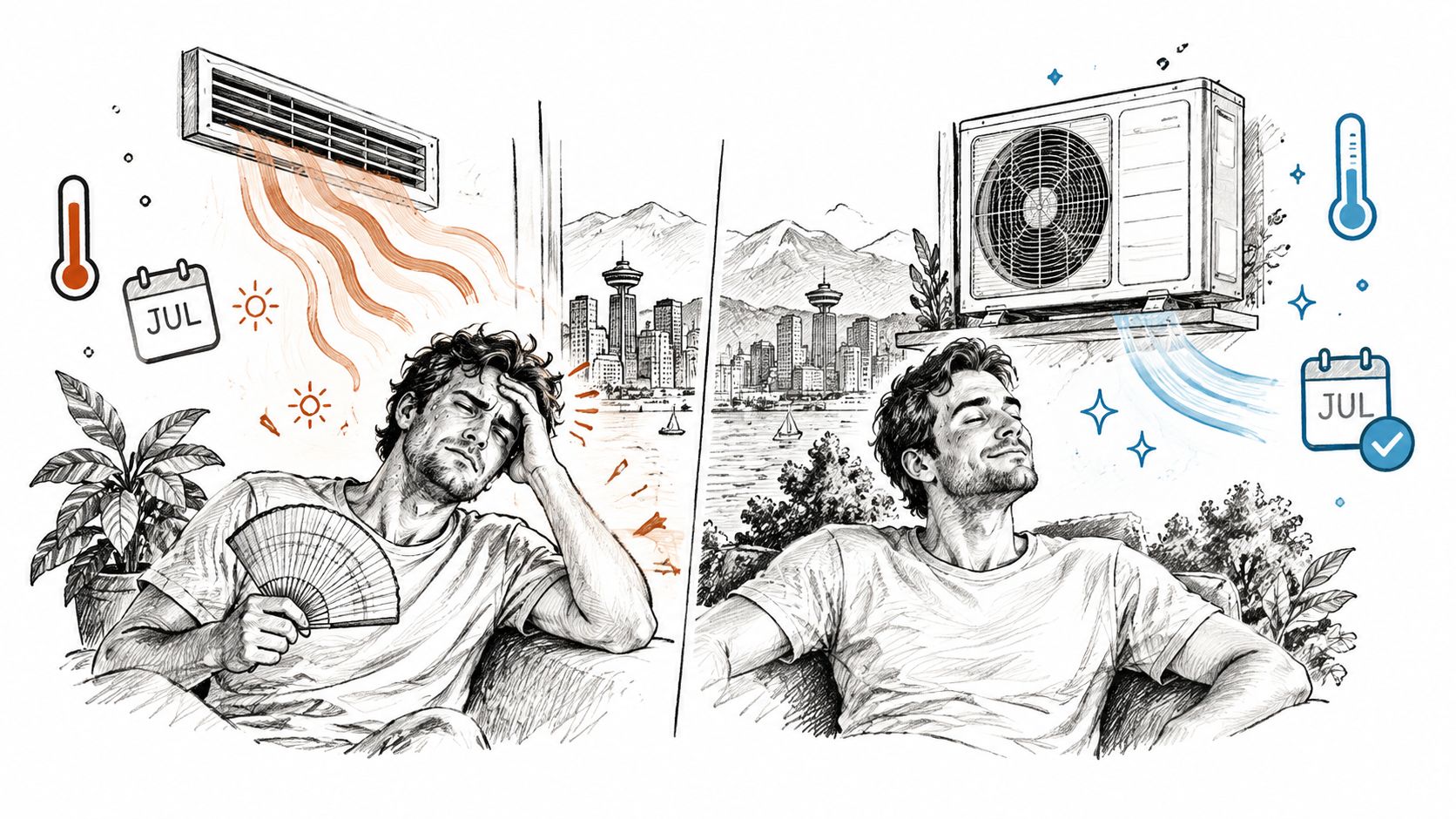
You turn on the air conditioner during a warm July afternoon in Vancouver, expecting a cool room, but the vents push out lukewarm air. The thermostat is set correctly, the outdoor unit is humming, and yet the house keeps getting warmer. In Richmond, the same problem may appear as weak airflow, a damp ceiling below an indoor unit, or a system that runs for hours without making the home comfortable.
Air conditioner maintenance and service works best when homeowners handle simple upkeep consistently and bring in a qualified technician for electrical, refrigerant, drainage, and performance problems. Vancouver's mild climate can make AC maintenance easy to postpone, but the first hot spell is a poor time to discover a clogged filter, dirty coil, blocked condenser, or failing component.
Table of Contents
- Why Your Air Conditioner Needs Regular Care
- Essential DIY Maintenance Checklist
- Step-by-Step Guide to Common Maintenance Tasks
- When to Call a Professional for Service
- DIY vs Professional Service Making the Right Choice
- Final Tips for Year-Round AC Performance
Why Your Air Conditioner Needs Regular Care
A Vancouver homeowner may first notice longer cooling cycles, warm upstairs bedrooms, or an outdoor unit that sounds harsher than last summer. In a Richmond home, uneven cooling can also reflect restricted airflow, coastal debris, drainage trouble, or a component that needs testing rather than another thermostat adjustment.
Regular care separates safe homeowner upkeep from work that belongs with a qualified HVAC technician. Homeowners can observe performance and keep accessible areas clean. A technician can inspect filters, indoor and outdoor coils, airflow, condensate drainage, electrical components, controls, and refrigerant-related performance without guessing at the cause.
California HVAC efficiency research identifies dirty evaporator coils, filters, condenser coils, improper refrigerant charge, incorrect fan settings, malfunctioning economizers, and blocked refrigerant lines as causes of avoidable energy waste. The research associates neglected maintenance with about 10% of air-conditioning energy use (California HVAC efficiency study). Greater Vancouver has different equipment and weather, but the mechanical lesson applies: restricted airflow and poor heat transfer reduce cooling performance.
Practical rule: A tune-up should leave you with clear findings, measured performance, and recommended next steps, not merely a claim that someone “looked at” the unit.
Age changes the repair decision. Older equipment may cool adequately during a mild Vancouver day yet struggle during a heat event. A service assessment can show whether cleaning and adjustment are enough, or whether a leaking coil, weak compressor, outdated refrigerant arrangement, or repeated electrical fault makes replacement more sensible. Call Encano when diagnosis requires electrical, refrigerant, or sealed-system work.
Essential DIY Maintenance Checklist
Homeowners can safely handle the tasks that involve cleaning, observation, and basic settings. Work with the power off whenever you're cleaning near equipment, and never remove electrical covers or touch refrigerant lines.
- Check the filter: Inspect the central HVAC filter and replace or clean it when it's loaded with dust. Natural Resources Canada recommends changing or cleaning forced-air filters every three months or as they become loaded (Natural Resources Canada home HVAC guidance). A Richmond home with renovations, pets, or a dusty return-air area may need closer visual monitoring.
- Keep return and supply grilles open: Furniture, curtains, and storage boxes can choke airflow. A system may appear to have a refrigerant problem when the actual issue is that the blower can't move enough air through the home.
- Clear the outdoor condenser: Remove leaves and grass from around the unit and trim back vegetation without bending the fins. The outdoor coil needs free air movement to release heat.
- Check the thermostat: Confirm that the mode is set to cooling, the fan setting suits your preference, and the target temperature is below the current indoor temperature. Replace batteries if the display is fading.
- Look for water: Check around the indoor air handler, drain pan, and nearby ceiling or floor. Water marks deserve attention before they become a larger property-management problem.
- Listen and observe: Note grinding, rattling, repeated clicking, burning smells, weak airflow, icing, or a system that starts and stops unusually often. Don't open the unit to investigate these symptoms.
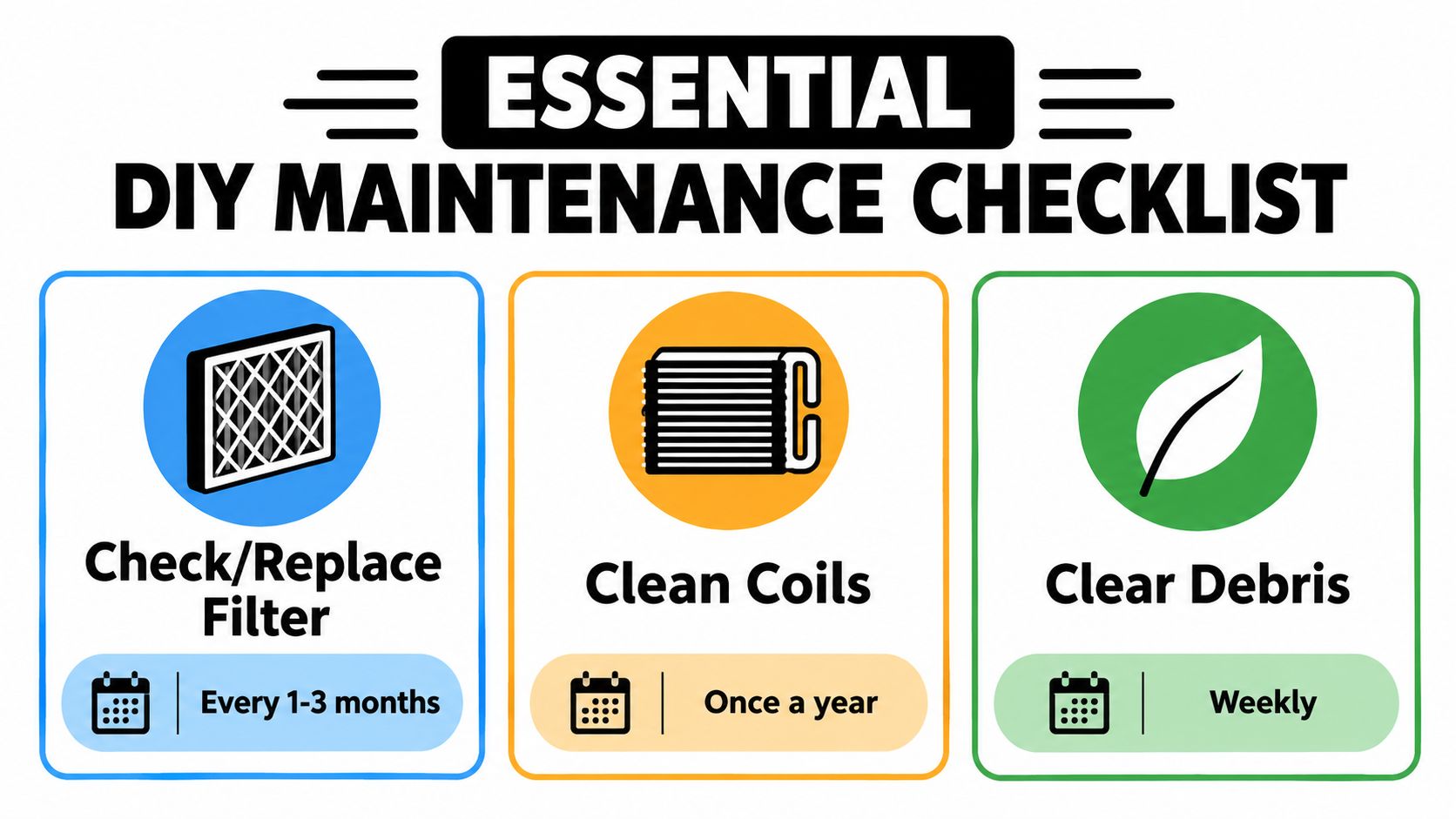
Filters and outdoor clearance are worthwhile homeowner jobs because they address airflow and ventilation without exposing you to live electrical parts or refrigerant. Coil cleaning is more conditional. Light surface dust may be removable from an accessible outdoor coil with the system isolated and a gentle approach, but indoor coil cleaning, fin straightening, drain clearing, and chemical cleaning are better left to a technician when access is limited or the unit is part of a furnace or heat-pump assembly.
Step-by-Step Guide to Common Maintenance Tasks
Start with the filter because it's the simplest airflow check and the most common homeowner-maintained component.
Filter inspection and replacement
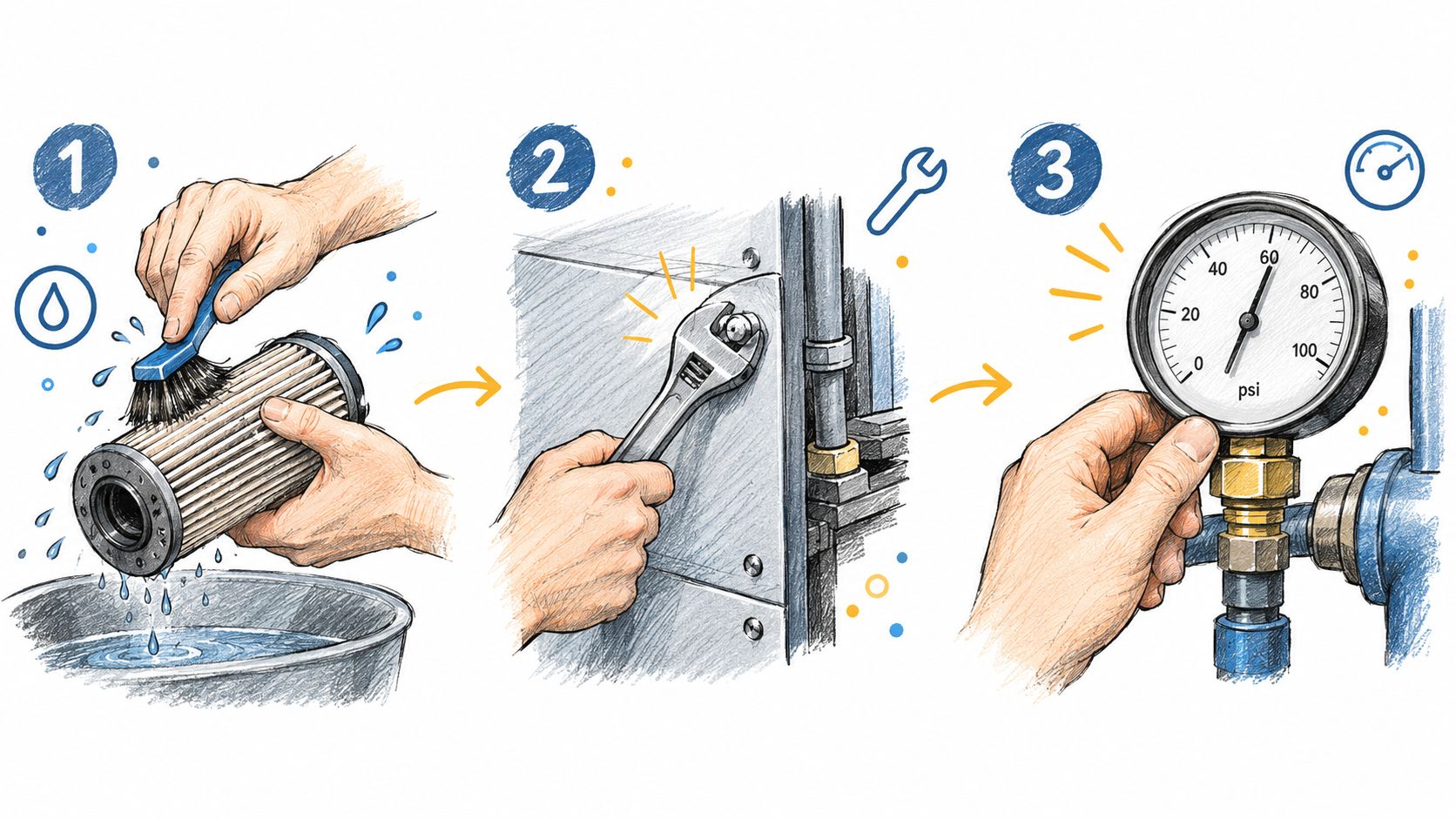
- Set the thermostat to off. If the filter sits inside or beside the air handler, use the equipment switch or breaker only if you know which disconnect controls it.
- Slide out the filter and check the airflow arrow on its frame. Photograph the orientation before removing it if you're unsure.
- If it's a disposable filter, install a matching size and type. If it's washable, follow the manufacturer's cleaning instructions and let it dry completely before reinstalling.
- Close the grille or access panel and restore the system. Weak airflow after a new filter suggests a deeper restriction, blower issue, frozen coil, or ductwork problem.
A blocked filter can reduce airflow enough to affect cooling and contribute to coil icing. If the return grille itself is dusty or the home has persistent uneven temperatures, an inspection may need to include the air distribution system. For related maintenance planning, see ductwork cleaning and air distribution guidance.
Outdoor unit inspection
Switch the system off before approaching the condenser. Remove leaves by hand, keep garden tools away from the coil, and use a soft brush only for loose surface debris. Don't pressure-wash the fins, spray water into electrical compartments, or try to straighten badly bent fins with a household tool.
The useful homeowner question is whether air can move freely through the unit. If the coil is matted with dirt, the fins are damaged, or the fan is noisy, stop at observation and arrange professional service.
This video demonstrates the general cleaning and inspection principles, but it doesn't replace equipment-specific safety procedures or diagnosis.
Condensate and airflow observations
Look for standing water, algae-like buildup, damaged insulation, or a drain line that no longer discharges as expected. Don't pour chemicals into an unfamiliar drain system, especially in a condo, attic, or multi-unit building where an overflow can damage another property.
A practical example is a Richmond townhouse where the air conditioner runs normally but water appears below the indoor unit. The safe homeowner response is to turn the system off, protect nearby flooring, and call for service. The likely fault could be a blocked drain, damaged pan, frozen coil, or installation issue, and those possibilities require different remedies.
When to Call a Professional for Service
DIY care stops where diagnosis, sealed-system work, electrical testing, or equipment disassembly begins. Call an HVAC professional if the system blows warm air after the thermostat and filter checks, produces unusual noises, trips a breaker, shows ice, leaks water, smells burnt, or delivers inconsistent cooling between rooms.
Refrigerant is not a homeowner refill task. Low charge usually means there may be a leak, and adding refrigerant without finding the cause can mask the fault while leaving the system underperforming. A qualified technician can use appropriate testing equipment to assess charge, leak evidence, coil condition, controls, compressor operation, and airflow.
California research provides useful evidence about the maintenance gap. After repairs were excluded, only 24% of residential customers in one California baseline study reported annual HVAC maintenance, while 33% said they never had maintenance except for repairs (California HVAC maintenance behaviour research). The same research found that annual maintenance was much more common among large commercial customers than residential customers. For a Vancouver homeowner, the practical implication is simple: don't wait for a breakdown to become your maintenance schedule.
A filter can be replaced without a technician. A refrigerant leak, capacitor fault, frozen coil, or electrical failure cannot be safely diagnosed by guessing.
Professional service is also important for property managers. California state facilities must have HVAC systems inspected at least annually, with inspections and maintenance documented in writing (California State Administrative Manual HVAC requirements). British Columbia buildings may have different obligations, but the operational principle still helps: keep dated records of the equipment checked, deficiencies found, corrections completed, and follow-up items outstanding.
If warm air, poor cooling, or recurring faults continue, arrange professional air conditioning repair rather than replacing parts based on an online symptom list.
DIY vs Professional Service Making the Right Choice
DIY upkeep is appropriate when the task is visible, low-risk, and reversible. Professional service is appropriate when the fault could involve electricity, refrigerant, pressure, combustion-adjacent equipment, hidden drainage, or a component that requires calibrated testing.
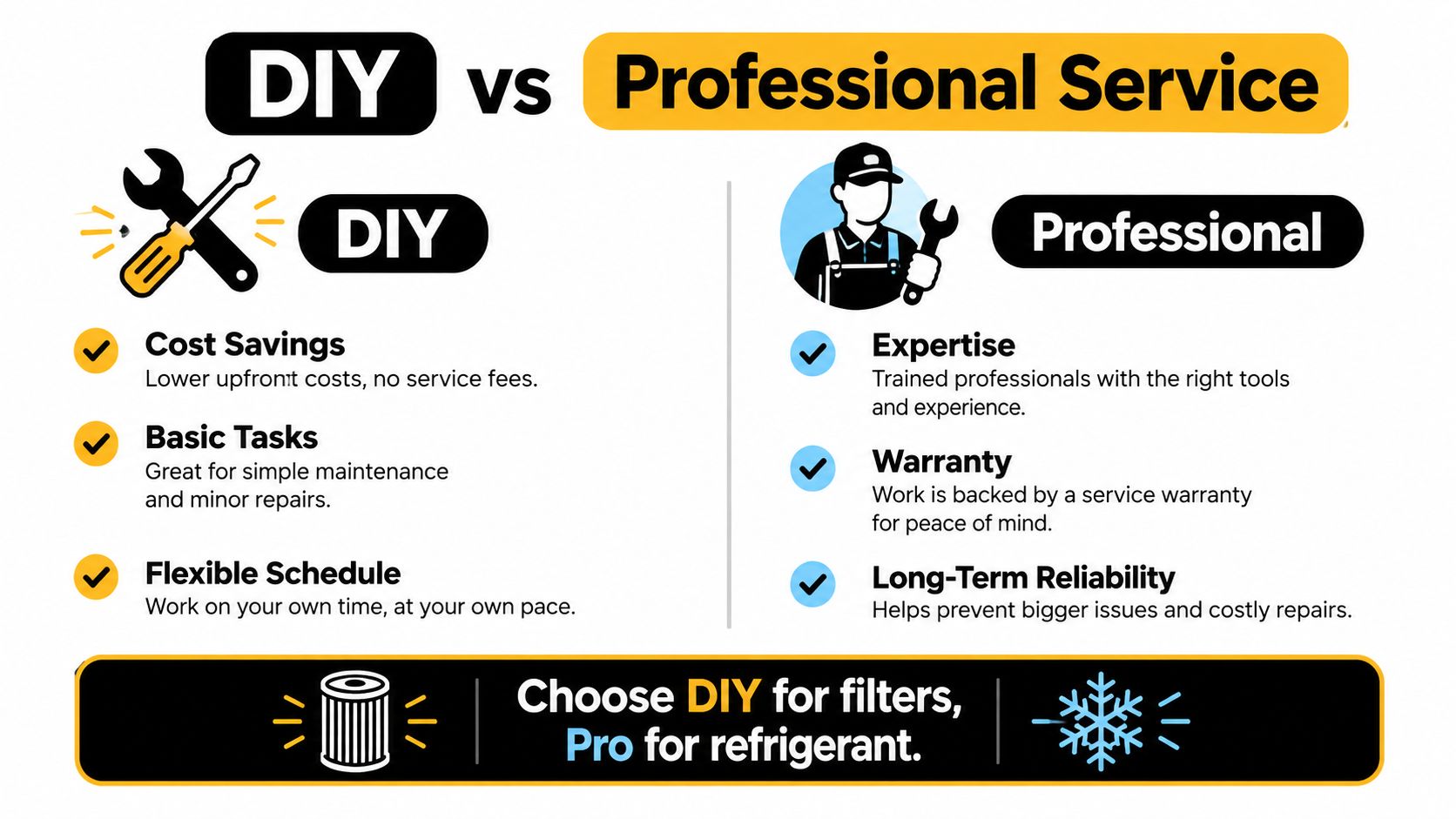
| Homeowner upkeep | Professional service |
|---|---|
| Replace or clean an accessible filter | Test refrigerant-related performance and leaks |
| Clear leaves and vegetation | Measure airflow and inspect coils properly |
| Check thermostat settings | Diagnose electrical components and controls |
| Notice water, noise, icing, or weak airflow | Repair drainage, wiring, motors, compressors, and sealed-system faults |
| Keep vents unobstructed | Assess repair versus replacement for ageing equipment |
The trade-off isn't just cost. A homeowner may save a service call by cleaning a filter, but guessing at a capacitor or refrigerant problem can damage the system or create a safety hazard. A professional visit also gives a property manager a written record and a clearer decision about whether maintenance, repair, or replacement makes sense.
Encano Plumbing & Drainage Ltd. provides HVAC maintenance, repair, installation, replacement, and emergency service for homes and buildings across Greater Vancouver. For a homeowner in Vancouver or Richmond, the sensible boundary is clear: handle filters and clearance yourself, and call a qualified provider when the system's performance, electrical safety, drainage, or refrigerant circuit is involved.
Final Tips for Year-Round AC Performance
A Vancouver homeowner who checks the filter, keeps vents open, and clears the outdoor unit before cooling season gives the system a better starting point. Watch for changes in airflow, noise, run time, moisture, and comfort rather than waiting for complete failure.
For a heat pump, Natural Resources Canada recommends annual professional maintenance and filter cleaning or replacement every three months (Natural Resources Canada heat-pump guidance). Before winter, review whether covering your air conditioner is appropriate for your equipment and installation.
Encano Plumbing & Drainage Ltd. offers scheduled HVAC maintenance, air conditioner repairs, replacements, and emergency service for homes, strata properties, commercial sites, and government buildings. Visit Encano Plumbing & Drainage Ltd. to book an assessment for your Vancouver or Richmond cooling system before a small issue becomes a summer breakdown.