A licensed technician and the required permit are the line between safe gas-line repair and dangerous guesswork, always. In British Columbia, underground gas-line work also requires a licensed contractor, qualified gas fitter, applicable code compliance, testing, and completion documentation, never a clamp-and-hope shortcut.
You may be reading this because the gas has just been shut off, an excavator exposed a pipe beside your home, or a technician told you the damaged line belongs to you rather than the utility. That distinction determines who isolates the system, who repairs the pipe, who inspects the work, and who can restore service. Treating every gas line as “the utility's problem” creates delays. Treating every line as ordinary plumbing creates danger.
The province's safety framework has required formal gas-incident reporting since the Gas Safety Regulation took effect on March 1, 1983. The modern British Columbia Gas Safety Regulation also ties permitted work to immediate completion notification and inspection. Gas lines repair is therefore not finished when a fitting looks tight. It's finished when the correct people have isolated, repaired, tested, inspected, documented, and safely returned the system to service.
Table of Contents
- How to Respond to a Suspected Gas Leak and Recognize the Signs
- What Proper Gas Line Repair Involves After Isolation and Testing
- The Permit and Documentation Trail Homeowners Should Expect
- Why Attempting Gas Line Repair Yourself Increases Real Risks
- Realistic Gas Lines Repair Costs and Typical Timelines by Scope
- A Real Gas Line Damage Incident in Greater Vancouver
How to Respond to a Suspected Gas Leak and Recognize the Signs
You smell rotten eggs while making dinner. The stove is off, but the odour is stronger near the floor, and you hear a faint hiss behind the cabinet. Don't investigate with a lighter, don't touch the switches, and don't reach for your phone inside the house. Move people and pets out, then call from outside.

FortisBC says a rotten-egg odour may indicate a natural-gas leak. Its emergency procedure is direct: stop what you're doing, avoid smoking, matches, electrical switches, cellphones, and other ignition sources, leave the building, and call 1-800-663-9911 or 911 from outside using the FortisBC natural-gas emergency guidance. The danger isn't limited to a visible flame. A switch, motor, vehicle, or phone can provide an ignition source in the wrong conditions.
Signs that deserve immediate action
Odour is the clue many people recognise, but it isn't the only one. Watch for:
- Hissing or blowing sounds: Sound near a fitting, meter, appliance connector, or exposed pipe can indicate escaping gas.
- Repeated pilot-light failure: A pilot that won't stay lit can point to an appliance or supply problem that needs qualified diagnosis.
- Dead vegetation: A strip of dead or dying plants above a buried service line deserves professional attention, especially when paired with odour or ground disturbance.
- Recent excavation damage: A line exposed, scraped, bent, or struck by equipment is an emergency even if no smell is obvious.
- Unusual appliance behaviour: Weak operation, repeated shutdowns, or abnormal combustion symptoms should not be solved by adjusting valves yourself.
If workers expose a gas line beside a Surrey property, they should stop digging, keep people away, avoid operating equipment that could create ignition, and call the emergency line. FortisBC specifically warns people not to repair an exposed gas line themselves. A temporary clamp isn't a safe repair plan.
Practical rule: If you suspect escaping gas, move first and diagnose later. The safest inspection point is outside the hazard area.
Call 911 or the utility emergency line for an active leak, gas odour, damaged line, fire, injury, or immediate risk to occupants. Once the utility or emergency responders have made the site safe, arrange the customer-owned repair through a licensed gas professional. For additional household steps, use this guide on what to do if you smell gas in your house. Never restore gas independently.
What Proper Gas Line Repair Involves After Isolation and Testing
Once the utility has isolated the supply, the job changes from emergency control to controlled technical repair. It is here that cheap quotes often reveal themselves. If the plan says only “replace damaged section,” it's incomplete.
In British Columbia, underground gas-line repair and replacement is regulated gas work. The contractor must be licensed by Technical Safety BC, employ appropriately licensed gas fitters, maintain the applicable CSA-B149.1 Gas Code, obtain the required permit, and submit a completion notification after the work. A Class A gas fitter can perform installations and alterations on gas systems under a permit, which makes credential and permit verification essential in Richmond, Vancouver, Burnaby, Surrey, and nearby communities. The Technical Safety BC Class A gas fitter requirements provide the relevant qualification context.
The repair sequence
The crew should first confirm the line route and identify other buried services. Excavation then proceeds in a controlled manner, with the exposed pipe and fittings examined for corrosion, movement, impact damage, unsuitable joints, and damage beyond the obvious break.
Where a gas pipe crosses another underground pipe or conduit, the regulation requires at least 50 mm of clearance above or below the gas line. That space protects the pipe from mechanical contact and leaves room for future maintenance. A repair that holds pressure but leaves the line rubbing against another service isn't a sound repair.
The work should cover:
- Utility locating and controlled excavation, including hand exposure where required.
- Inspection of the complete exposed area, not just the visibly damaged point.
- Compliant joining or replacement, using suitable materials and methods.
- Pressure and leak testing, before the line is covered or returned to operation.
- Corrosion assessment and approved backfill, so the repaired section isn't damaged during reinstatement.
- Completion notification and inspection documentation, where required.
| Stage | Purpose | Who handles it |
|---|---|---|
| Isolation | Stop gas flow and control the immediate hazard | Utility or qualified gas professional |
| Locate and expose | Confirm routing and reveal the full repair area safely | Licensed contractor and excavation crew |
| Repair or replace | Restore the piping with compliant materials and joining methods | Appropriately qualified gas fitter |
| Test | Verify pressure integrity and check for leaks | Qualified gas professional |
| Inspect and close out | Confirm permitted work and preserve the compliance trail | Permit holder, gas fitter, and regulatory authority |
For example, a Richmond homeowner with a corroded gas line feeding a furnace may need two distinct scopes. A qualified gas fitter handles the customer-owned piping under the applicable gas-piping authorisation. Furnace commissioning and safety testing require the appropriate appliance qualification. A useful gas-line inspection process should identify that boundary before anyone starts digging.
The Permit and Documentation Trail Homeowners Should Expect
The crew has repaired the pipe, the appliance is still off, and the invoice is already in your inbox. Do not treat the job as finished until the paperwork shows what was authorised, tested, inspected, and approved for reconnection. An invoice proves payment. It does not prove safe or permitted work.
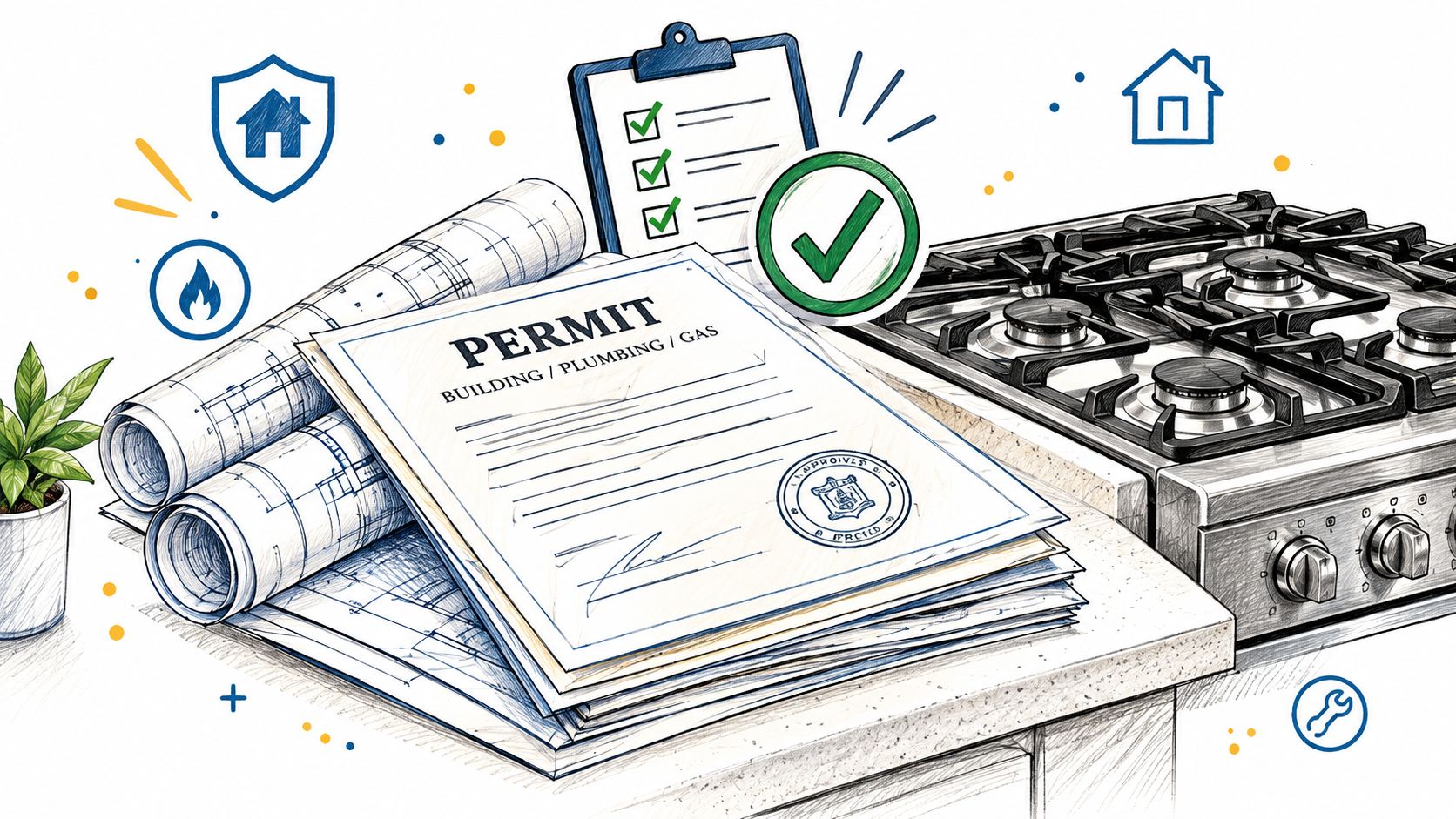
British Columbia requires the permit holder, gas fitter, or field safety representative to notify the regulatory authority when each permitted phase is complete and request an inspection. The B.C. regulation on permitted gas work and inspection makes that inspection trail part of the work, not an optional favour added to the bill.
Your close-out checklist
Request these records before accepting the repair:
- Permit information: Keep the permit number, approved scope, property address, and permit holder's details.
- Contractor credentials: Record the company name and the gas fitter responsible for the work.
- Piping information: Retain an updated piping layout or approved plans where required.
- Test results: Ask for the pressure or leak-test result and the section of system tested.
- Inspection status: Confirm whether rough and final inspections apply, then keep the results.
- Shutoff locations: Ensure the shutoffs for the repaired line and connected equipment are accessible and clearly identified.
- Restoration authority: Confirm who may authorise reconnection and who will relight or recommission each appliance.
The final item separates the homeowner-owned pipe from the utility-owned side. A qualified gas fitter handles permitted customer piping. The utility controls its own service equipment, isolation, and utility-side reconnection. Do not ask a contractor to restore utility-owned equipment, and do not assume the utility will reconnect a customer-side repair without the required permit or inspection clearance.
Connecting gas to an appliance also requires appliance work. Under B.C. rules, the responsible person must adjust and test the appliance to the manufacturer's specifications, set the input rate correctly, and confirm safe venting. The B.C. Gas Safety Regulation identifies correction methods that include replacing a fixed orifice, changing an adjustable-orifice setting, or readjusting regulator outlet pressure.
Consider a commercial rooftop heater in Burnaby after its gas line is replaced. The qualified worker must verify the regulator setting and appliance input, then confirm safe venting before returning the unit to service. A tight pipe does not prove safe combustion.
A repair record protects the current occupant, the next technician, property manager, insurer, buyer, and tenant by showing what changed and what was verified.
For planned work, a clear gas-line installation and compliance process should define the permit, inspection, utility handoff, and reconnection responsibilities before the crew leaves.
Why Attempting Gas Line Repair Yourself Increases Real Risks
Gas piping isn't ordinary plumbing. Water usually announces a bad joint with a drip. Gas can move unseen, collect in a concealed space, ignite from a source you didn't realise was active, or feed an appliance that has the wrong pressure or input adjustment.
British Columbia's Gas Safety Act and Gas Safety Regulation prohibit starting gas-system installation or alteration without the required authorisation, such as an appropriate permit or other authorisation under the Act. The rules also separate gas-piping qualifications from appliance work. A person holding a gas-piping certificate may install and test gas piping under an appropriate permit, but that person must not install, service, or commission gas appliances unless properly qualified for that work. The B.C. qualification regulation makes the distinction clear.
Why shortcuts fail
A homeowner or handyman can make a repair look finished while leaving several hazards behind:
- The wrong section gets replaced: Damage, corrosion, or movement may extend beyond what's visible.
- Buried services remain too close: Excavation can remove the required separation from another pipe or conduit.
- The joint isn't properly tested: A connection can appear sound and still fail a pressure or leak test.
- The appliance receives the wrong input: A regulator, orifice, or appliance setting may not match manufacturer specifications.
- The inspection trail disappears: Without permits and completion records, future troubleshooting becomes guesswork.
A Richmond homeowner with a corroded line feeding a furnace is a useful example. The piping repair belongs under the applicable gas-piping authorisation. The furnace commissioning and safety testing belong to someone with the appropriate gas-appliance qualification. One person may hold both qualifications, but you shouldn't assume that a pipe repair credential covers appliance work.
Older appliances create another trap. B.C. requires gas appliances installed in the province to display an applicable certification or approval mark. A limited reinstallation exception applies to appliances with a maximum input below 120 kW, but a gas fitter must first examine the appliance, repair it if necessary, and certify that it's in safe working condition. An appliance without the required approval status may not qualify for installation. The applicable appliance requirements should be checked when equipment is disconnected.
A New Westminster landlord who reconnects an old appliance because “it worked before” has skipped the examination and certification step. That isn't confidence. It's an undocumented assumption attached to a fuel system.
Use a licensed professional when the line is damaged, concealed, underground, connected to an appliance, or affected by a permit. If you're unsure whether the work falls within your authorisation, stop. Uncertainty is a reason to call, not a reason to experiment.
Realistic Gas Lines Repair Costs and Typical Timelines by Scope
I won't give you a fake price range for gas-line repair. The final cost depends on access, excavation, corrosion, pipe length, testing, permits, inspection scheduling, and whether an appliance must be commissioned. Material is only one part of the job.
Underground work usually takes longer because the crew must locate the line, contact BC 1 Call at least three business days before disturbing ground, expose the located line by hand before mechanised excavation, and maintain a one-metre safety zone around the gas line. FortisBC recorded 779 gas-line damage incidents across B.C. in 2024, including 77 in Surrey and 62 in Vancouver, and nearly 60% involved failure to contact BC 1 Call before digging, according to its 2024 gas-line damage report.
What changes the estimate
A contractor's quote should identify the work that drives labour and scheduling:
- Interior access: Finished walls, floors, cabinets, and appliance connections can make a short pipe run labour-intensive.
- Outdoor excavation: Soil, landscaping, concrete, buried services, and restoration affect the work beyond the pipe itself.
- Corrosion or impact: The visible failure may not be the full extent of the defect.
- Testing and inspection: Pressure testing, permit close-out, and inspection availability can determine completion.
- Appliance scope: Regulator adjustment, input verification, venting checks, relighting, or appliance repairs add qualified work.
- Shared infrastructure: A strata's common line may require coordinated access and staged reconnection.
| Scenario | Typical duration | Main cost drivers |
|---|---|---|
| Short interior house-line replacement | Often a focused service visit, if access is clear | Pipe length, access, fittings, testing, permit requirements |
| Corroded service run near a foundation | May require excavation and follow-up inspection | Locating, hand exposure, excavation, corrosion extent, backfill, restoration |
| Common line affecting multiple suites | Often requires coordinated scheduling rather than one simple visit | Isolation, suite access, meter access, appliance checks, inspection, staged reconnection |
These are scope descriptions, not promises of price or completion time. A strata manager dealing with several affected suites should expect coordination to matter as much as pipe replacement. One failed common line or inaccessible meter can delay safe reconnection for multiple occupants.
The cheapest quote often omits the items that keep the repair legal and verifiable. Compare estimates by asking whether they include locating, controlled excavation, compliant joining, testing, permit handling, inspection documentation, and restoration. A low labour figure that excludes those steps isn't a saving. It's an incomplete scope.
A Real Gas Line Damage Incident in Greater Vancouver
A Surrey excavation crew is preparing a trench beside a strata building when the bucket exposes a gas line. There's no visible flame, but the pipe is scraped and the crew can smell gas. The supervisor stops the work, keeps workers and residents away, avoids operating equipment that could create ignition, and calls the emergency line from outside the hazard area.
The utility isolates its side of the system. That doesn't automatically mean the utility repairs every pipe on the property. The line serving the building may include customer-owned house piping, and responsibility for that portion passes to the property owner or strata. This is the handoff that generic “call a plumber” advice usually misses.
Who does what after shutoff
The sequence should look like this:
- Emergency response and isolation: Occupants evacuate if gas is suspected. The utility or emergency responders control the immediate hazard and isolate supply.
- Ownership confirmation: The utility identifies the boundary between its equipment and customer-owned piping.
- Licensed repair: The strata arranges a qualified gas professional to inspect the exposed line, complete the permitted repair, test the system, and document the work.
- Inspection and appliance checks: Required inspection occurs, while connected appliances are checked for compatibility, input, pressure, and safe venting.
- Utility restoration: The utility reviews the repair and controls meter or service restoration. Occupants and contractors don't reopen the supply independently.
- Relighting and handoff: Qualified personnel restore appliances where authorised, verify operation, and give the strata the completion records.
SoCalGas's customer guidance illustrates this ownership distinction: the utility states that it can't modify, repair, or install customer house lines, while its restoration process includes access to the meter and residence, houseline leak testing, and connected-appliance safety checks. Its Palos Verdes service restoration explanation also shows why a repaired pipe doesn't automatically equal restored gas service. Fuel changes, replacement appliances, meter access, and additional professional checks can still affect reconnection.
For a multi-unit building, the manager should keep residents informed, arrange access to affected suites, and preserve the utility and contractor records. If one common line supplies multiple appliances, the final sequence may require coordinated checks rather than turning on one suite at a time.
The pipe repair and the gas restoration are separate milestones. Don't treat “the contractor is finished” as permission to reopen service.
The incident ends properly only when the customer-owned line passes its tests, required inspection documentation is complete, connected appliances are verified, and the utility controls final restoration. That process may feel slower than tightening a clamp, but it prevents the next emergency call.
Encano Plumbing & Drainage Ltd. provides gas-line inspection, leak detection, diagnosis, repair, replacement, pressure testing, and post-repair safety verification across Greater Vancouver. Visit Encano Plumbing & Drainage Ltd. to arrange qualified help for a suspected leak, damaged customer-owned line, appliance-side gas issue, or documented repair plan.