
You're standing in the kitchen with a mug of tea, the thermostat says the heat should be on, and the hallway still feels cold enough to keep your coat on. In a Lower Mainland home, that usually means the problem isn't mystery magic, it's one of a handful of predictable faults in a furnace, boiler, heat pump, electric baseboard, or a tankless coil setup. The trick is to check the right things in the right order, because most heater not working in house calls start with power, settings, airflow, or ignition, and the wrong guess can waste a whole morning.
Table of Contents
- Why Your House Feels Cold at the Worst Possible Time
- Safety First Before You Touch Anything
- The Universal Pre-Checks That Fix Most No-Heat Calls
- Matching the Symptom to Your Heating System
- Airflow, Filters, and the Forgotten Vents
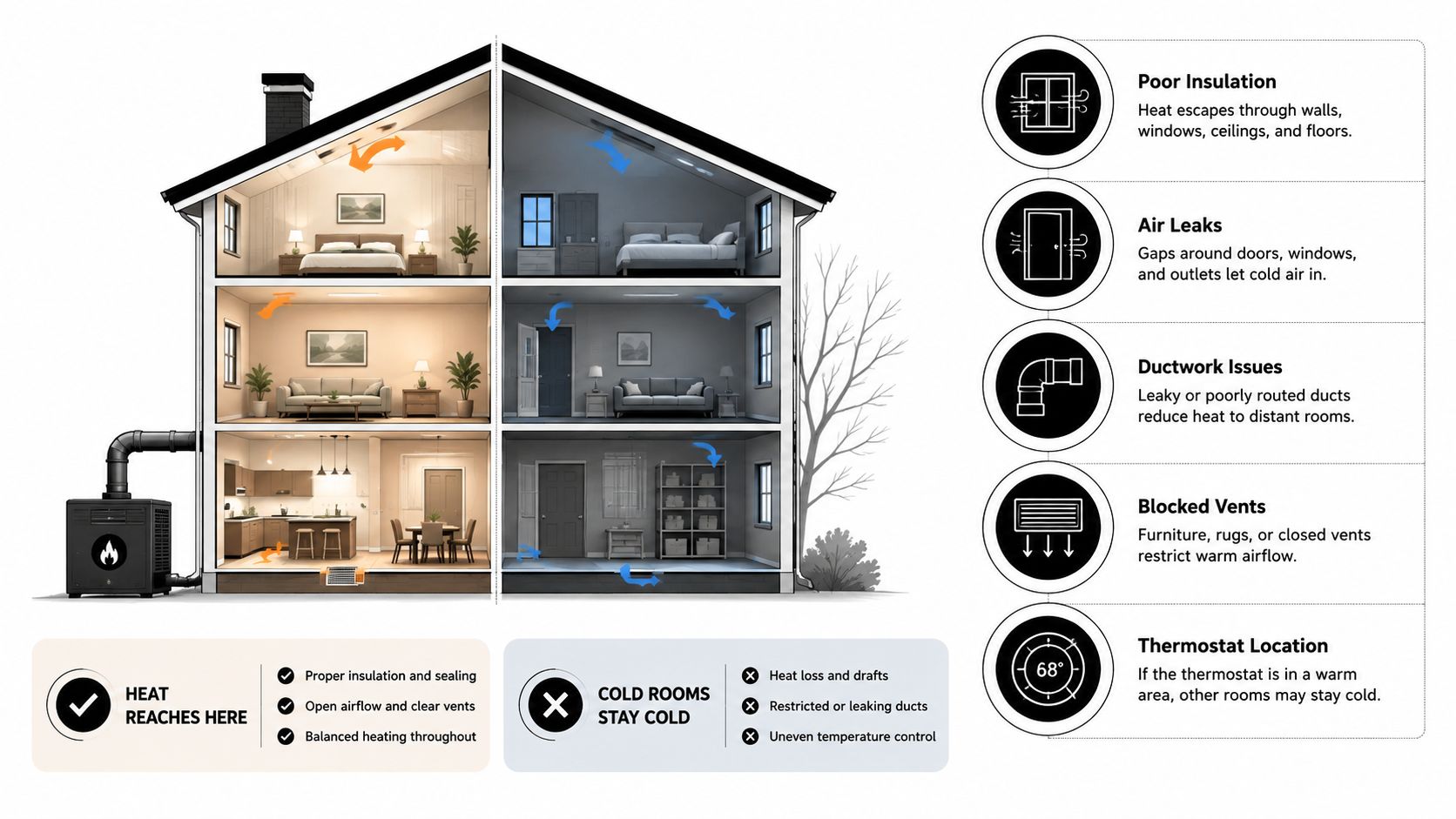
- When Some Rooms Stay Cold Even With the Heat On
- Knowing When to Call a Licensed Heating Pro
Why Your House Feels Cold at the Worst Possible Time
At 6:30 a.m. in February, a Vancouver homeowner walks downstairs expecting the usual blast of warm air. The thermostat is set to 22, the furnace is quiet, and the bedroom down the hall is freezing. That's the kind of morning when people assume the worst, but in practice the fix is often much simpler than the panic makes it feel.
Winter heating matters more in British Columbia than people sometimes expect. Vancouver's average January temperature is around 0°C, and many inland and northern communities sit below freezing, so a failed heater can quickly become a livability issue rather than a comfort complaint. In that kind of weather, a room that won't warm up isn't just annoying, it can affect the whole household's routine and safety.
The same basic fault patterns show up again and again. Power gets cut, the thermostat is set wrong, airflow gets choked, or the ignition sequence never completes. BC Hydro has also said heating is a leading driver of winter electricity use, and its customer guidance puts thermostat, filter, breaker, and fuel-supply checks near the top of the list when a home isn't warming properly.
A calm first pass usually finds the answer fast. If you know where the thermostat, breaker, furnace switch, filter, and gas shut-off are, you can often narrow the problem in minutes instead of waiting half a day for a service window.
Practical rule: if the system won't start after the simplest checks, stop guessing and move to the next branch in the sequence. Random resets and repeated panel openings don't fix a dead heater.
For homeowners in Richmond, Vancouver, Burnaby, New Westminster, Delta, and Surrey, that matters because help is available, but you don't always need it immediately. A structured check tells you whether you've got a quick homeowner fix or a problem that needs a technician with tools, parts, and test equipment.
Safety First Before You Touch Anything
Before you reach for the thermostat cover or the breaker panel, take ten seconds and look and listen. If you smell gas near a furnace or boiler, hear sharp buzzing, see scorch marks, or notice water pooling near the unit, stop there. A heater problem can be a comfort issue, but it can also be a fire, gas, or flooding issue.
A second red flag is a carbon monoxide alarm. If it chirps or activates, get people out, don't keep testing the furnace, and don't try to “see if it settles down.” The same goes for a strong gas odour, which is a leave-the-area problem, not a troubleshooting problem. Heating equipment has been tied to a large share of residential fire losses in North America, and the National Fire Protection Association reported that heating equipment was involved in about 56,000 U.S. home structure fires, causing nearly 500 civilian deaths, almost 1,500 injuries, and $1 billion in property damage over the 2009 to 2013 period.
Check the area around the heater too. Storage bins, paint cans, cardboard, and loose debris don't belong next to a furnace or boiler, and blocked air around the unit makes troubleshooting harder than it needs to be. If the unit is a heat pump or boiler and you see active water leakage, that's a shut-it-down-and-call-for-help situation.
On the breaker panel, look for a tripped circuit and reset it once only. If it trips again right away, stop. That's no longer a basic reset, it's a sign of a deeper electrical fault or a component pulling too much current. Don't keep flipping it back and forth, because repeated resets can mask the underlying issue and delay a proper repair.
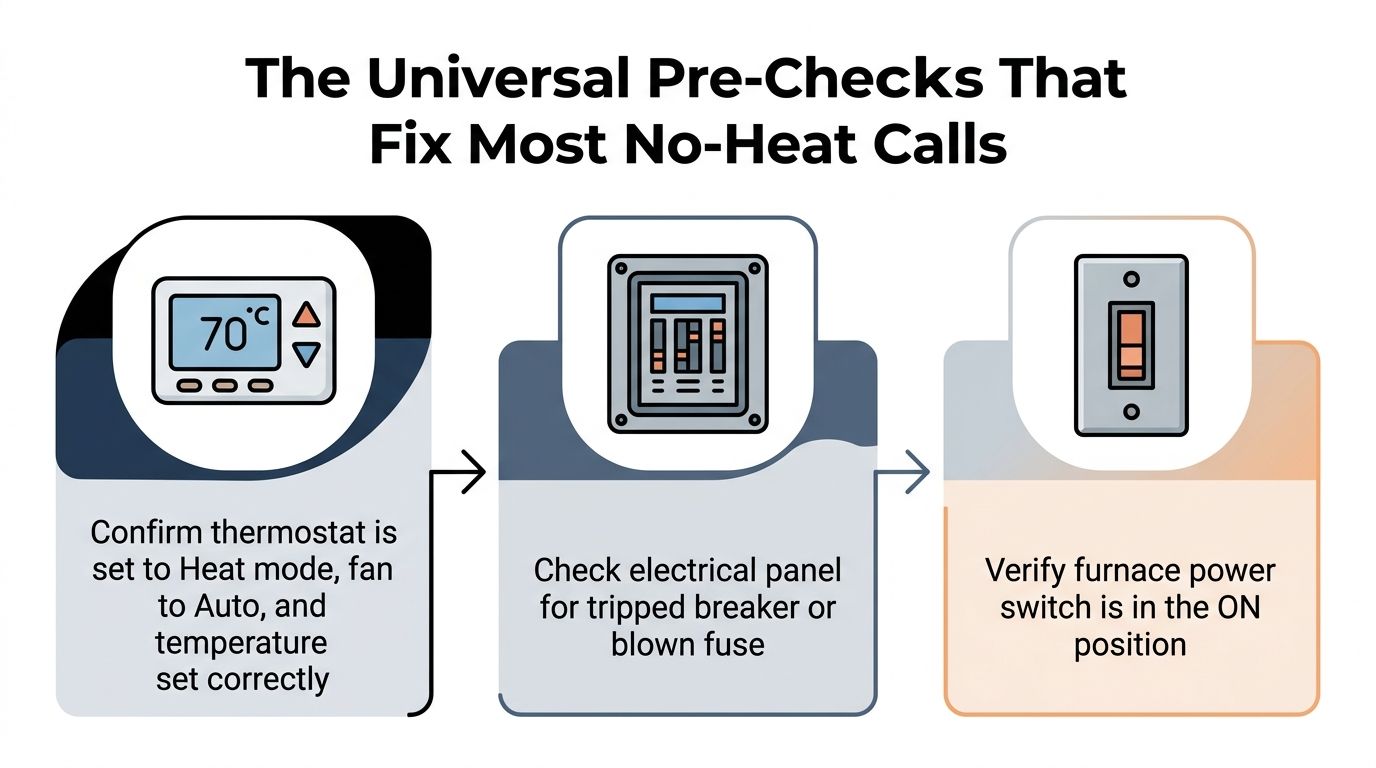
Before opening any access panel, confirm the thermostat is in Heat mode, the setpoint is above the room temperature, the furnace power switch is on, and the gas valve is open if you're working with a gas system. Keep a simple printout taped near the furnace, then use it as your safe-stop checklist every time the house feels cold.
The Universal Pre-Checks That Fix Most No-Heat Calls
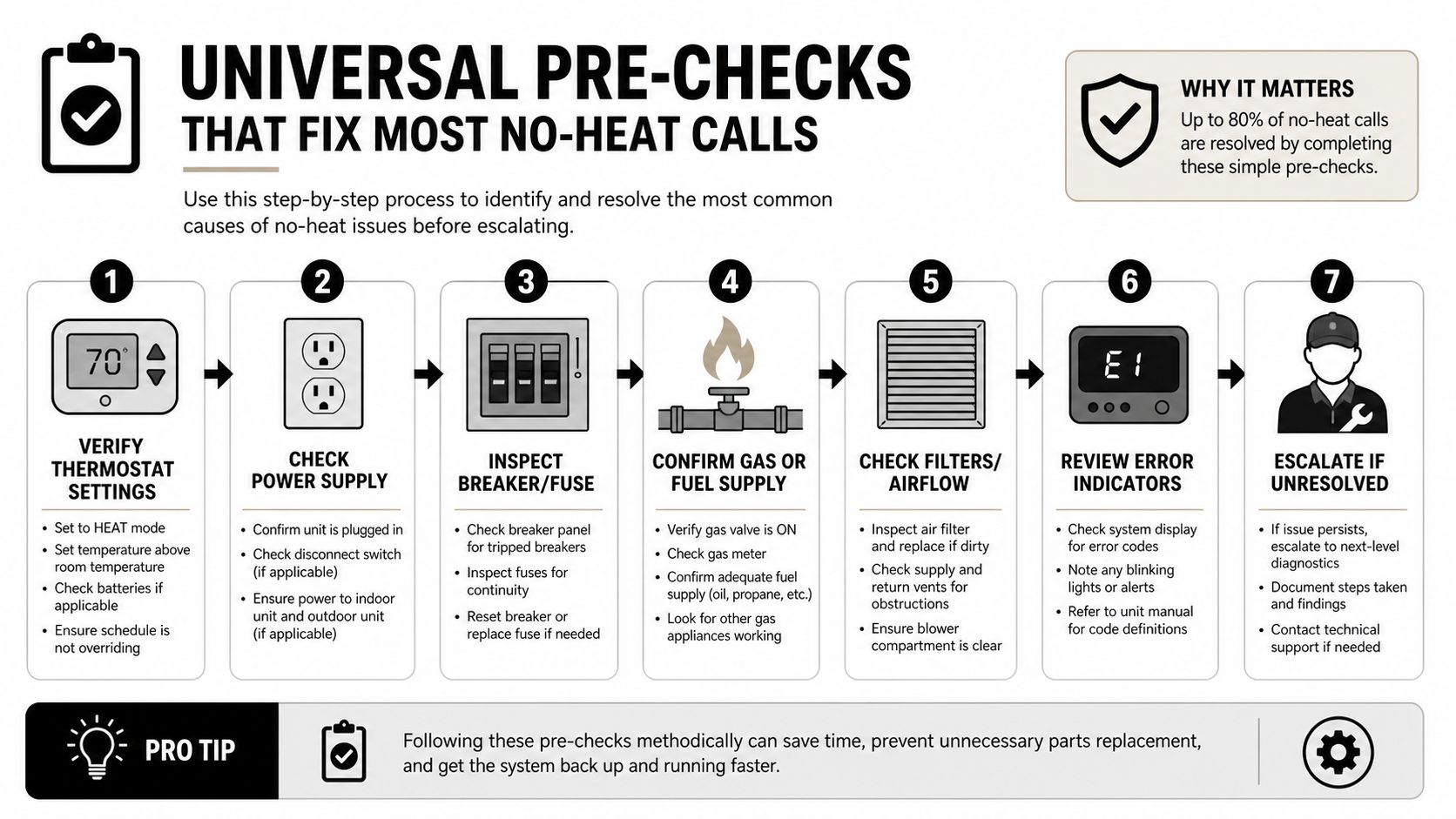
The fastest homeowner fix is often the least dramatic one. Start with the thermostat, because a surprising number of no-heat calls turn out to be a setting issue, a dead battery, or a schedule override. If the display is dim, replace the batteries before you do anything else, then confirm the system is set to Heat, not Cool or Off, and push the setpoint several degrees above the current room temperature.
Thermostat, breaker, and furnace switch
Next, check the electrical side. Find the breaker labelled for the furnace or air handler, and confirm it hasn't tripped. Then check the light-switch-style furnace power switch, which is often on the wall near the unit and gets bumped during storage, cleaning, or moving boxes.
Practical rule: if the thermostat is calling for heat and nothing starts after a few minutes, the next most useful checks are power and airflow, not random parts replacement.
The gas supply is the final universal check for gas-fired equipment. Make sure the shut-off valve is open, then confirm that other gas appliances in the home are working. A practical Richmond example is a home where the heat stopped right after the gas company replaced a meter, but the fault was a closed shut-off valve behind the dryer. The system wasn't broken, it was starved of fuel.
Different equipment types fail in different ways, and the first clue is usually how the silence behaves.
| Common No-Heat Causes by Heating System | Most common no-heat cause | First DIY action |
|---|---|---|
| Gas furnace | Power issue, airflow fault, or ignition failure | Check thermostat, breaker, furnace switch, and filter |
| Boiler | Loss of power, zone control issue, or ignition problem | Check boiler switch, thermostat, and whether the circulator runs |
| Electric baseboard | Tripped breaker or failed thermostat control | Check breaker panel and thermostat setting |
| Heat pump | Thermostat issue, outdoor unit fault, or defrost/auxiliary heat problem | Check thermostat, power, and outdoor unit clearance |
| Tankless coil system | Boiler not firing or circulator not moving water | Confirm boiler is operating and the fuel supply is open |
For homeowners who want a deeper walk-through after these checks, the process lines up well with the fault-tree guidance in Encano's furnace repair overview. The point is to avoid paying for a truck roll when the fix is as simple as a switch, breaker, or closed valve.
Matching the Symptom to Your Heating System
A heater that's “on” can still be failing in very different ways depending on the equipment. A forced-air gas furnace has an inducer, igniter, flame sensor, and blower sequence. A boiler has pressure, zone valves, and ignition or pilot components. Electric baseboards don't need combustion at all, so the usual suspect is the circuit feeding the unit. Heat pumps add outdoor-unit behaviour, defrost logic, and auxiliary heat strips into the mix.
What to look for by system type
If the furnace powers up but never gives you sustained warm air, the usual suspects are ignition failure, flame-sensor contamination, or a gas interruption. Watch the start-up sequence instead of resetting it ten times. If the inducer starts, the igniter glows, and then the system shuts down, that's a different failure path than a unit that never even attempts ignition.
Boilers deserve a different check. Look at the pressure gauge, make sure the thermostat is demanding heat, and listen for the circulator. If one zone is cold and the rest are fine, a zone valve may not be opening or the problem may be isolated to a branch of the system. For tankless coil setups, the boiler itself has to fire properly before you'll get heat or domestic hot water.
Electric baseboards are more straightforward, but they still need power. If one room is cold and the others aren't, the breaker for that zone may have tripped or the thermostat may have failed. Heat pumps can be trickier on cold Vancouver mornings because the outdoor unit, defrost cycle, and auxiliary heat all have to cooperate, and a locked-out unit won't behave like a simple furnace fault.
A practical way to sort it is by symptom, not by brand name. If you're hearing the blower but feeling cool air, you're not at a thermostat problem anymore. If a boiler is silent and the house is cooling fast, the problem may be control power or zone movement. If a baseboard is dead in one room only, the issue is likely local to that branch, not the whole house.
Direct takeaway: matching the symptom to the system saves time. It keeps you from chasing a furnace-style solution on a boiler problem, or a furnace filter issue on an electric baseboard circuit.
For a broader heating and cooling context in the Lower Mainland, Encano's heating and cooling page is a practical reference point for the kinds of systems local homes use.
Airflow, Filters, and the Forgotten Vents
Airflow causes more “the heater isn't working” complaints than people expect. A filter that hasn't been changed since summer can load up with dust and pet hair until the furnace struggles to breathe, overheats, and shuts itself down on safety. That's not dramatic failure, it's the unit protecting itself.
What to check in under five minutes
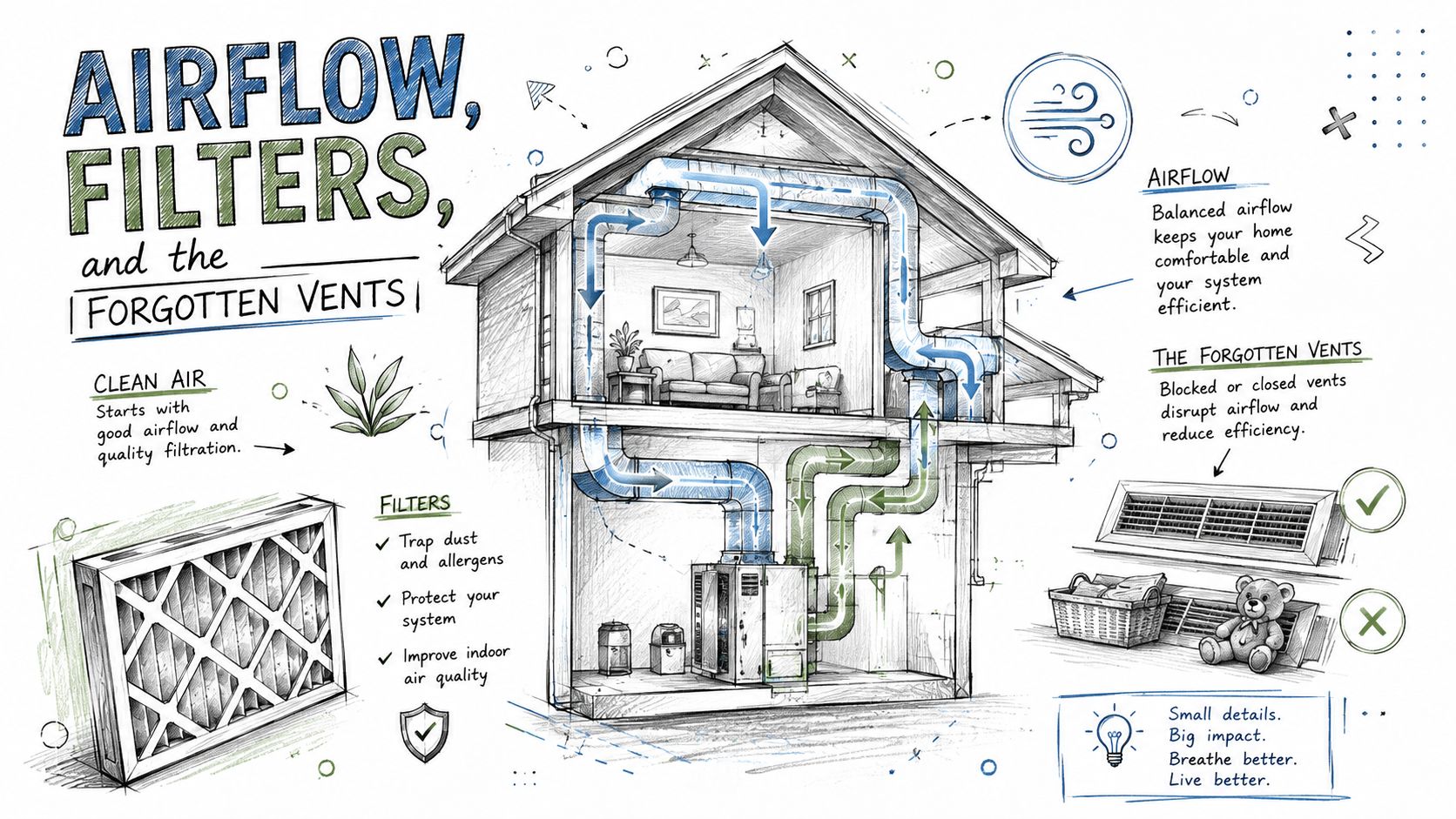
Pull the filter and look at it in good light. If it's coated, warped, or visibly clogged, replace it. Then walk the house and open every supply register that's been shut for winter, because closing too many registers raises resistance in the duct system and can trigger the furnace limit switch.
- Filter condition: Replace a dirty filter before you blame the burner or thermostat.
- Register position: Re-open closed supply vents in rooms that need heat.
- Return clearance: Move furniture, baskets, and rugs away from return grilles.
- Outdoor openings: Clear snow, leaves, or nesting debris from combustion-air and exhaust vents.
A West Side Vancouver home I'd treat as a classic example had a furnace short-cycling every ten minutes. The owner thought the unit was dying, but the return grille was blocked by a bookshelf. Once the return path opened up, the furnace stopped overheating and the house warmed normally.
The outside of the house matters too. High-efficiency units depend on clear intake and exhaust pathways, and those can be blocked by snow, leaves, or a bird's nest. If a furnace or heat pump can't move air freely, it can't do its job efficiently, and sometimes it won't run at all.
A heater can look dead when the real problem is circulation, not equipment failure.
For a more detailed airflow breakdown, Encano's airflow guide is useful because it puts the duct side of the problem into plain language. That's the part most homeowners miss when the thermostat is working and the unit still won't heat properly.
When Some Rooms Stay Cold Even With the Heat On
The most frustrating call isn't always “the heater won't turn on.” It's the one where the furnace runs all day and two rooms still feel like a fridge. In Richmond and Vancouver, I see this a lot in homes that mix older ductwork with newer windows, basement suites, or later additions. The heating equipment is working, but the air isn't getting where it needs to go.
The four usual reasons one room lags behind
The first culprit is duct leakage. If supply ducts run through an attic or crawlspace and leak at the joints, a chunk of the warmed air never reaches the register. In a Burnaby split-level from the 1980s, the upstairs bedrooms stayed cold because the original ducts leaked at nearly every joint in the attic, and the fix was sealing the joints with mastic and adding insulation around the duct runs.
The second culprit is a blocked return. A return grille behind a bookshelf, sofa, or storage bin can choke the whole system, especially in smaller homes where the return path already has limited capacity. The supply registers may blow fine, but the air can't circulate back to the furnace properly.
The third issue is poor zoning, or the lack of zoning. A single thermostat in a hallway can't always balance a home with a cold above-garage room, a sunny west-facing room, and a basement suite. If the upper floor runs hotter or colder than the main level every day, the thermostat location is part of the story, not just the furnace.
The fourth issue is plain heat loss. Additions that were never reinsulated, large windows on the west side, and bedrooms over garages all lose heat faster than the rest of the house. The system may be delivering warm air as designed, but the room is shedding it faster than it can be replaced.
A good homeowner check is simple. Feel each register, compare room temperatures with a basic thermometer, and make sure the return is open. If you have more than one thermostat, compare what each floor is reading. If one room stays cold while the rest of the home is normal, the problem is usually distribution or building envelope, not the furnace itself.
Routine care helps prevent that kind of imbalance from turning into a winter complaint. Replace filters on a sensible schedule, keep the area around the unit clear, and make sure thermostat batteries don't die just as the first cold snap hits. For heat pumps, keep the outdoor head clear of vegetation and debris so the unit can breathe properly. If the condensate drain is active when the system runs, that's another sign the equipment is moving through a normal operating cycle.
| Seasonal Maintenance Check | Why it matters |
|---|---|
| Replace the filter regularly | Protects airflow and keeps the system from overheating |
| Test smoke and CO detectors | Confirms the house is ready for a heating fault |
| Check thermostat batteries | Prevents a dead display from looking like a furnace failure |
| Clear the unit and outdoor openings | Keeps airflow and combustion air unobstructed |
| Book a tune-up | Catches wear before the first cold night exposes it |
A dead battery in the thermostat can look exactly like a furnace issue in the fall, so don't skip that simple check. For households that want one local option to handle inspection and repair, Encano Plumbing & Drainage Ltd. services heating systems alongside plumbing and drainage work, which matters when the problem isn't just the furnace but the vents, condensate, or adjacent mechanical equipment.
Knowing When to Call a Licensed Heating Pro
Some problems are homeowner territory. Others are not. If you smell gas, hear a CO alarm, see water leaking from a boiler or air handler, notice scorch marks, or find a breaker that won't stay reset, stop troubleshooting and call a licensed technician. A heater that stays dead for more than a couple of hours after the basic checks also deserves a professional visit, especially when the house is cooling off fast.
A good Vancouver-area HVAC contractor should show up with a clear diagnostic process, explain what failed, and give you pricing that separates repair from replacement. You want written findings, not a vague “it's old” line and a hard sell. If the contractor can't tell you what they checked and why the unit failed, keep looking.
For families in Richmond, Vancouver, Burnaby, New Westminster, Delta, and Surrey, that handoff matters because winter outages don't stay convenient for long. Encano works across furnaces, boilers, heat pumps, and tankless coils, and the same crew also handles plumbing and drainage work when a heating problem overlaps with water, venting, or mechanical room issues. That's useful when you don't want to juggle three different companies for one cold-house call.
A simple seasonal routine prevents a lot of these emergencies. Keep filters fresh, test batteries in thermostats and detectors, clear vents and returns, and book an annual service before the first hard cold snap. If you've done those things and the house still won't heat properly, the unit is telling you it needs a licensed diagnosis.
Call a pro when the fault moves past a switch, breaker, or filter. If you're in the Lower Mainland and the heat's out, book Encano Plumbing & Drainage Ltd. through Encano Plumbing & Drainage Ltd. for heating help that fits the way local homes are built, from quick repairs to full system troubleshooting.