You open your email and see a notice from the city about your building's cross-connection control program. Or a strata council member forwards a letter and asks, “Do we need to deal with this now?” If you own a house with irrigation, manage a mixed-use building, or oversee a strata in Vancouver or Surrey, that moment is familiar. The notice sounds technical, but the issue is simple. The city wants proof that water on your property can't flow backward and contaminate the drinking water supply.
That's what backflow preventer testing is about. It isn't just a plumbing checkup. It's a safety and compliance requirement tied to how municipalities protect public water. For property owners and managers in Greater Vancouver, the confusion usually isn't about whether testing matters. It's about what a backflow preventer does, who's allowed to test it, when it must be done, and what happens if the device fails.
A practical example helps. Say your strata has an underground sprinkler system that hasn't been used for a while. Many people assume the old backflow assembly no longer matters. In Vancouver, that assumption can create a compliance problem if the assembly is still connected to the water line. The rule follows the connection, not just whether the fixture gets used.
Table of Contents
- An Introduction to Backflow Preventer Testing
- What Is Backflow and Why Is Prevention Critical
- Your Guide to BC and Metro Vancouver Regulations
- The Backflow Testing Process Step by Step
- Understanding Test Results Costs and Common Issues
- How to Prepare and the Consequences of Non-Compliance
- Your Certified Backflow Testing Partner in Vancouver
An Introduction to Backflow Preventer Testing
Backflow assemblies often receive attention only when a test report is requested. A property manager gets a reminder from the municipality. A homeowner books spring irrigation work and suddenly hears about a certified tester. A building owner replacing equipment learns there's a backflow device near the water entry and it needs official documentation.
That uncertainty is normal because the device usually sits in a mechanical room, outside in an enclosure, or near an irrigation line. When it's working properly, nobody notices it. But municipalities do, because it protects the public water system from contamination moving the wrong way through a private plumbing connection.
Practical rule: If your property has a backflow assembly, treat testing as part of routine building compliance, the same way you'd treat required life-safety inspections or scheduled maintenance.
Here's a practical example. A small commercial property in Burnaby has a boiler feed line and an irrigation connection. The owner assumes the mechanical contractor “looked after that years ago.” Then a water utility asks for current records. At that point, key questions start. Is the device still active? Was it tested by someone properly certified? Was the report submitted where required?
For owners across Greater Vancouver, the fastest way to lower stress is to understand the basics. Backflow is a water safety issue. Testing is the formal check that confirms the assembly still works as designed. The process is straightforward when the device is accessible, the right technician is involved, and reporting is handled properly.
What Is Backflow and Why Is Prevention Critical
Clean water is supposed to move one direction only. From the municipal supply into your building, then out to fixtures, systems, and equipment, similar to a one-way street. A backflow event is wrong-way traffic. Water reverses direction and carries something with it that doesn't belong in the drinking water line.
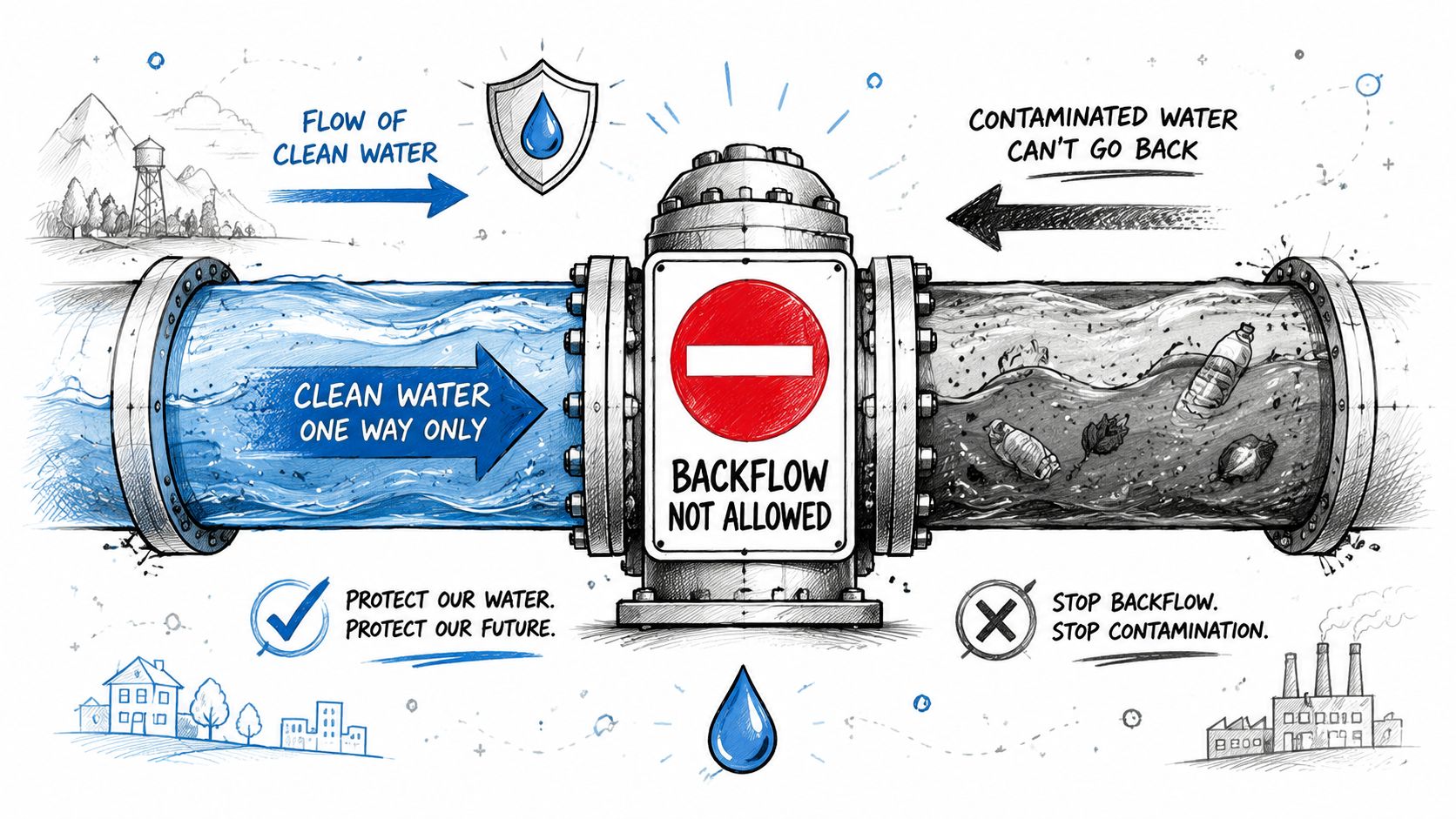
The one-way street idea
A backflow preventer acts like a safety gate. It allows water to move the proper way and helps stop reverse flow if conditions change. That matters anywhere potable water connects to something that could introduce contamination, such as irrigation, boilers, fire protection systems, or commercial equipment.
A practical example is a garden irrigation system. Water in those lines may sit for long periods and may be exposed to soil, fertilizers, or other outdoor contaminants. If water pressure changes and the protective device isn't functioning, that water can move the wrong direction.
Two ways water can reverse
There are two common causes people should understand.
Back-siphonage happens when supply pressure drops and creates a suction effect. Think of drinking through a straw. If pressure on the supply side falls, water can get pulled backward from a connected system.
Back-pressure happens when pressure inside a private system becomes stronger than the municipal supply pressure. In that case, the private system pushes water back toward the potable line.
A boiler system is a useful example of back-pressure. If the internal system pressure is higher than the incoming water pressure, water from the mechanical system can force its way backward unless a working backflow assembly stops it.
Backflow isn't a theoretical plumbing term. It's the reason municipalities require protective assemblies anywhere a private water system could affect the public supply.
That's also why testing matters. A device can look fine from the outside and still have worn internal seals, fouled check valves, or damage from age and weather. A certified tester uses proper equipment to verify that the assembly still closes, seals, and holds the required pressure conditions.
Your Guide to BC and Metro Vancouver Regulations
A property can pass the mechanical test and still end up with a compliance problem. That usually happens because the wrong person performed the test, the city was not given the report in the format it expects, or the assembly stayed connected after a system was supposedly taken out of use.
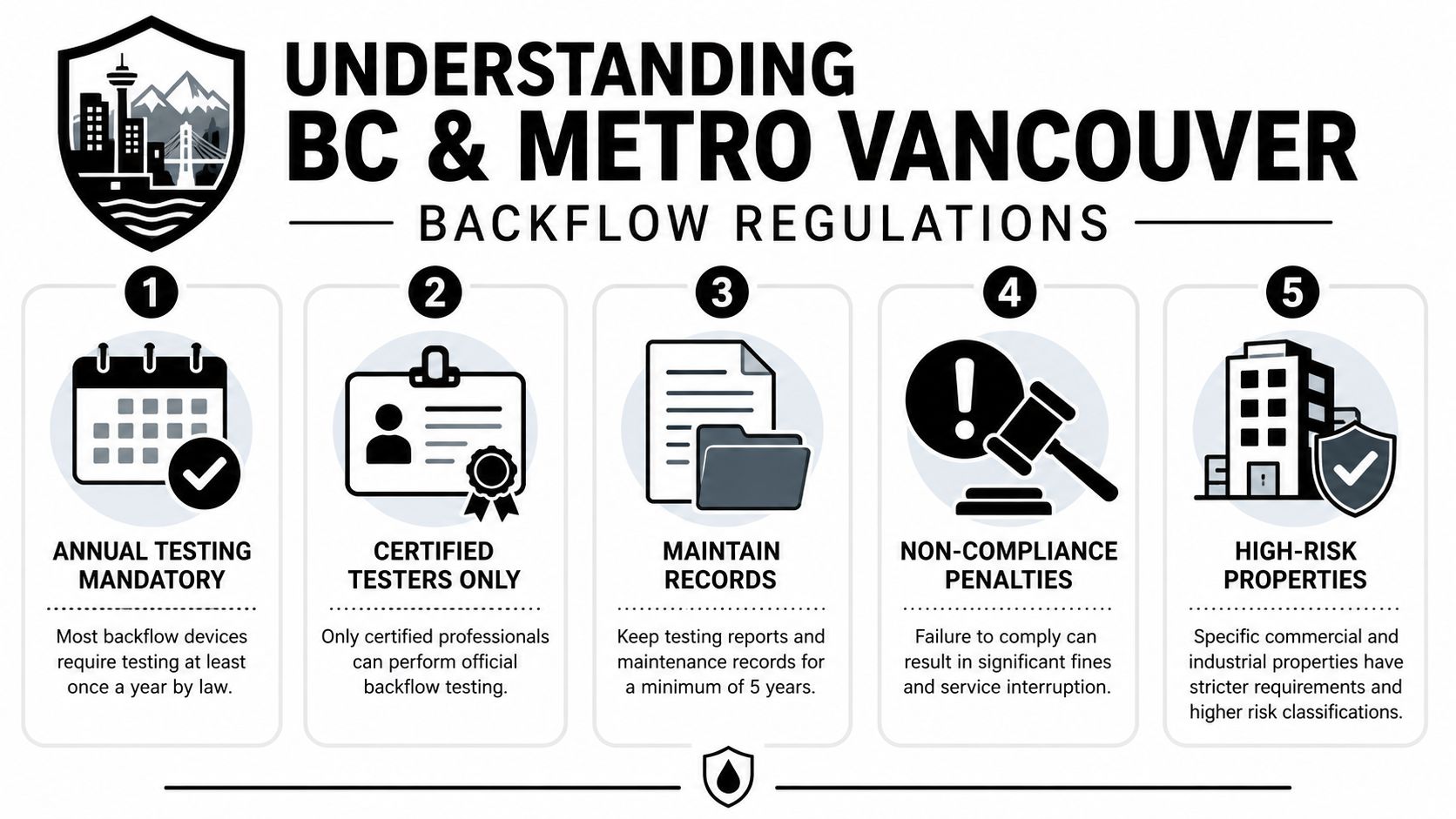
For strata managers and commercial owners in Greater Vancouver, that distinction matters. Plumbing compliance is not only about whether the device works. It is also about whether the test was completed by a properly qualified person and filed the way the local water utility requires.
Who can test in British Columbia
In BC, including municipalities such as Vancouver, Surrey, and Burnaby, backflow prevention assembly testing must be carried out by a properly certified tester. Many municipal utilities also require that tester to be registered with the municipality before the report will be accepted, as outlined by Backflows.ca on BC tester requirements.
The practical takeaway is simple. Before booking service, ask who will sign the report and whether that person meets the certification and local registration requirements for your municipality.
That step saves time. It also helps avoid the common problem of paying for a test that does not satisfy the city's reporting rules.
What local Metro Vancouver rules mean in practice
Vancouver requires testable backflow assemblies to be tested at specific points in the life of the device: at installation, on a recurring annual basis, and again after cleaning or repair. For an owner or manager, that means the testing schedule follows the assembly itself, not just the equipment it serves.
A good way to understand this is to picture the backflow assembly like a fire alarm panel. Even if one part of the building is not being used much, the safety device still has to remain serviceable and documented while it is connected to the system.
That point causes confusion on older properties. An irrigation line may be shut down, or a tenant improvement may have changed how water is used, but if the assembly is still tied into the potable water system, the compliance obligation may still remain.
Surrey also requires annual testing for testable backflow preventers, and the city expects the report to be submitted through its official process within the required reporting window, as described in this summary of Surrey annual backflow testing requirements. For a strata council or building operator, paperwork is part of the job, not an afterthought.
Here is a common real-world example. A Surrey townhouse complex schedules the annual test for irrigation and a fire service connection. The devices pass, but the report is not submitted on time. The assemblies may be functioning properly, yet the property can still show up as non-compliant because the administrative step was missed.
That is why local experience matters. A contractor working in Greater Vancouver should understand not only how to test the assembly, but also how Vancouver-area municipalities track records, review submissions, and follow up on missing reports. On larger or older sites, related plumbing investigations such as drain camera inspection services for aging building systems can also help managers document broader infrastructure conditions while they are already planning compliance work.
The short version for BC property owners and managers
- Testing must be performed by a properly certified person, and some municipalities require that tester to be registered with the city.
- Vancouver applies testing requirements at installation, annually, and after cleaning or repair.
- Surrey expects annual testing and timely report submission through its required process.
- A connected assembly can still require testing even if the downstream use has been reduced or stopped.
- Compliance includes the report, the tester's qualifications, and the municipality's filing requirements.
For owners and managers in Metro Vancouver, the safest approach is straightforward. Treat backflow testing as a regulated recordkeeping task as much as a plumbing task, and use a contractor who works with BC and local municipal requirements every day.
The Backflow Testing Process Step by Step
A typical call starts with a simple goal. Confirm the assembly can protect the drinking water system, document the result properly, and leave the owner or manager with a clear record for compliance.
What happens on site
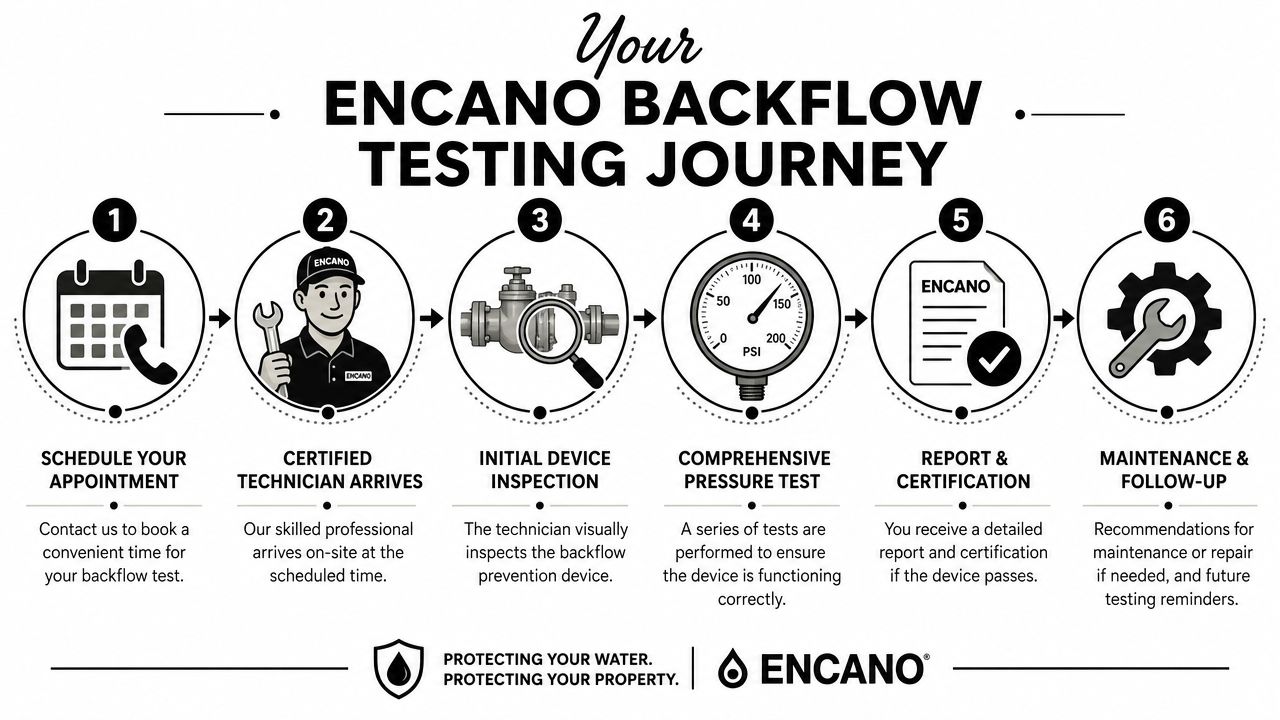
The tester begins by locating the assembly and checking whether it can be accessed safely. Then comes a visual inspection. The technician looks for leaks, corrosion, missing caps, freeze damage, and any sign the device has been buried, painted over, or altered in a way that interferes with testing.
Next, the tester confirms the device details for the report. That includes the make, model, size, and serial number. On older strata and commercial properties, this step often reveals record mismatches. The paperwork may list one assembly while the mechanical room contains another, or the serial number may no longer match what the municipality has on file. Before the test result can be submitted cleanly, those details need to line up.
The actual field test is done with a calibrated differential pressure test kit connected to the test cocks on the assembly. In plain terms, the tester is checking whether the internal check valves and relief components are doing their job under controlled conditions. A backflow preventer is similar to a one-way gate. The test confirms that the gate still closes properly when conditions change.
Water service through that branch usually has to be shut off for a short period during testing. On a well-managed site, tenants or staff may not notice more than a brief interruption. On a busy building with poor access, stored materials, or a locked room, the test can take longer because the first task is primarily creating a safe working area. For this reason, clear access is necessary on test day.
In BC, testing and installation work must be done by qualified personnel. For property managers in Greater Vancouver, that practical point is just as important as the plumbing work itself. A valid test is not only about the device passing. It also depends on the right person performing the test and recording it correctly for the local authority having jurisdiction.
A short video can help if you've never seen the equipment and sequence in person.
What gets recorded and submitted
After the test, the technician records whether each assembly passed or failed and notes any condition that affects compliance. If a device fails, the next step is usually repair, rebuild, or replacement, followed by a retest. If it passes, the report is completed for the owner's records and, where required, for municipal submission.
Each assembly is documented separately. That point causes confusion on larger sites. A mixed-use property may have one assembly serving irrigation, another protecting the domestic service, and another tied to fire protection or a specialized system. One passing result does not cover the rest. Each device has its own identity, test outcome, and paperwork trail.
For strata managers and owners in Metro Vancouver, local experience proves invaluable for saving time. Different municipalities may have different filing processes, naming conventions, or follow-up expectations, so the report has to be accurate from the start. If a building team is already organizing access to mechanical spaces, it can also be practical to combine that visit with related maintenance work such as drain camera inspection services for older building plumbing, especially where aging infrastructure is part of the bigger maintenance picture.
A proper backflow test visit should leave you with four clear answers. Which device was tested, whether it passed, what needs correction if it failed, and what record was prepared or submitted.
Understanding Test Results Costs and Common Issues
The first question after compliance is usually practical. What happens if the device doesn't pass? The second is financial. What's this likely to involve?
The honest answer is that testing costs and repair costs vary by property, device type, access, and what the technician finds. I'm not going to invent a price range that may not fit your building. A small residential irrigation assembly is one thing. A larger commercial assembly in a mechanical room with coordination requirements is another.
What a pass or fail usually means
A pass means the assembly performed correctly during the certified field test. It doesn't mean the device is brand new. It means it met the required functional test conditions that day.
A fail usually points to a serviceable issue, wear, or damage. Common causes include debris interfering with check valves, deteriorated rubber parts, corrosion, or frost damage on outdoor assemblies. Some units can be cleaned or rebuilt. Others are old enough or damaged enough that replacement is the smarter path.
A practical example. A homeowner turns on an irrigation system after winter and the tester finds the vacuum breaker won't hold properly. The problem may be freeze damage from inadequate winterization, not a sudden mystery failure.
If you're concerned about whether a failed device also affects your potable water quality, broader water quality testing services can help answer a different question than the mechanical backflow test itself.
Common Backflow Preventer Test Failures and Solutions
| Problem | Common Cause | Typical Solution |
|---|---|---|
| Check valve won't seal | Debris, mineral buildup, worn internal parts | Clean internal components, rebuild if parts are available, then retest |
| Relief valve leaking or not responding properly | Internal wear, fouling, age-related deterioration | Service or rebuild the valve assembly, or replace if condition is poor |
| Test cocks or shut-off valves leaking | Worn seals, corrosion, physical damage | Repair fittings or valve components before retesting |
| Repeated failure after service | Severe internal wear, obsolete parts, body damage | Replace the assembly |
| Exterior damage to irrigation device | Frost exposure, impact, poor enclosure protection | Replace damaged parts or the full device and improve protection |
A few decision points matter more than price alone:
- Age and parts availability: If rebuild kits are hard to source, replacement may be more practical.
- Location of the device: Outdoor or buried-adjacent assemblies often show more weather-related wear.
- Urgency of compliance: If a report deadline is close, the fastest code-compliant fix can matter more than trying several rounds of repair.
- Building operations: For strata and commercial sites, the best choice is often the one that restores compliance with the least disruption.
How to Prepare and the Consequences of Non-Compliance
A common Greater Vancouver scenario looks like this. The annual test is due, the technician arrives on site, and the assembly is behind stored materials in a locked room with no key available. The device itself may be fine, but the appointment still stalls because access and records were not lined up in advance.
Preparation matters for a simple reason. Backflow testing is part mechanical check, part compliance task. If either side is missing, the job can stay unfinished.
Prepare the site before the appointment
Start with access. The tester needs a clear path to the assembly, enough room to use test equipment, and any keys, fobs, or site contacts needed to reach the location. In strata buildings, that often means coordinating with building staff, a council member, or the property manager ahead of time.
Then deal with the practical details:
- Clear the area: Move storage bins, bikes, garden items, or other obstacles away from the assembly.
- Arrange entry: Confirm access to mechanical rooms, parkade cages, sprinkler rooms, or exterior enclosures.
- Advise occupants or staff: Some tests involve a brief interruption to the connected line, so it helps to give notice in advance.
- Pull together past records: Old test reports, repair invoices, and replacement history help sort out model numbers and past compliance notes.
- Flag visible problems early: Leaks, corrosion, frost damage, or signs of tampering can affect what the technician finds on site.
Records are easy to overlook, but they save time. They work like a service log for the assembly. If the city record lists one device and the installed unit is different, past paperwork helps resolve that mismatch faster.
If the test shows an older or poorly located assembly is part of the problem, it also helps to review proper backflow preventer installation considerations rather than treating testing and installation as two separate issues.
What happens if testing is missed or follow-up is delayed
In BC and Metro Vancouver municipalities, annual testing is usually tied to local water system protection programs. For owners and managers, that makes this more than a maintenance reminder. It becomes a documented requirement that has to be completed and submitted properly.
The consequences are usually administrative first. A missed test, an unsubmitted report, or a failed assembly with no repair follow-up can trigger notices from the municipality or utility. For a strata council or commercial owner, that can create extra coordination work, deadline pressure, and questions during inspections, tenant discussions, or building file reviews.
There is also the operating risk. A backflow assembly is installed to keep water moving in one safe direction. If it is not tested, nobody has current proof that it is doing that job as intended. That gap matters most in buildings with irrigation, fire protection, boiler systems, or other cross-connection risks.
For property managers, the practical takeaway is simple. Treat the annual test like any other scheduled compliance item. Book early, make access easy, keep the paperwork together, and deal with failures promptly. That approach usually costs less time than trying to fix an overdue file under deadline.
Your Certified Backflow Testing Partner in Vancouver
By the time most owners look into this topic, they're trying to solve two problems at once. They need the device tested properly, and they need the paperwork handled without confusion. That's why certified testing matters. The value isn't only in attaching gauges to a valve. It's in identifying the correct assembly, testing it correctly, documenting the result, and helping the owner deal with the next step if repairs are needed.
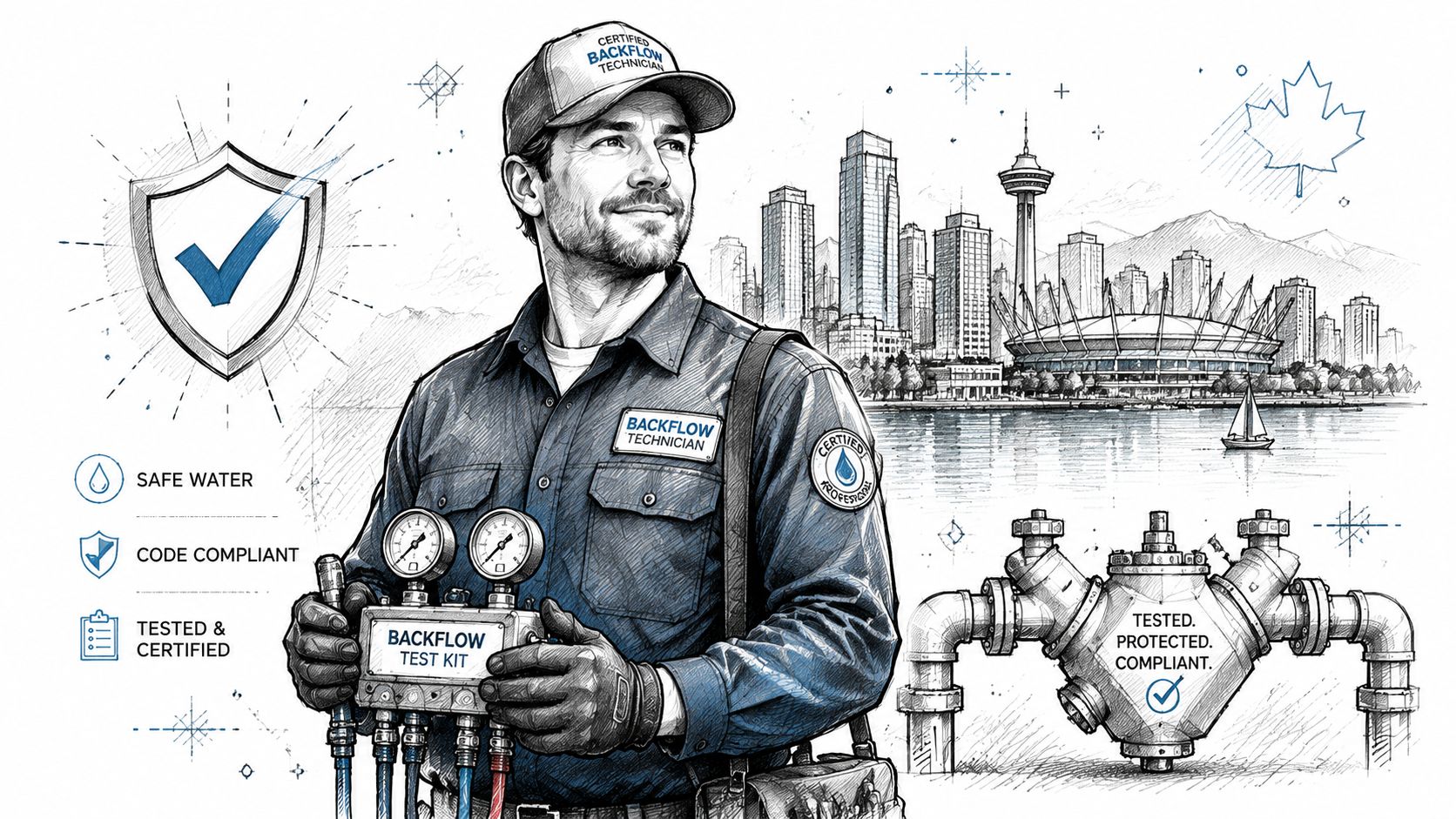
For homes, strata properties, and commercial buildings across Greater Vancouver, local knowledge matters because compliance is shaped by BC certification rules and municipal processes. A contractor working in this area needs to understand those local requirements, not just the mechanics of the device.
A practical example. If a Surrey property manager books a test close to deadline, the work isn't finished when the gauge comes off. The reporting side still has to be completed correctly and on time for the city's process. That administrative follow-through is part of the actual service.
Encano Plumbing & Drainage Ltd. provides plumbing and drainage services across Vancouver and nearby communities, including backflow-related work for properties that need licensed inspection, testing coordination, and follow-up support as part of broader system maintenance.
If your property has a backflow assembly and you're unsure about the next due date, the device location, or the condition of the unit, now's the time to sort it out while you have options and time to schedule properly.
If you need help with backflow preventer testing, reporting support, or related plumbing work in Greater Vancouver, contact Encano Plumbing & Drainage Ltd.. Their team serves homeowners, strata managers, and commercial properties across the region and can help you book the right service, confirm access requirements, and move your property toward safe, documented compliance.