
In Greater Vancouver, an emergency plumbing call after 4 PM typically starts at C$375 for a minimum 1.5-hour service window, with the hourly rate doubling from C$125 to C$250, before parts or access work are added. That means the emergency plumbing cost depends on more than the repair itself, it also reflects dispatch, timing, minimum billing, materials, and how difficult the damaged pipe is to reach.
At 2 AM, a homeowner usually isn't comparing plumbing companies calmly. There's water pooling across the floor, a ceiling starting to stain, or a toilet backing up when every other service is closed. The right question isn't, “What does an emergency plumber charge?” It's, “What am I paying for before the repair even starts, and what could make this job more complicated?”
That distinction matters. A transparent quote should separate the call-out fee, after-hours labour, parts, and any additional work needed to open walls, locate a hidden leak, or restore damaged surfaces. If you understand those layers, you can act quickly without authorising an unclear price under pressure.
Table of Contents
- When a Pipe Bursts at Midnight
- How Emergency Plumbing Pricing Is Structured
- Standard Rates Versus After-Hours and Holiday Surcharges
- Real-World Emergency Scenarios and Estimated Costs
- The Hidden Cost Driver Is Access and Diagnostics
- Practical Ways to Reduce Your Emergency Plumbing Bill
- When to Call a Professional and When to Wait
When a Pipe Bursts at Midnight
At 2 AM, you wake to running water. By the time you reach the hallway, flooring is soaked, a cabinet has swollen, and the shutoff under the sink still cannot stop the flow. The main valve may be near the meter, but finding it under pressure is difficult.
Treat that as a genuine emergency. If you can do so safely, shut off the water, move valuables away, and keep clear of electrical equipment. Use this step-by-step guide to stopping a burst pipe quickly while professional help is on the way.
Your first cost is the service window. A Greater Vancouver rate sheet lists a standard plumber at C$187.50 for a minimum 1.5-hour service call. The same minimum after 4 PM is C$375.00, and the hourly component rises from C$125 to C$250 during that after-hours period. Those figures show the baseline already in place before parts, difficult access, or additional diagnostics are considered.
At midnight, you are paying for more than pipe repair. The bill reflects immediate dispatch, after-hours availability, travel, assessment, and the minimum block of chargeable labour. Access can add another layer if the plumber must open a wall, remove cabinetry, or trace a concealed leak.
At 2 AM, decide first whether the water can be safely contained until regular hours.
Call promptly if water is still flowing, the leak is close to electrical equipment, sewage is entering living space, or a shutoff valve cannot control the problem. Waiting can increase property damage and make access or restoration more involved. A contained drip stopped at a local valve gives you more time to compare daytime appointments.
Before work starts, ask the plumber to separate the dispatch charge, after-hours labour, minimum service period, parts, diagnostics, and access work. A split fitting may be inexpensive, while reaching it can determine the final emergency plumbing cost. Get that breakdown before authorising repairs, even when the situation is urgent.
How Emergency Plumbing Pricing Is Structured
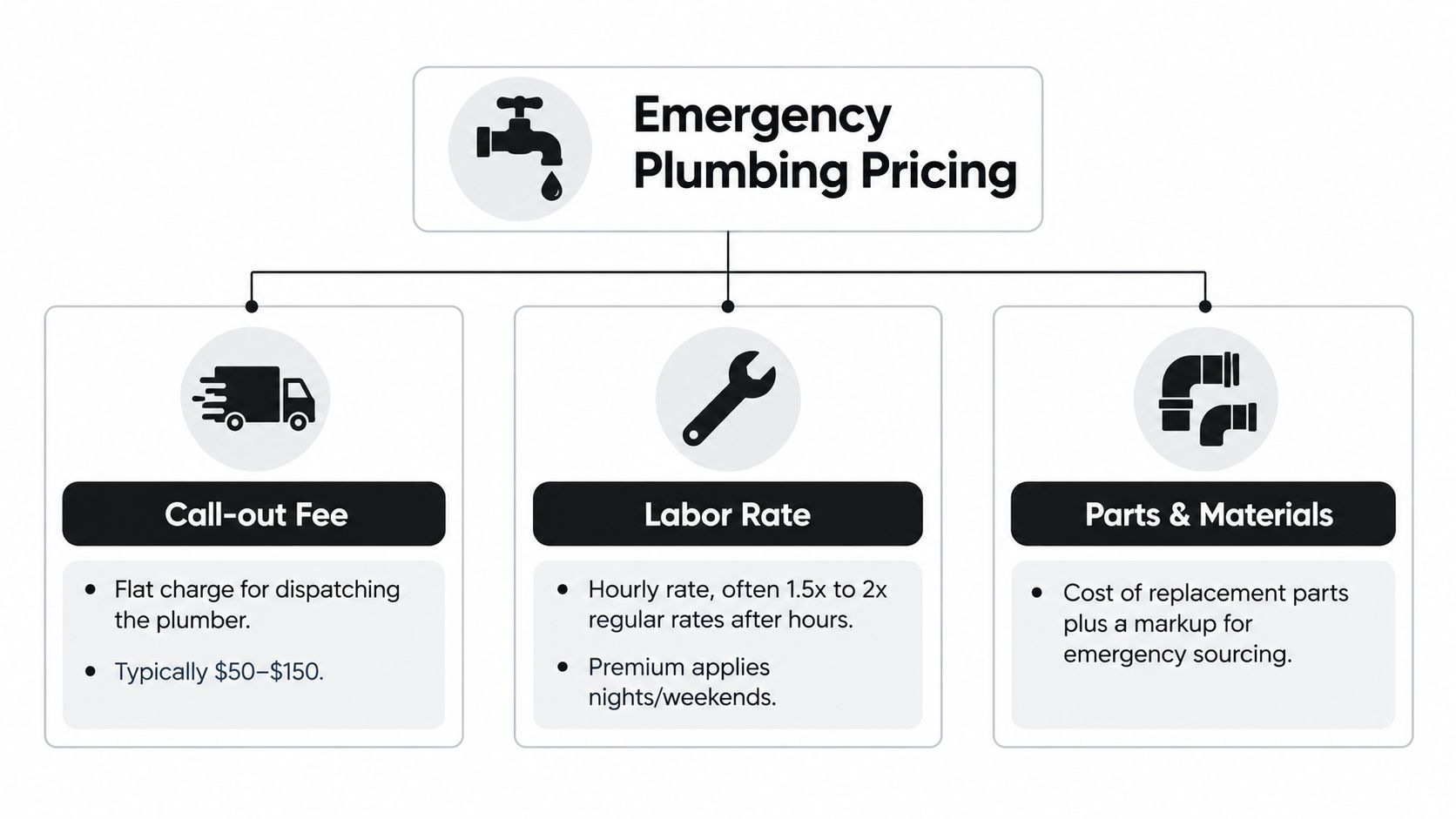
At 2 AM, the first quote rarely represents the full bill. Emergency plumbing cost usually builds in layers: dispatch, labour, materials, and, when the problem is concealed or difficult to reach, access and diagnostics. Authorise the job only after you understand which layers apply.
The call-out layer
The call-out or dispatch fee pays for sending a plumber to your property and starting the assessment. Local BC references place emergency call-outs around C$150 to C$250, according to this BC plumbing cost guide.
Ask two direct questions before booking:
- What does the call-out include? Confirm whether it covers travel, the initial inspection, shutting off water, and diagnosis.
- Does it apply toward repair labour? Some companies credit the fee against approved work. Others keep it as a separate charge.
The fee may still apply if you decline the repair, so confirm that condition before the plumber arrives.
The labour layer
After-hours labour adds the largest immediate premium, and a minimum billing block can apply even when the repair takes only a short time. The hourly rate alone therefore cannot show your first out-of-pocket cost.
Burst-pipe repairs are often quoted at roughly C$200 to C$800, depending on access and scope. That work may include isolating the water supply, locating the failure, removing damaged material, testing the repair, and working in a restricted space. The range describes the repair itself, not necessarily every dispatch or restoration charge.
The materials layer
Parts usually sit outside the labour charge. A simple repair may need a coupling, valve, flexible connector, or pipe section. A larger call can require specialty fittings, replacement components, protective materials, or emergency sourcing.
Request an itemised estimate covering:
- Dispatch or service-call charges.
- Minimum labour time and after-hours rates.
- Parts and material costs.
- Diagnostic or access work.
- Restoration excluded from the plumbing repair.
The headline hourly rate is only one line on the bill. Your minimum out-of-pocket is the dispatch fee plus the minimum labour charge, before parts and access work.
That breakdown gives you a sound decision under pressure. A cheap fitting can still produce a high invoice if reaching it requires opening a wall or tracing a concealed failure.
Standard Rates Versus After-Hours and Holiday Surcharges
At 2 AM, the first number to confirm is not the hourly rate. Ask for the minimum amount required to send a plumber, start the clock, and assess the failure. Timing can change the labour charge before anyone knows whether the problem is a valve, pipe, drain, or fixture.
As noted in the Greater Vancouver rate sheet cited earlier, the hourly component rises from C$125 to C$250 after 4 PM. The listed standard minimum service call is C$187.50, while the after-hours minimum is C$375.00 for the same 1.5-hour window.
| Service Window | Dispatch Fee | Hourly Rate | Minimum Charge |
|---|---|---|---|
| Standard daytime | Confirm before booking | C$125 | C$187.50 for a minimum 1.5-hour call |
| After 4 PM | Confirm before booking | C$250 | C$375.00 for the same minimum 1.5-hour call |
| Weekend or holiday emergency | Confirm whether separate dispatch applies | Confirm the premium in writing | Confirm the minimum before authorising work |
Use this table as a comparison, not as a universal tariff. One contractor may bundle the emergency visit, while another separates dispatch, labour, and materials. Either structure can be acceptable when the estimate and invoice show each charge clearly.
Why the premium exists
After-hours pricing covers availability, call handling, travel, equipment, and work outside the scheduled crew's normal hours. Dispatch coordination and minimum billing also affect the total. The premium is reasonable only when you know what it covers.
The commonly missed charge is the response fee. Separate after-hours dispatch charges may be about $100 to $300, or $200 to $500, before repair work begins, according to this emergency plumbing pricing guide.
For a Greater Vancouver homeowner, the practical question is the full first-hour or minimum-call amount, including dispatch and after-hours labour. Do not approve a visit based on the hourly figure alone.
Use this wording on the phone:
“Before I approve the visit, what is the total minimum charge, including dispatch, after-hours labour, tax, and the first expected materials?”
Then ask whether wall access, specialised equipment, or a second trade requires separate approval. This keeps a low labour quote from hiding the scope. The dispatch fee, minimum labour block, and access complexity determine your initial out-of-pocket cost before the repair is complete.
Real-World Emergency Scenarios and Estimated Costs
Two homes can report “a leak” and receive very different quotes. The difference usually comes from where the failure is located, whether the water can be shut off, and whether the plumber can reach the damaged component without opening finished surfaces.
A burst pipe behind drywall
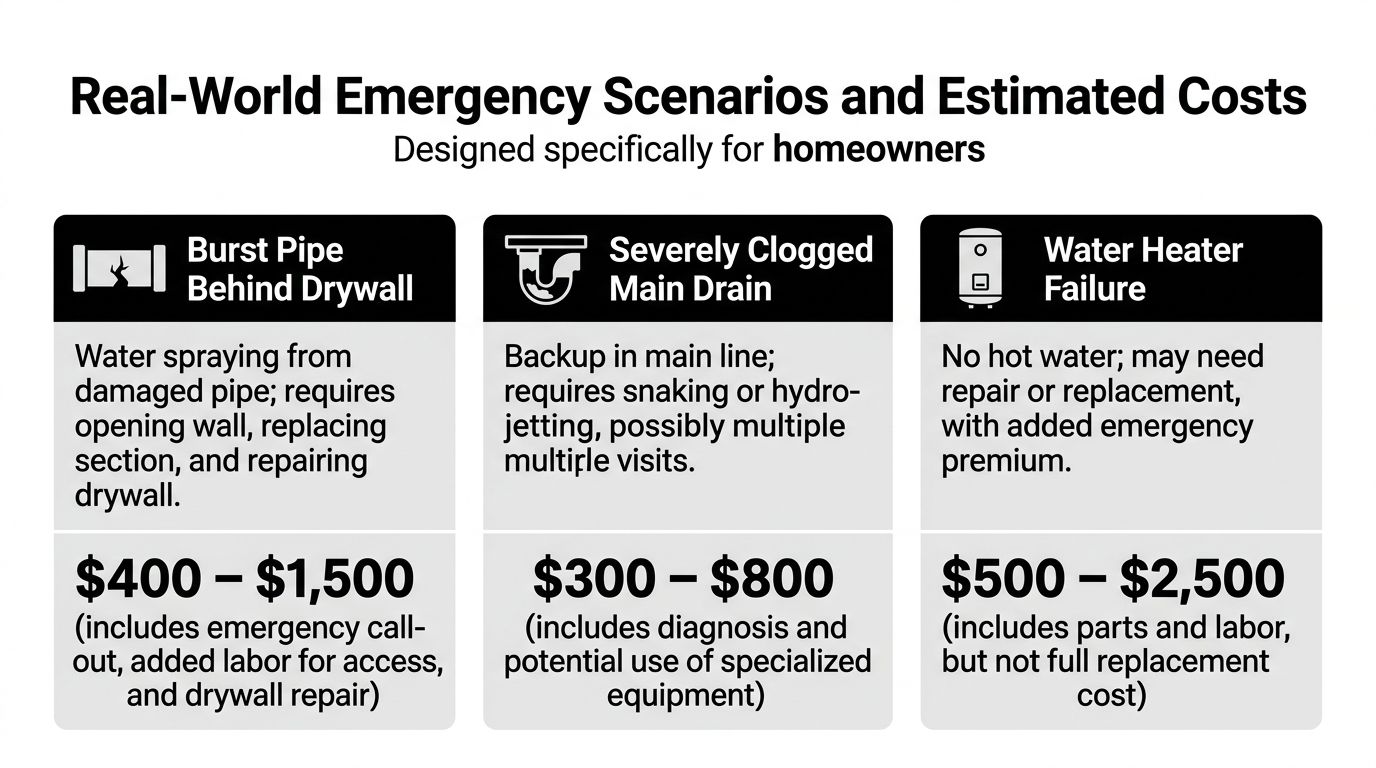
Water spraying from an enclosed pipe requires more than cutting out the failed section. The plumber may need to shut off the building supply, locate the exact failure, open the wall, replace the pipe section, pressure-test the repair, and leave the drywall ready for restoration.
A Vancouver market guide estimates emergency burst-pipe or active-leak work at $150 to $700, generally taking 2 to 6 hours. The same guide notes that opening walls or ceilings raises the total, particularly when a hidden leak requires access and cleanup, as described in this Vancouver emergency repair guide.
The infographic's broader planning range for a burst pipe behind drywall is $400 to $1,500, including emergency call-out, access labour, and drywall repair. Treat that as a scenario estimate, not a guaranteed quote. Plumbing restoration and full water-damage remediation may be outside the plumber's scope.
A severely clogged main drain
A single blocked sink is different from a main-line backup affecting multiple fixtures. The technician may test several drains, run a snake through the cleanout, inspect the line, or use hydro-jetting if the blockage is persistent or the pipe walls are heavily restricted.
The scenario estimate shown in the infographic is $300 to $800, including diagnosis and possible specialised equipment. Before approving that work, ask whether the price covers one attempt, a defined amount of machine time, or a return visit if the blockage returns.
For a homeowner facing a backup, emergency plumbing service information can help you identify which details to provide when requesting service.
A water heater failure
A failed water heater can mean a component repair, a leaking tank, or a larger replacement decision. The diagnostic steps may include checking the source of water, isolating the heater, assessing valves and connections, and determining whether the tank itself has failed.
The infographic places this scenario at $500 to $2,500, including parts and labour but not full replacement cost. Ask whether the estimate covers diagnosis and repair only, and whether replacement, disposal, permits, or related upgrades would be priced separately.
The useful comparison is scope. A plumber who identifies the cause, explains the repair boundary, and gives you a written estimate is more valuable than one who offers a low opening figure that excludes the work needed to finish the job.
The Hidden Cost Driver Is Access and Diagnostics
At 2 AM, a failed pipe may be the least expensive part of the emergency. The bill grows when the plumber cannot see the break, reach it without removing finished materials, or verify that the first repair solved the cause.
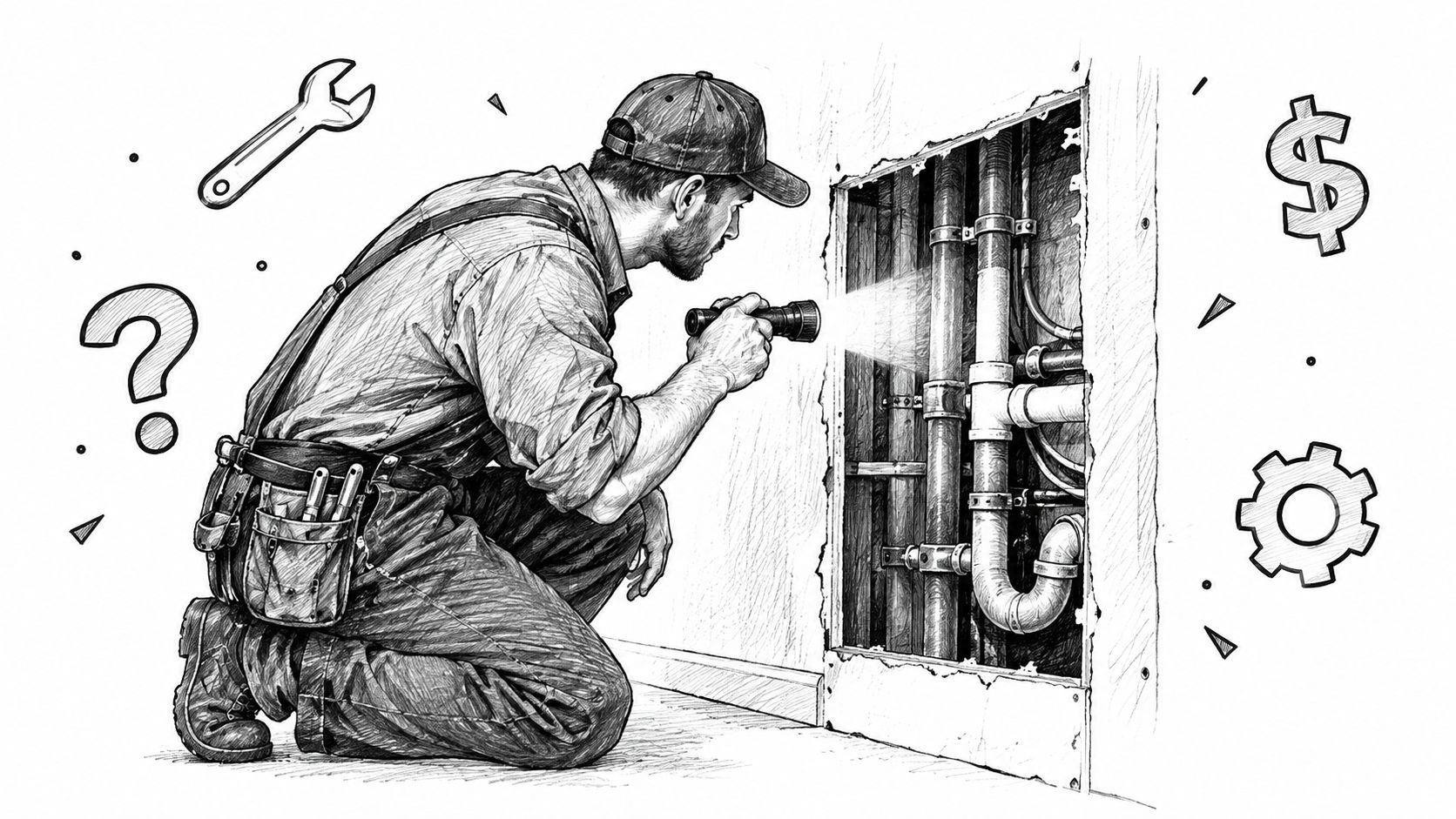
A leak under a sink may require only a valve or connector. A ceiling stain can come from a pipe above, a drain connection, or a fixture on another level. The technician may need to trace moisture, inspect the line, open part of a wall, then test the system after the repair. Those steps add labour and access time, but skipping them can leave the active failure in place.
Why diagnostics can be the sensible expense
Emergency plumbing cost is often layered. The dispatch charge and after-hours labour establish the minimum bill, then diagnostics and access determine how far the work expands. Ask for that structure before authorizing service, not just a single hourly rate.
Diagnostics may include video inspection of drain or sewer lines, acoustic leak detection for concealed water movement, and pressure testing after a repair. These tools narrow the work area and can reduce unnecessary demolition. They still require labour, but they give the plumber evidence before cutting further into walls, floors, or ceilings.
As noted earlier, burst-pipe repairs range from roughly C$200 to C$800, depending on access and scope. A plumber working in an open utility room faces a different job from one working behind finished drywall, under flooring, or inside a ceiling cavity.
If the plumber can't reach the failure, the repair quote is really an access and investigation quote.
Complex failures change the entire budget
A slab leak, sewer backup, or main water line rupture should not be priced like a fixture repair. California pricing data shows the wider spread for concealed and infrastructure-level emergencies. Slab leak detection and repair can run roughly $1,500 to $4,000 after hours, while main water line ruptures can reach $1,500 to $5,000 or more, according to this complex plumbing repair cost guide.
Those figures are not a Greater Vancouver quote. They show the pricing principle clearly: diagnostics, access, and restoration can outweigh the cost of the failed component. Ask, “What kind of emergency is this, and how much inspection work is required?” That question produces a more useful estimate than a generic emergency rate.
If the quote expands after investigation, request photographs, test results, and a clear explanation of the added scope. Confirm what the dispatch fee, labour, access work, and restoration include before approving the next stage.
Practical Ways to Reduce Your Emergency Plumbing Bill
You can reduce emergency plumbing cost by controlling damage before the plumber arrives and by removing uncertainty from the first phone call. Don't attempt a complex repair while water is moving through walls or near electrical equipment, but a few safe actions can prevent a manageable failure from becoming a larger one.
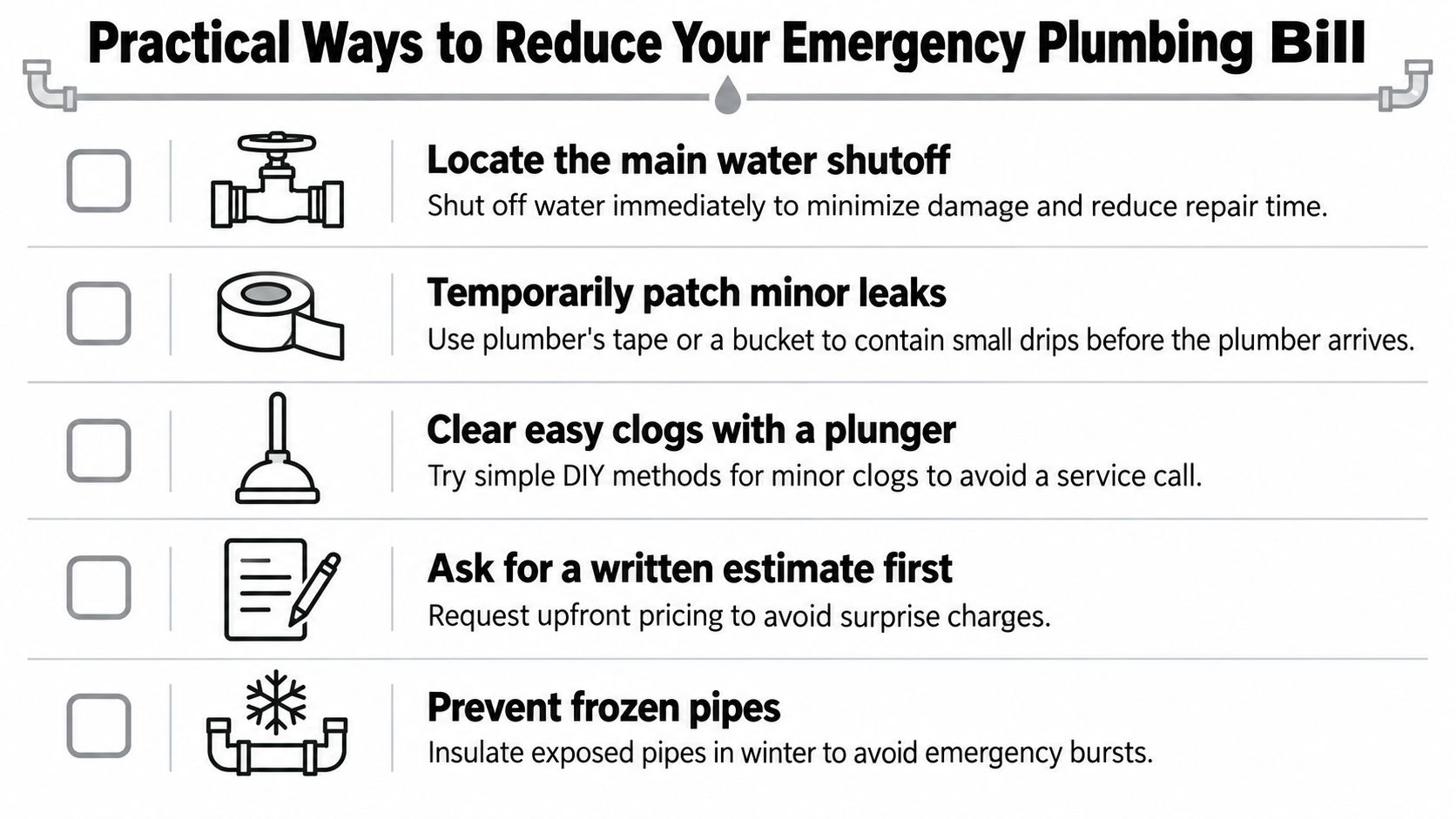
Locate the main water shutoff. Close it when a fixture valve won't stop active flow. Reducing the water volume can limit damage and lets the plumber begin diagnosis without waiting for uncontrolled flooding to stop.
Contain minor leaks. Use a bucket, towels, or plumber's tape for a small accessible drip. This is temporary containment, not a permanent repair, and it shouldn't be used where the pipe is split, pressurised, or concealed.
Try a plunger on a simple clog. A single slow sink or toilet may respond to basic plunging. Stop if water backs up elsewhere, sewage appears, or repeated plunging doesn't change the flow.
Ask for a written estimate first. Confirm the dispatch charge, minimum labour, after-hours rate, materials, tax, and the price of additional access work. Also ask who handles drywall, flooring, or water-damage restoration.
Prevent frozen pipes. Insulate exposed pipes and address cold, draughty areas before freezing conditions arrive. Preventive work is easier to schedule than a burst-pipe response.
Regular inspections and timely repairs can also reduce the chance of a night-time failure. This guide on how regular plumbing maintenance can save money over the long term offers a practical planning perspective.
If the problem is contained, document it with photos and note when it started. That information helps the plumber distinguish an active emergency from a repair that can safely be scheduled during standard hours.
When to Call a Professional and When to Wait
Call immediately for active flooding, sewage backing up into living areas, water near electrical equipment, a suspected gas-line problem, or a failed shutoff that leaves water running. Move people away from unsafe areas, avoid electrical switches near water, and contact the appropriate emergency utility service for gas concerns.
You may be able to wait for regular hours when a local valve has stopped a contained drip, one sink is clogged without sewage, a toilet can be isolated, or a water heater has stopped heating without leaking. Keep monitoring the area, and don't wait if the condition worsens.
The smart decision is based on water movement, safety, contamination, and access, not inconvenience alone. For urgent Greater Vancouver service, Encano Plumbing & Drainage Ltd. offers emergency plumbing response, leak detection, drain services, and upfront pricing before work begins, so you can get the situation assessed and understand the likely cost before authorising the repair.