
A routine furnace tune-up in Greater Vancouver typically lands around C$150 to C$220, but crawl-space access or after-hours booking can push the same visit to C$298 to C$398. The final furnace tune up cost depends less on the word “tune-up” and more on where the unit is, when you need service, and what the technician is checking.
The first cold morning is when many homeowners start asking. The furnace has been quiet through the warmer months, then the thermostat calls for heat and the system runs longer than expected, makes a new sound, or struggles to warm the far rooms. You can book service immediately, wait until the furnace stops working, or compare a few quotes while appointments are still available.
A cheap-looking price isn't always a complete tune-up. A proper visit should address combustion safety, the heat exchanger, burners, airflow, controls, and visible wear, not just involve vacuuming dust from the cabinet. The sections below break down the B.C. variables that change the invoice.
Table of Contents
- The Real Cost of a Furnace Tune Up in Greater Vancouver
- What a Standard Tune Up Actually Covers
- The Four Factors That Move Your Price Up or Down
- A Sample B.C. Quote and How It Changes
- How Regular Maintenance Pays for Itself
- How to Get an Accurate Quote Before You Book
- Red Flags That Mean a Cheap Quote Is Not a Deal
The Real Cost of a Furnace Tune Up in Greater Vancouver
A furnace tune-up quote can look reasonable until the technician sees where the equipment is installed. A Richmond homeowner with a furnace in an open utility room may receive a straightforward weekday price. The same service becomes more expensive when the unit sits behind a low crawl-space hatch or the appointment is requested after hours.
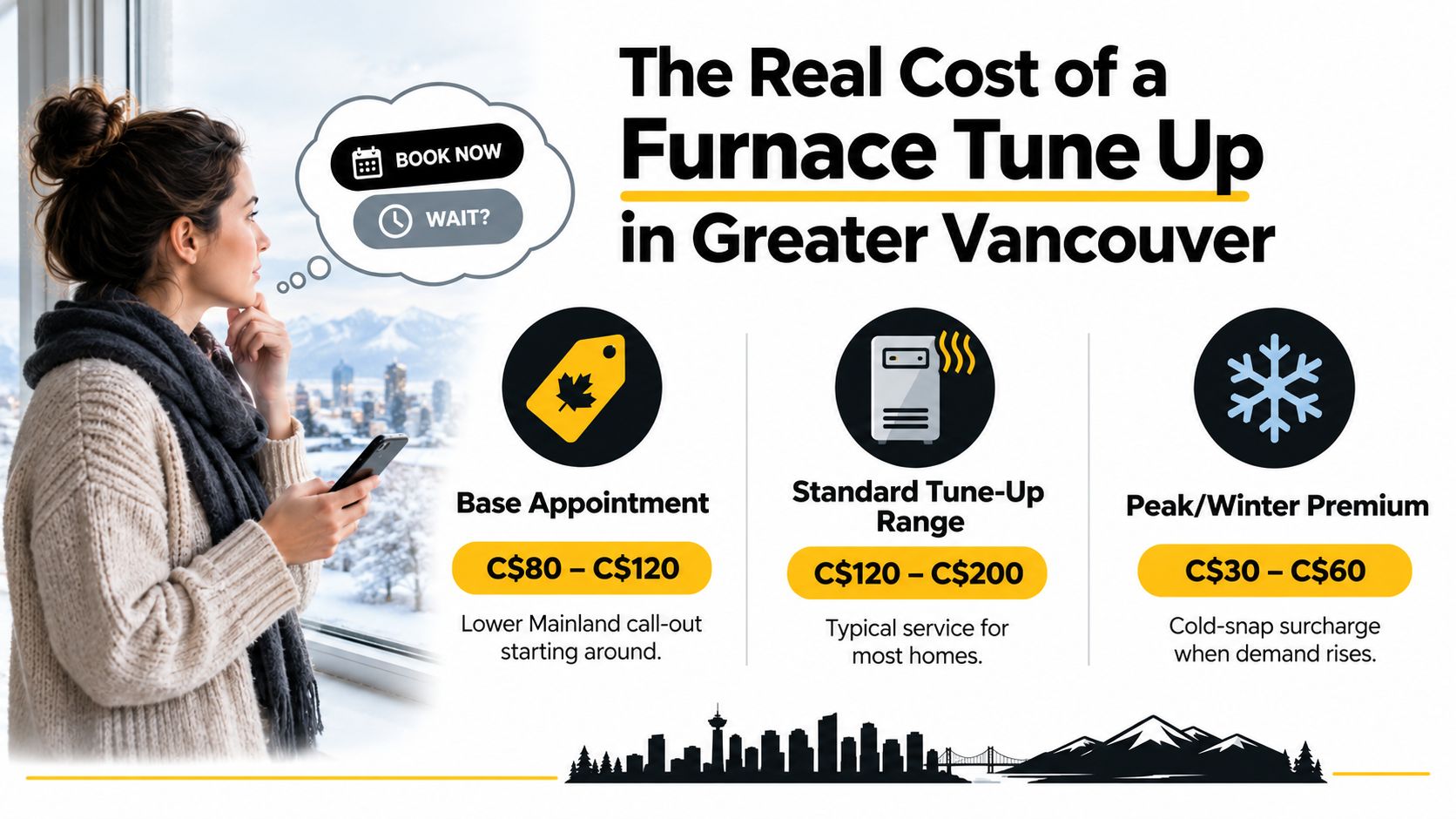
One B.C. regional guide lists a Lower Mainland base appointment fee of C$129 and C$149 elsewhere in B.C., before tax. Across Canada, a professional furnace tune-up generally falls between C$150 and C$220 per visit. Those figures describe different pricing situations rather than a contradiction. Service scope, access, timing, and the condition of the furnace all affect the final invoice. Greenfoot Energy's Canada furnace maintenance cost guide provides the regional comparison.
What the starting price really tells you
The Lower Mainland figure is an entry point, not a guarantee that every furnace can receive a complete service for that amount. A technician can work faster and more safely around a basement furnace with clear access during regular weekday hours. A furnace tucked behind a narrow crawl-space opening may require more setup, restricted movement, and additional time to reach the burner, controls, and venting.
After-hours timing changes the equation as well. A weekend evening call can carry a higher service rate even when the furnace needs the same basic inspection. Ask whether the advertised price covers travel, labour, safety testing, and any diagnostic work before approving the booking.
Homeowners comparing routine maintenance with how much a new furnace costs should keep those decisions separate. Replacement planning depends on the equipment's condition and expected remaining service life, not just the cost of one tune-up. An older furnace may justify maintenance while you plan a replacement, but a tune-up does not turn into a repair or replacement assessment automatically.
Practical rule: Budget for a routine visit, then ask which access conditions, appointment times, and diagnostic charges can change the price.
Why the ceiling is higher
The published B.C. schedule lists annual service and safety inspection rates of C$198 during regular hours and C$298 after hours. Crawl-space versions are C$298 during regular hours and C$398 after hours. The published B.C. gas furnace service schedule shows why the lowest advertised number may not match the invoice for a difficult Vancouver-area visit.
The useful question is not, “What is the cheapest furnace tune up cost?” Ask, “What does this price include, and what conditions make it change?” That answer gives you a more dependable quote than comparing headline prices alone.
What a Standard Tune Up Actually Covers
A proper furnace tune-up should leave you with more than a clean cabinet and a completed invoice. The technician should confirm that the furnace starts, burns fuel, moves air, responds to the thermostat, and shuts down safely. The visit may also reveal a component that still operates but is showing wear.
A detailed California furnace maintenance checklist includes items such as combustion analysis and heat-exchanger inspection. That guidance also identifies the need for calibrated carbon monoxide instrumentation when assessing combustion. A visual check can reveal damage, but it cannot confirm how safely the appliance is burning fuel.
Start with combustion and the heat exchanger
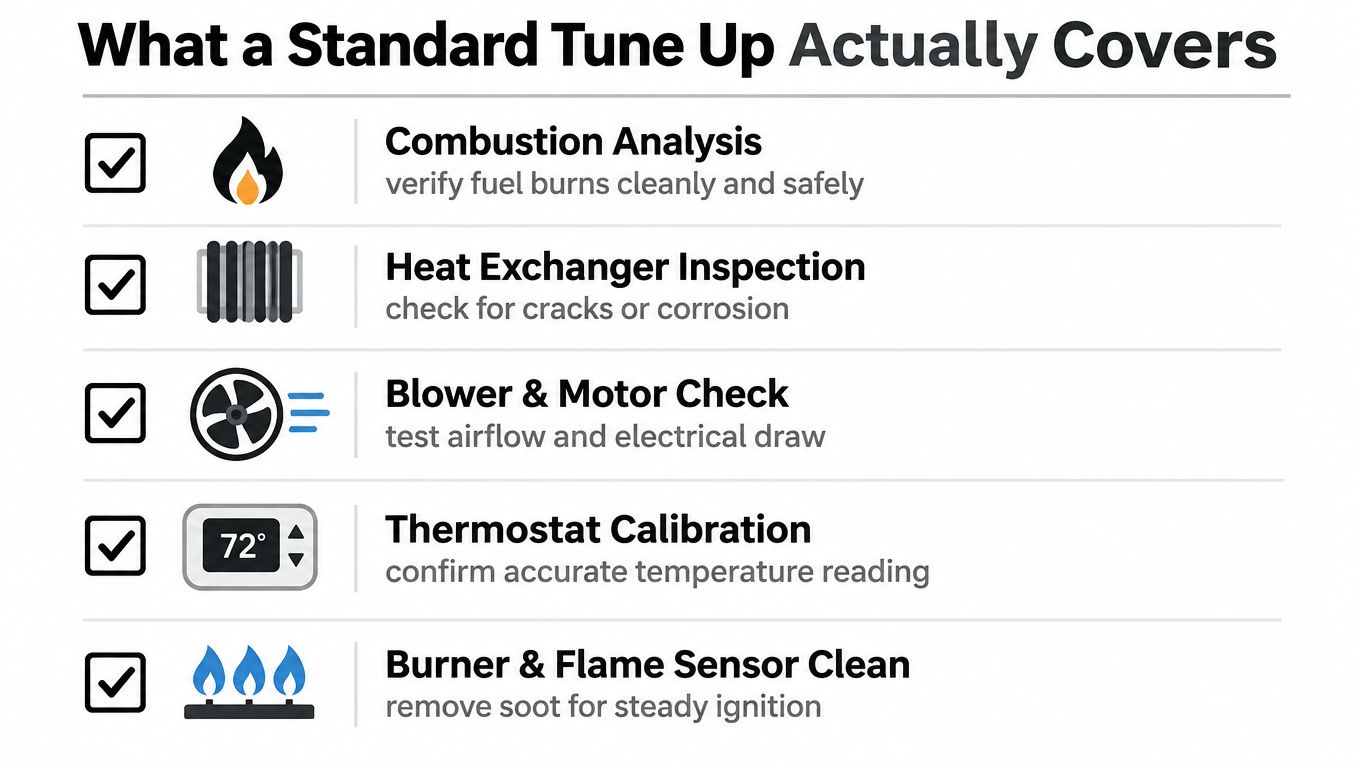
The service should begin with the components that separate safe combustion from unsafe operation. The technician may inspect the heat exchanger for visible cracks or corrosion, observe the burner flame, check venting, and use calibrated instruments to assess combustion and carbon monoxide levels.
A furnace can heat the home and still have a combustion problem that requires attention. Ask what the contractor means by “safety check.” If the quote does not state whether combustion analysis is included, get that answer before approving the work. A basic safety inspection and a fuller tune-up may cover different tasks.
Check ignition, flame sensing, and burners
Dust and residue can collect on the burners. Ignition parts and the flame sensor can also become dirty or unreliable. The technician should inspect and clean the relevant components, confirm steady ignition, and test whether the safety controls respond correctly when the flame fails to establish.
A flame sensor that needs cleaning does not automatically indicate a major repair. It is often a small service issue that can be addressed before the furnace becomes unreliable. Confirm whether this cleaning is included in the quoted tune-up or charged separately.
Verify airflow and electrical operation
The blower assembly, motor, wiring, electrical connections, and filter all affect how efficiently heated air reaches the rooms. The technician should check airflow, inspect the blower and motor, and look for loose, damaged, or overheated connections. Between visits, homeowners can follow the furnace filter replacement schedule for their equipment.
Thermostat operation belongs in the scope too. The furnace should respond to a call for heat and shut down at the correct point. If the thermostat reading differs from the room temperature, the technician should investigate that discrepancy rather than assume the furnace is at fault.
Use the embedded visual below as a reminder of the main service areas, not as a replacement for a written scope.
Two quotes can carry the same price and provide different work. “Clean and inspect” leaves too much open to interpretation. “Combustion analysis, heat-exchanger inspection, burner cleaning, blower check, thermostat verification, and safety-control testing” gives you a specific scope to compare.
The Four Factors That Move Your Price Up or Down
The furnace tune up cost isn't determined by one universal rate. Four practical conditions shape the work: the equipment, its age and condition, physical access, and appointment timing.
Equipment and fuel source
A gas furnace requires combustion and gas-safety checks that an electric heating appliance doesn't require in the same way. High-efficiency equipment may also have additional components, such as condensate pathways and related venting, that need attention. Ask the contractor whether the quoted service is specifically for your furnace type, rather than assuming a generic HVAC maintenance price applies.
The equipment label helps. Give the contractor the make, model, fuel type, and any error code before the appointment. That information won't produce a binding quote by itself, but it tells the technician whether the visit needs specialised knowledge or additional diagnostic work.
Age and condition
Age doesn't automatically set the price, but older equipment commonly deserves a closer inspection. Corroded fasteners, worn wiring, restricted burners, deteriorating vent connections, and hard-to-access parts can turn a quick maintenance visit into a diagnostic appointment.
Condition matters just as much. A relatively new furnace with a blocked filter can need immediate attention, while an older unit in excellent condition may still complete a straightforward service. The honest way to price this factor is to distinguish the maintenance charge from corrective work discovered during the visit.
Physical access
Access is one of the clearest B.C. price drivers. A furnace in an open basement utility room gives the technician room to work, inspect, and safely use instruments. A unit in a tight crawl space requires more careful movement and can add an access-related charge.
The published B.C. schedule places a C$100 difference between the listed regular-hours annual inspection and the crawl-space version, and the same access distinction remains after hours. The B.C. furnace service and safety information also states that gas appliance servicing should be performed by a certified gas fitter employed by a B.C. Safety Authority licensed gas contractor.
Timing
Regular weekday service and an urgent evening visit aren't interchangeable products. After-hours work carries a different operational burden, particularly when the homeowner has no heat and wants an immediate response.
A three-year-old furnace in a basement utility room booked during regular hours is a very different job from a much older furnace in a tight crawl space booked during a weekend cold snap. When requesting a quote, state the access conditions and preferred timing up front. Those details prevent a low initial number from becoming a surprise invoice.
For related heating and equipment planning, review this overview of heating and cooling services, while keeping the furnace maintenance quote focused on the actual appliance and work requested.
A Sample B.C. Quote and How It Changes
A Richmond homeowner with a gas furnace in an accessible utility area can use a published B.C. service schedule to test whether a quote makes sense. The listed price for an annual service and safety inspection is C$198 during normal weekday hours and C$298 after hours. For a furnace installed in a crawl space, the listed rates rise to C$298 during regular hours and C$398 after hours. The B.C. gas furnace maintenance pricing page also identifies a minimum one-hour diagnostic charge for a licensed gas fitter.
Sample pricing by access and timing
| Service scenario | Weekday rate | After-hours rate |
|---|---|---|
| Accessible furnace, annual service and safety inspection | C$198 | C$298 |
| Crawl-space furnace, annual service and safety inspection | C$298 | C$398 |
The table describes the appointment, not every possible repair. A safety inspection and annual service may identify a failed component, damaged venting, or a combustion concern. Those findings require a separate explanation and, wherever possible, a separate price for corrective work.
The same furnace, two appointments
Book the accessible furnace during a weekday, and the example comes to C$198 plus tax. Wait until a weekend evening and request the same type of inspection, and the posted example becomes C$298 plus tax.
Change only the access conditions. A furnace located in a crawl space brings the weekday example to C$298, while after-hours service reaches C$398, before tax. The appliance is identical. The technician still faces different working conditions, available appointment coverage, and time demands.
That comparison shows why a single advertised furnace tune-up price can be misleading for Greater Vancouver homeowners. The quote should identify whether the visit is a safety inspection, a fuller tune-up, or diagnostic work after a fault appears.
A useful quote separates the base service, access condition, timing, tax, and any repair discovered during testing.
Weekday visits on the posted schedule include call-out and travel time, along with a minimum one-hour diagnostic charge for a licensed gas fitter. Ask your contractor whether the same structure applies or whether the company uses another pricing model. The goal is a written scope that matches the appointment you agreed to before work begins.
How Regular Maintenance Pays for Itself
Homeowners rarely book a tune-up because they enjoy paying for maintenance. They book it to reduce the chance that a small defect becomes a no-heat call at the worst possible time. The financial logic becomes clearer when you compare preventive service with the cost of a furnace repair.
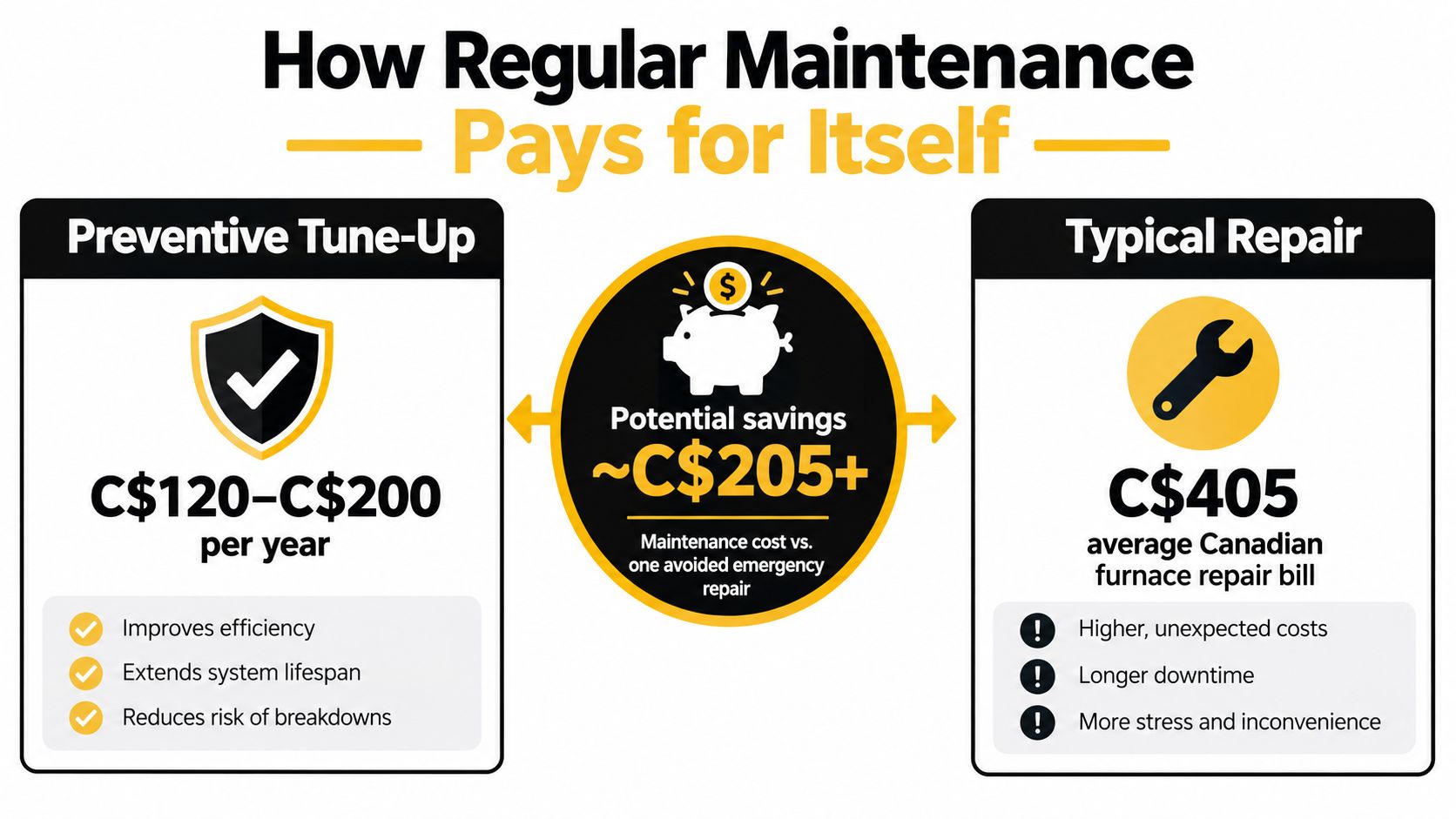
A Canada-oriented furnace source cites an average furnace repair bill of about C$405, with repairs ranging from roughly C$87 to C$2,025. Carrier Canada's furnace tune-up guidance provides that repair-cost context and explains why annual servicing is generally recommended before the heating season.
The value is in catching the small fault
A technician may find a dirty flame sensor, restricted burner, weak electrical connection, or worn capacitor during a planned visit. Some findings need immediate correction, while others can be monitored and scheduled. Either way, the homeowner gets information before the furnace fails without warning.
The tune-up doesn't guarantee that a furnace won't break down. It does give the technician an opportunity to test safety controls and identify conditions that a thermostat test won't reveal. That distinction matters because preventive service is risk management, not a promise of perfect operation.
Efficiency is part of the equation
A furnace that burns cleanly and moves air properly has a better chance of delivering heat without unnecessary strain. Cleaning and calibration can support stable operation, but homeowners should be cautious about anyone promising a fixed reduction in utility bills without measuring the system and understanding the home's envelope, ductwork, thermostat settings, and fuel use.
The practical payoff can be immediate if service identifies a problem before it damages another component. It can also be less visible, such as avoiding a late-night service call or discovering that a filter is restricting airflow. Those benefits are why the cost should be judged against the condition and risk of the particular furnace, not against a generic maintenance promise.
How to Get an Accurate Quote Before You Book
A phone quote is only as good as the information you provide. Before calling, record the furnace make and model, fuel type, location, access route, last service date if known, and any symptoms such as unusual sounds, short cycling, weak airflow, or a yellow flame.
Then use a direct script:
“I need annual service for a gas furnace in Greater Vancouver. Is your price for a full tune-up or only a safety inspection, and what exactly is included?”
Ask these five questions
What service am I buying? Ask the contractor to define “tune-up,” “maintenance,” and “safety inspection.” Those terms can describe different scopes, so don't assume a low price includes the same work as a full visit.
Who will perform the gas work? Confirm that the technician is a qualified gas fitter and ask about the contractor's licensing where relevant. A company that can't answer clearly hasn't given you enough information to approve gas appliance service.
Are combustion analysis and heat-exchanger inspection included? These are important distinctions between a quick visual check and a deeper safety assessment. Ask whether calibrated carbon monoxide instrumentation is used for combustion analysis.
What are the call-out and minimum diagnostic charges? The service price may include travel, or it may be separate. Ask what happens if the technician finds a fault and needs to diagnose it beyond the maintenance scope.
Does the quote account for access? Tell the contractor if the furnace is in a crawl space, attic, tight closet, or strata mechanical area. A quote based on an accessible basement furnace may not apply to a difficult installation.
A binding price usually requires the contractor to understand the equipment, location, access, timing, and requested scope. A flat phone number before those questions are answered is often a placeholder, not a final promise. Get the scope in writing, including tax treatment, after-hours pricing, and whether repairs require separate approval.
Red Flags That Mean a Cheap Quote Is Not a Deal
A low furnace tune up cost can be reasonable when it matches a limited, clearly described service. It becomes a warning sign when the contractor cannot explain what the technician will inspect, test, or record. A cheap quote may cover little more than a visual check, while a proper visit may include combustion testing, safety controls, burner condition, airflow, and heat-exchanger inspection.
Ask for the scope before booking. Phrases such as “furnace check” or “maintenance” are too vague for a useful comparison. The written quote should identify the tasks included, the equipment being serviced, and whether findings or test results will be documented.
Watch for these warning signs
- No combustion clarification: The contractor will not confirm whether combustion analysis is included or whether calibrated carbon monoxide instruments are used.
- Unclear gas qualifications: The booking staff cannot tell you who will perform the gas appliance work or what qualification applies.
- No written price conditions: The quote leaves out crawl-space or other difficult access, after-hours timing, call-out fees, diagnostic charges, tax, or the process for approving repairs.
- Pressure to authorise unrelated work: The technician identifies one issue, then immediately recommends several repairs without showing the evidence, explaining the urgency, or giving separate prices.
- A price far below the local range: A number well below the commonly published B.C. band from C$129 to C$220, documented in the earlier Canada furnace maintenance pricing guide, calls for a scope comparison rather than automatic approval.
A rushed visit can miss a combustion or heat-exchanger concern, while an overlooked worn component may contribute to a later breakdown. That does not make every low quote unsafe. It means the contractor needs to show exactly what the price buys and what it does not include.
Separate maintenance findings from sales pressure. A credible technician can explain what was tested, show the relevant evidence, identify whether the issue requires immediate attention, and give you time to consider repairs when immediate action is not required. If the furnace has an active safety concern, follow the technician's instructions and stop operating it until the problem is properly assessed.
Encano Plumbing & Drainage Ltd. provides furnace tune-ups and heating, gas, plumbing, and drainage service for homeowners and property managers across Greater Vancouver, with scheduled appointments and 24/7 emergency response. For a clear discussion of furnace access, service scope, and timing, visit Encano Plumbing & Drainage Ltd. and request a quote before the next cold snap.