
You can tell winter is coming in Vancouver when the furnace starts doing just enough to keep the house barely comfortable. The bedrooms feel cooler than the hallway, the basement air is damp, and the system seems to run longer than it did last year. That's usually the point where a furnace tune up stops being an abstract maintenance task and becomes a practical decision about heat, safety, and whether you want a small problem turning into a mid-season breakdown.
Table of Contents
- What a Furnace Tune Up Actually Is
- What Technicians Inspect Step by Step
- Benefits of a Furnace Tune Up Explained
- DIY Furnace Care Versus Hiring a Professional
- Warning Signs You Need a Tune Up Now
- How Much a Furnace Tune Up Costs in Greater Vancouver
- How Often to Schedule a Furnace Tune Up
- What to Expect From an Encano Furnace Tune Up
What a Furnace Tune Up Actually Is
A Burnaby homeowner usually notices the need in a plain, annoying way. The thermostat is set where it's always been, the furnace is running, but the house still feels uneven and slow to recover on a cool November morning. At that point, a furnace tune up is not a guess or a sales pitch. It's a maintenance visit that checks whether the furnace is operating safely, cleaning what's dirty, and measuring whether the system is still performing the way it should.
A tune up is like a car service, not a tow truck call. A repair visit happens when something has already failed, or when a part is clearly broken. A tune up is the preventive check that catches wear, dirt, weak airflow, and unsafe operating conditions before they turn into that failure.
Basic cleaning, safety check, and diagnostic visit
A basic service visit might include cleaning key parts and replacing a filter if needed. A combustion and safety check goes further, because gas furnaces need verification of venting, flame quality, and safe operation. A diagnostic visit is what you need when there's already a symptom, like short cycling, weak heat, or an unusual smell, because the technician is then tracing a specific fault instead of doing routine upkeep.
That difference matters in coastal British Columbia. In damp homes, especially where the furnace sits in a basement, crawlspace, or utility room, moisture and intermittent use can create problems that don't show up as dramatic failures right away. A tune up is often where those issues get found while they're still manageable.
Practical rule: if the furnace still runs but the heat feels weaker, noisier, or less even, a tune up is usually the right first move. If it won't start, shuts down repeatedly, or you smell gas, that's no longer a tune up conversation.
What Technicians Inspect Step by Step
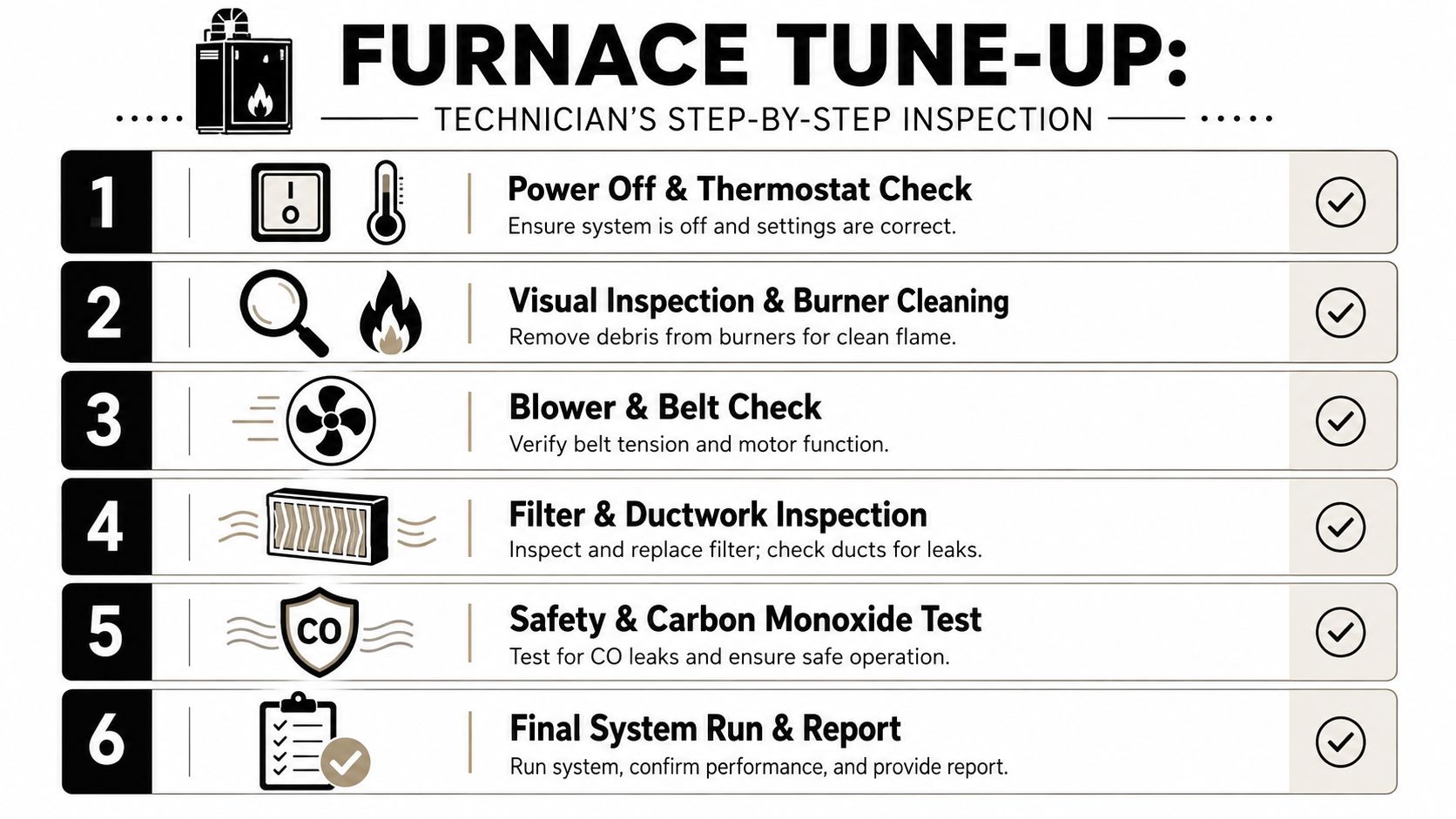
A furnace tune-up starts with a controlled look at the whole system, not a quick spray and a glance at the burners. In a Greater Vancouver home, I usually want to check the cabinet, venting, intake, condensate path, and the space around the furnace before I touch the controls. Coastal humidity leaves a clear trace. Rust, moisture streaks, blocked intakes, and a dirty filter often say more about the system's condition than the thermostat setting does.
From there, the technician moves through the parts that affect safety, airflow, and heat transfer. Burners need to be clean enough to hold a steady flame. The blower has to move enough air to carry that heat through the house. A technician who understands airflow in a furnace looks beyond the heat source itself, because weak airflow often shows up first as uneven rooms, long run times, or short cycling, especially in homes where the furnace has sat idle through mild weather.
The order matters
A proper visit starts with the obvious items and ends with measurements. That sequence matters because a dirty filter, loose belt, or blocked condensate line can skew the readings later in the job. If those basics are left in place, the numbers can look normal or look wrong for the wrong reason.
The checks that matter most are the ones that show how the furnace is operating under load. Line voltage, motor amperage draw, temperature rise across the heat exchanger, and combustion analysis help confirm whether the system is working within expected limits. Temperature rise matters because it shows whether the furnace is moving enough air for the heat it is making. If that reading is off, the technician can look at airflow, blower performance, or gas input instead of guessing.
Combustion analysis is the safety check that should not be treated as optional on gas equipment. Checklists for furnace service call for keeping carbon monoxide and flue-gas readings within safe operating limits, and a visual inspection alone cannot confirm that. I have seen furnaces that looked acceptable from the outside but were running with poor flame sensing or weak combustion. That is why the safety readings matter more than a clean-looking cabinet.
The technician also looks at the items that usually matter more in damp coastal homes than they do in dry climates. Corrosion around the cabinet, oxidation on fittings, moisture near the venting, and signs of condensate backup can point to problems that are still small enough to fix during a routine visit. Those checks separate a safe, useful tune-up from a quick cosmetic wipe-down, and they help identify when a furnace repair may be needed before a small issue turns into a shutdown.
The video below gives a good visual of what a structured tune-up process can look like on site.
A furnace can still heat the house while running outside its ideal range. The tune-up catches that gap before it becomes a repair call.
Benefits of a Furnace Tune Up Explained
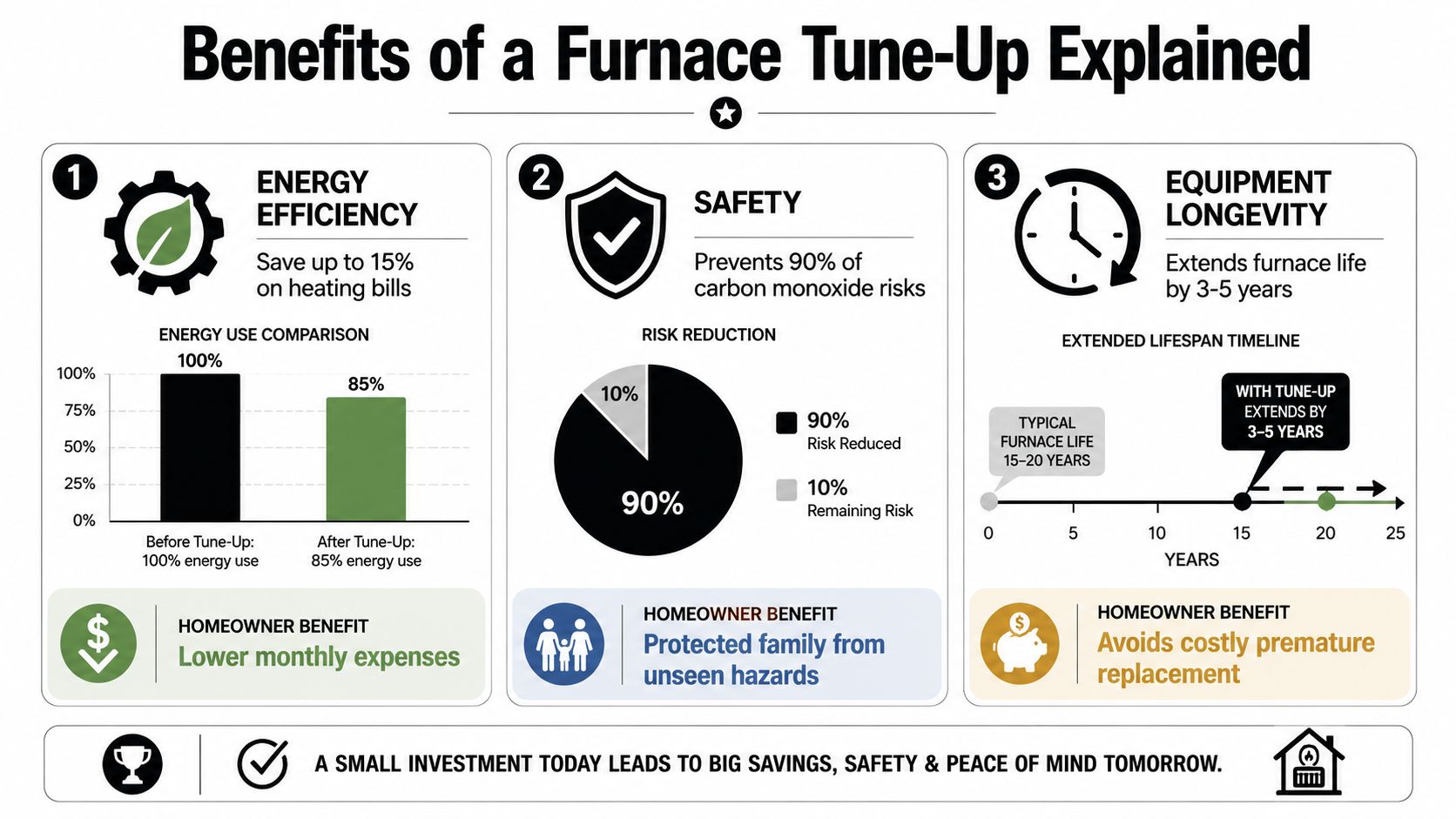
The payoff for furnace tune ups falls into three buckets, and they're not equally visible to homeowners. Efficiency is the one people notice on the gas bill. Safety is the one nobody wants to test the hard way. Longevity is the one that matters when you're trying to avoid replacing a furnace before it's worn out.
Energy efficiency
A published maintenance breakdown says a tune up can improve furnace efficiency by 5% to 20% and estimates $395.44 in annual fuel savings at the high end, with $5,931.63 in fuel savings over 15 years and $2,250 in tune-up costs for yearly maintenance Husky Air furnace tune-up infographic. That math is useful, but the practical point is simpler. Clean burners, correct airflow, and proper calibration help the furnace turn more of the fuel you already pay for into useful heat instead of waste.
A Minnesota state energy model also shows how routine maintenance can create measurable fuel savings, estimating 0.97 Dth of annual savings for a 60,000 Btu/h single-family furnace under its assumptions Minnesota technical energy reference. The model isn't BC-specific, but it gives a concrete benchmark for how even routine tune ups can reduce fuel use in systems that run through long heating seasons.
Safety and lifespan
Safety is where the money argument stops being the main point. Heat-exchanger checks, gas-leak testing, vent inspection, and combustion analysis are the parts that look for unsafe conditions before they become household problems Arpis furnace maintenance brochure. A cracked heat exchanger can allow combustion products into supply air, and a blocked vent or condensate drain can trigger lockouts or repeated shutdowns. Those aren't comfort issues, they're system-integrity issues.
Safety first: if the tune up doesn't include combustion and venting verification on a gas furnace, you're not getting the full value of the visit.
The longevity case is easier to understand. Industry maintenance data ties regular tune ups to the working life of a furnace with an average lifespan of 15 years and calculates $3,681.63 in total net savings over that span when annual maintenance is kept up Husky Air furnace tune-up infographic. A furnace that stays cleaner, stays properly adjusted, and avoids repeated stress cycles usually lasts longer and behaves more predictably through the heating season.
DIY Furnace Care Versus Hiring a Professional
Homeowners can absolutely do some furnace care themselves, and they should. A clean filter, clear vents, and a thermostat that's set correctly are all part of keeping the system healthy. The mistake is thinking those tasks cover the same ground as a real tune up.
What you can safely handle
Changing the filter is the most useful homeowner task, and it's also the one homeowners skip the longest. Keeping supply and return grilles clear, making sure storage isn't blocking the cabinet, and checking that the thermostat responds properly are all reasonable DIY steps. Those jobs help airflow and make it easier for the furnace to do its work without strain.
What belongs to a technician
Combustion analysis, gas pressure adjustment, heat-exchanger inspection, electrical testing, and any work tied to warranty documentation belong with a trained gas technician. Those are the checks that require instruments, experience, and a clear understanding of what safe readings look like. A homeowner can notice a problem, but shouldn't be the one trying to calibrate gas delivery or interpret combustion results.
That boundary is especially important when the symptom seems small. A Richmond homeowner may swap a filter and still notice weak heat in one part of the house. That's often the clue that airflow, blower performance, or another mechanical issue is still there, which is the point where a professional tune up becomes more than a convenience. If the issue is drifting into repair territory, it's worth looking at gas furnace repair before the first hard cold snap.
Dr HVAC's maintenance checklist is a good example of how broad the work can be, from burners and flame sensors to condensate lines, safeties, and amp readings Dr HVAC furnace tune-up checklist. That's why a technician visit is not just a nicer version of a DIY clean. It's a different level of inspection.
If you're comfortable changing a filter, do that. If you're trying to decide whether a gas furnace is safe and calibrated, call a professional.
Warning Signs You Need a Tune Up Now
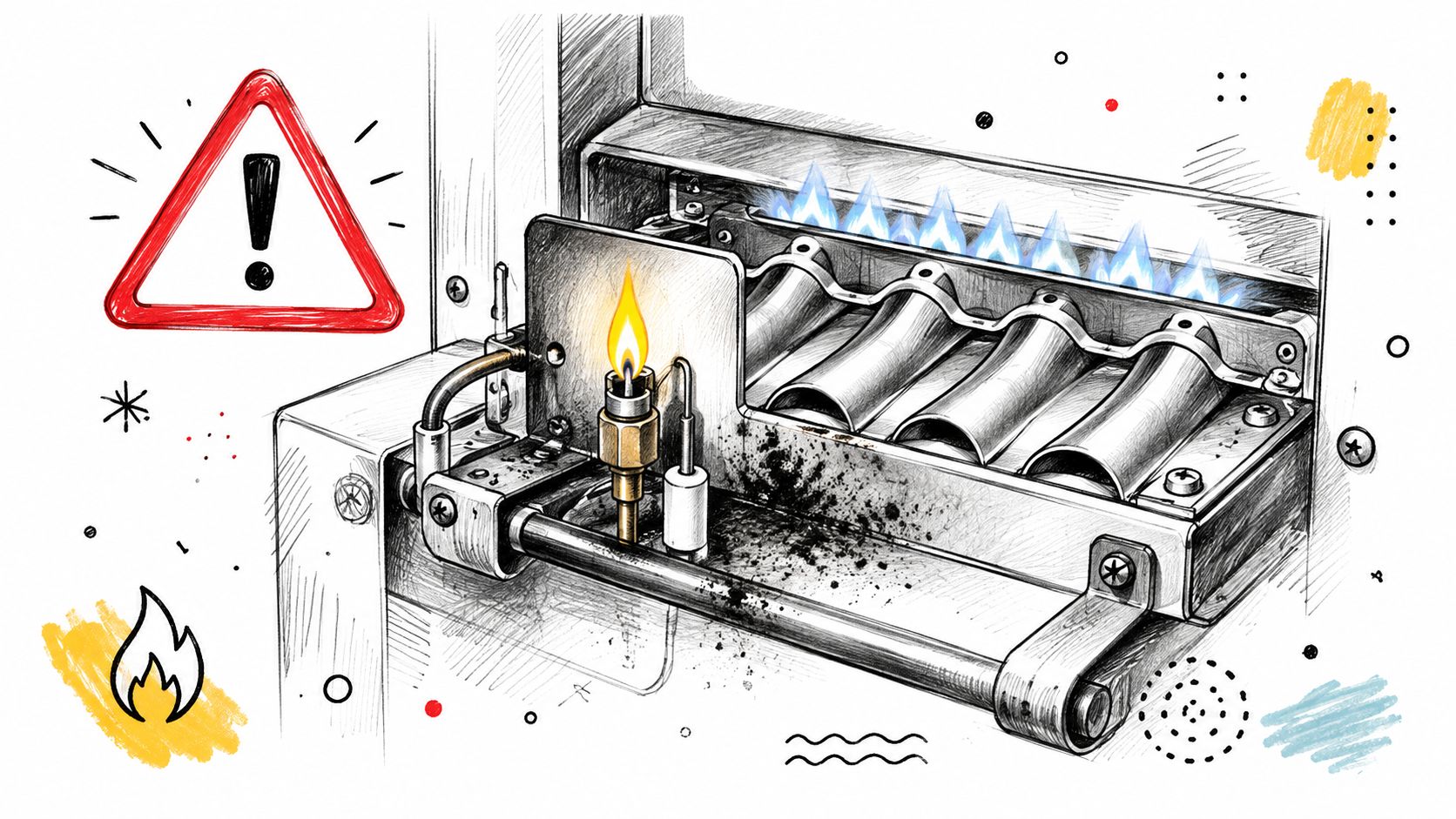
The signs that matter most usually cluster into three urgency levels. Some need a technician this week. Some should be booked this month. Some are a reminder to schedule before winter gets serious.
Book this week
A yellow burner flame, soot around registers, or a gas smell near the furnace needs fast attention. Those symptoms point to combustion or venting problems, and they're not the kind you wait on. Persistent cold rooms can fall into this group too, especially if the furnace is running but not delivering even heat.
Book this month
Short cycling, rising gas bills, and weird humidity swings are the quieter warning signs. In a Vancouver row house, a musty smell in January can turn out to be a slow condensate drain, which is a classic high-efficiency furnace issue in wet weather. In a Burnaby home, rising gas use can trace back to a dirty flame sensor that keeps interrupting normal operation before the homeowner ever sees a hard failure.
Book this season
If the furnace still starts, but it sounds different, takes longer to warm the house, or the air feels inconsistent room to room, the system is telling you it's overdue for attention. That's especially true in homes that sit unused for long stretches during shoulder seasons, then get asked to work hard when temperatures dip. Moisture and corrosion don't always announce themselves loudly in coastal BC, they often show up as a pattern of small annoyances first.
One useful habit is to do a fall walk-through before the first sustained cold spell. Listen for odd burner behaviour, smell for anything off, and check whether the furnace cycles normally. The earlier those clues are caught, the simpler the service call tends to be.
How Much a Furnace Tune Up Costs in Greater Vancouver
For a lot of homes in Greater Vancouver, the price question starts with what the technician can reach and test. Carrier places a typical tune up at $70 to $200, with more elaborate services or annual plans running $150 to $400 Carrier furnace tune-up guide. That benchmark helps, but local pricing often lands differently because contractors have to account for travel, labour, access, and the condition of the equipment. A furnace packed into a tight townhouse mechanical room takes more time than one sitting in an open basement, and coastal humidity can leave more corrosion on fasteners, burners, and venting parts than a dry inland home.
Furnace Tune Up Pricing Tiers
| Service Tier | Typical Price Range | What Is Included |
|---|---|---|
| Basic visit | Lower end of the published market range | Filter check, visual inspection, basic cleaning, and a simple operational run |
| Standard tune up | Mid-range of the published market range | Cleaning, blower and burner inspection, thermostat check, safety verification, and performance checks |
| Full pre-season service | Higher end of the published market range | Broader diagnostic work, combustion analysis, condensate inspection, and more detailed reporting |
The service level matters more than the sticker price. A low-cost visit that skips combustion checks or condensate inspection may leave the problem untouched, especially in a high-efficiency furnace that sees damp Vancouver weather and long idle periods between heating cycles. Ask exactly what the price covers before comparing quotes from Vancouver, Richmond, or Surrey.
Gas work also needs to be handled as licensed work, not a casual handyman task. That matters for safety and compliance, especially if the visit involves adjustments, repairs, or written maintenance on a gas appliance. If a contractor cannot explain what they will measure, what they will clean, and what they will report, the quote is too vague.
A practical price conversation should also cover access, furnace age, and whether the system has a condensate drain or high-efficiency venting. Older furnaces and tighter utility spaces take longer to service, and that time shows up in the price one way or another. If the repair cost starts to approach a meaningful share of a replacement, it can also help to review new furnace costs before deciding whether to keep putting money into the old unit.
How Often to Schedule a Furnace Tune Up
The practical rule is once a year, before the heating season starts. In coastal BC, that timing matters because a mild winter can make a furnace seem low-use, but humidity, salt air, and long idle periods still leave their mark between cold spells. A unit may not rack up the same run time as one in a colder province, yet damp conditions still create wear points that deserve attention.
Trane says the recommended frequency for a heating tune up is ideally once a year before the heating season starts Trane furnace tune-up guide. IndoorTemp also says the safest approach is a furnace tune up once a year, just before the cold months IndoorTemp HVAC tune-up benefits. Their broader maintenance guidance also points to one tune-up for heating and one for cooling, for two total HVAC tune-ups per year.
Schedule it once a year, ideally in early fall. By the time the first sustained cold spell hits Vancouver, the good appointment slots are usually already gone.
Timing also affects warranty protection. Maintenance records matter if a manufacturer asks whether the furnace was serviced properly, and routine documentation helps show the appliance was not neglected. The practical payoff is straightforward. When a technician has already checked the system before winter starts, you are less likely to find a weak blower, blocked vent, or drain problem during the coldest week of the year.
For homeowners who like a calendar rule, put furnace service into the same fall routine as gutter cleaning and weatherstripping checks. That keeps the visit close to the season where it matters most.
What to Expect From an Encano Furnace Tune Up
An Encano visit in Vancouver, Richmond, Burnaby, Surrey, or New Westminster should feel organised from the first few minutes. The technician should arrive ready to inspect, clean, test, and report, not just glance at the furnace and leave. For a homeowner or strata manager, the right question isn't whether the furnace “seems fine,” it's whether the service matched the checks that a gas appliance needs.
A solid visit usually starts with system access, then moves into a visual inspection of the furnace cabinet, venting, condensate, and surrounding area. From there, the technician should clean the key components that affect flame quality and airflow, verify safety controls, and run the unit long enough to confirm stable operation. If the furnace condition calls for it, Encano can also handle furnace repairs as part of the same broader service relationship, which is useful when a tune up uncovers something more than routine maintenance.
A quick checklist to confirm the visit was complete
- Safety and setup: power-off verification, thermostat check, and cabinet inspection.
- Core cleaning: burners, blower area, and debris around the unit.
- Measurement: airflow, temperature rise, gas-related checks, and combustion verification where applicable.
- Drainage and venting: condensate line, vent path, and signs of blockage or leakage.
- Final test: system run, note of any abnormal noise or cycling, and clear reporting.
That's the standard to hold any contractor to. If the technician can explain what they found, what they cleaned, and what readings they checked, you're getting the kind of furnace tune up that protects comfort and catches problems early.
For Greater Vancouver homeowners who want that work handled by a local team with 24/7 availability and transparent pricing, book the visit before the next cold spell turns a maintenance issue into an emergency.
Encano Plumbing & Drainage Ltd. handles furnace tune ups, furnace repairs, and related heating service across Vancouver, Richmond, Burnaby, New Westminster, Delta, Surrey, and nearby communities. If your furnace is running but not quite right, visit Encano Plumbing & Drainage Ltd. to book a local visit and get the system checked before the weather turns colder.