

You're standing in a Richmond utility room with a leaking tank, or looking at a cramped Vancouver condo closet where every centimetre matters. The replacement choice seems simple: install another hot water tank, or switch to hot water on demand. In practice, the right answer depends on your household's peak use, available gas or electrical service, strata rules, maintenance tolerance, and the rebates currently available in British Columbia.
The usual tank-versus-tankless comparison also misses a serious third option. A heat pump water heater can change the financial calculation for some Greater Vancouver homes, especially where local incentives apply. The most efficient-looking choice on a brochure may not be the least expensive or easiest system to own over the next decade.
| Decision factor | Conventional hot water tank | Hot water on demand | Heat pump water heater |
|---|---|---|---|
| How it heats water | Stores and reheats water | Heats water as it flows | Transfers heat into stored water |
| Main strength | Lower upfront complexity | Compact design and continuous supply when correctly sized | Potentially attractive rebate-supported efficiency |
| Main limitation | Standby losses and tank-leak risk | Flow limits, installation requirements, and servicing | Space, noise, airflow, and eligibility requirements |
| Best fit | Straightforward replacement and moderate demand | Space-conscious homes with suitable service | Homes that qualify for BC incentives and can accommodate the equipment |
Table of Contents
- Understanding Tank and Tankless Water Heaters
- Energy Efficiency and Operating Costs
- Upfront Price, Lifespan, and Total Ownership Cost
- Sizing and Flow Requirements for Your Home
- Real Vancouver Use Cases and Scenarios
- The Hidden Factor – Local Rebates and Maintenance Reality
- Making the Right Choice for Your Home
Understanding Tank and Tankless Water Heaters
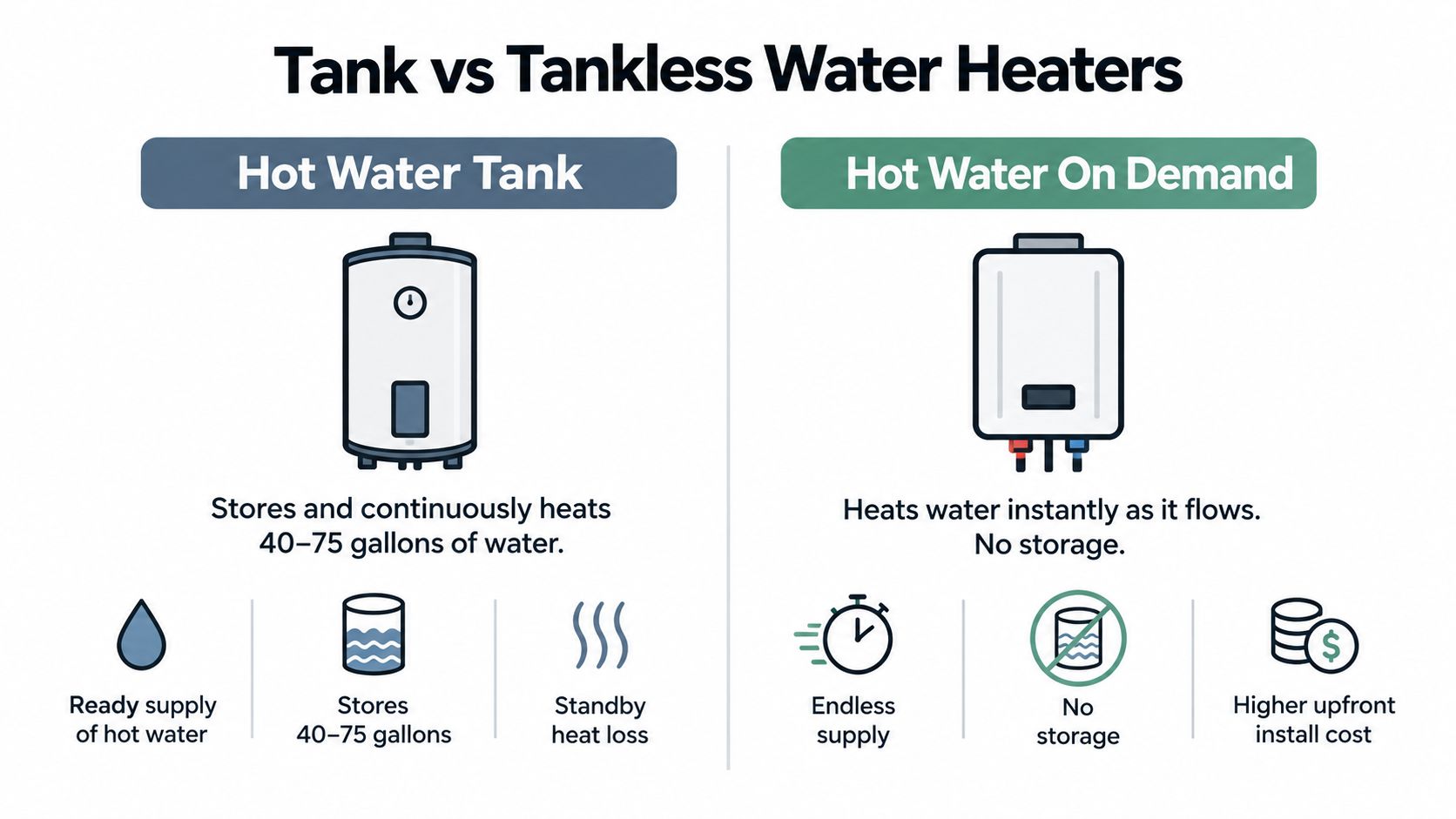
A conventional hot water tank keeps a reserve of heated water inside an insulated cylinder. The burner or electric elements cycle on and off to maintain that supply, even when nobody is showering. That design is familiar, relatively straightforward to replace, and forgiving when several people use hot water close together, provided the tank has enough stored capacity.
A hot water on demand, or tankless, system has no large reservoir. Open a tap and water moves through a heat exchanger, where the unit heats it as it passes. Close the tap and the main heating cycle stops. That removes the tank's stored volume and its standby heat loss, but it makes the unit's flow capacity and installation conditions more important.
For a deeper explanation of the operating principle, see this guide to how a tankless water heater works.
The ratings answer different questions
Storage tanks are commonly judged by a first-hour rating, which describes how much hot water the unit can deliver during a busy period, including its stored supply and recovery. Tankless units are judged by gallons per minute, or GPM, which describes how much water they can heat continuously under specified conditions.
That distinction matters. A tank may satisfy a short burst of heavy demand because it has water ready in reserve. A tankless unit can keep producing hot water, but only within its available flow and temperature-rise limits. A shower, kitchen tap, and washing machine running together may be comfortable with one model and disappointing with another.
Practical rule: Don't compare a tank's storage volume directly with a tankless unit's GPM. They measure different kinds of capacity.
Energy Efficiency and Operating Costs
Tankless systems generally use less energy than storage tanks, but the difference depends on fuel source, model, installation quality, and household demand. Natural Resources Canada reports an average Energy Factor of 0.85 for gas-fired tankless water heaters compared with 0.62 for gas-fired storage tank water heaters in its Canadian water-heater guide.
A storage tank repeatedly reheats water that may sit unused. Tankless equipment avoids that standby process and sends more of its input fuel toward producing hot water. California's energy analysis cites a 0.675 efficiency standard for common natural-gas storage water heaters and 0.82 or higher for instantaneous natural-gas models in its building-energy documentation.
NRCan also states that ENERGY STAR certified tankless water heaters use about 30% less energy on average than standard storage-tank types, while warning that simultaneous hot-water delivery can be limited. That limitation matters more than the headline efficiency figure in many Vancouver homes.
Efficiency isn't the same as lower bills in every house
A tankless unit may use less energy per litre of hot water, but the household must use enough hot water for the savings to matter. A small household with modest demand may not recover a higher installation cost quickly. A high-use home may see a clearer benefit, particularly when an older tank loses heat or reheats water throughout the day.
Fuel and electrical service can change the result. Older Vancouver homes may need upgraded gas piping, venting, or combustion-air arrangements for a high-output gas tankless unit. Electric tankless models can require substantial electrical capacity, which may not be practical in an older house or a condo with strata-controlled electrical infrastructure.
A heat pump water heater deserves a place in the same comparison. In Greater Vancouver, local rebates can make one less expensive to own than either a conventional tank or standard tankless system, depending on eligibility, available space, electrical service, and strata approval. Its efficiency advantage does not remove the need to check noise, condensate drainage, room temperature, and service access.
Peak demand can erase brochure expectations
Tankless systems provide hot water continuously only within their flow and temperature-rise limits. In Vancouver's cooler incoming water conditions, the unit must raise the water temperature further than it would in a warmer climate. That leaves less flow available when showers, laundry, and kitchen use overlap.
California's life-cycle comparison found that tankless units could reduce annual energy use by 2,800 MJ, about 16%, and lower global-warming emissions by 175 kg of CO2 per year, according to the same California analysis. Those figures support the efficiency case, but they do not replace a load calculation. Over a decade, actual operating cost also depends on water use, utility rates, maintenance, and whether the home can support the required gas or electrical installation.
Upfront Price, Lifespan, and Total Ownership Cost
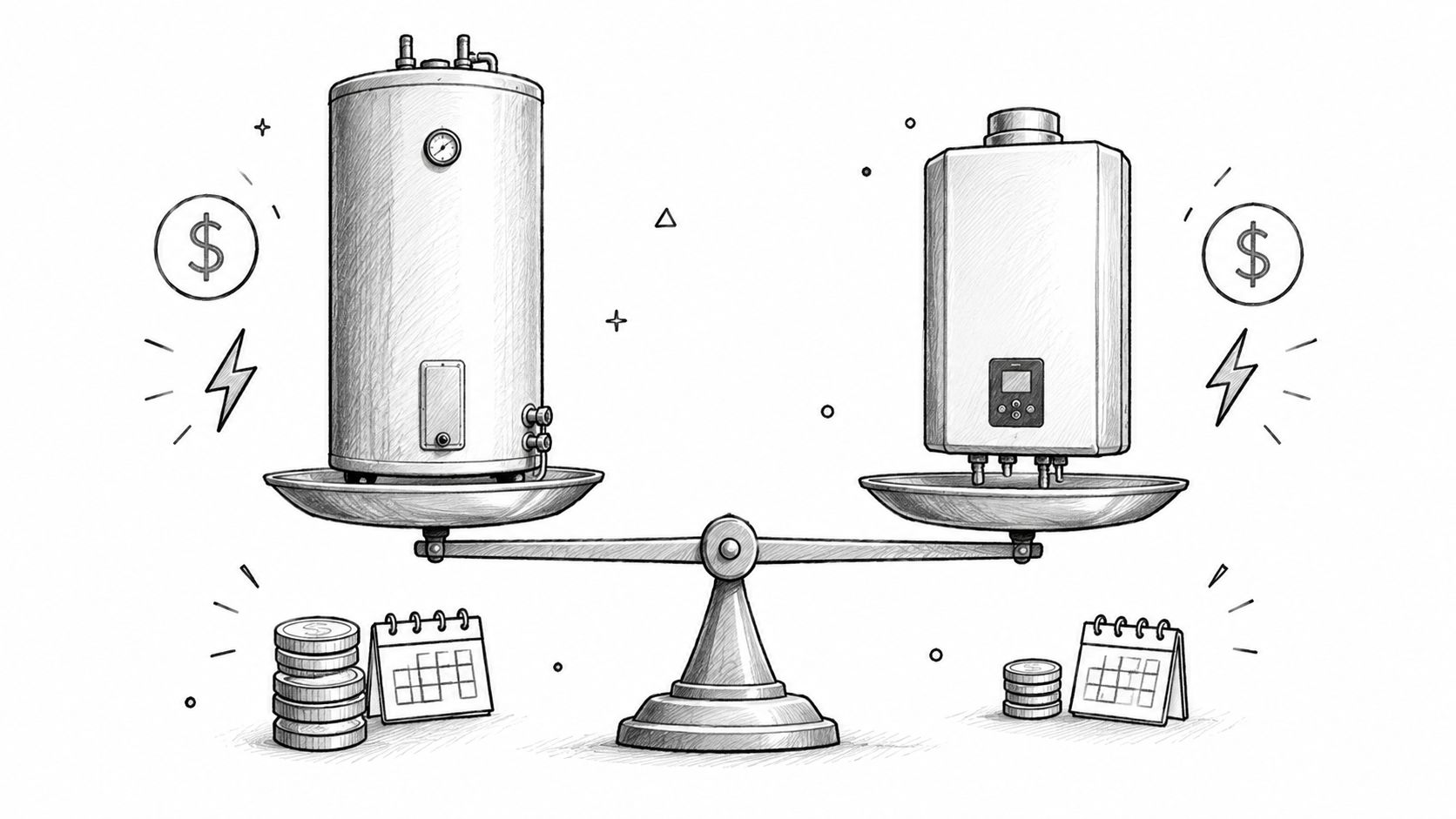
The least expensive installation is often another storage tank, particularly when the existing gas, electrical, venting, water connections, and drain arrangement can be reused. A tankless conversion may involve more than hanging a compact box on the wall. The contractor may need to assess gas capacity, venting, condensate drainage, electrical supply, isolation valves, water pressure, and the route for service access.
For a broader look at the factors that shape the bill, use this practical guide to water heater replacement cost. The useful question isn't just, “Which unit costs less today?” It's, “What will this installation cost to own, maintain, repair, and replace in this particular building?”
The ownership calculation
A tank usually offers a simpler replacement path and a lower initial price. Its failure mode can be abrupt, however. Once the cylinder corrodes, a leak can damage flooring, storage areas, or the suite below, which is a serious concern in condos and stacked townhomes.
Tankless equipment avoids a large stored vessel and can provide continuous hot water when correctly sized. It also brings more components that need diagnosis, including sensors, flow controls, heat exchangers, venting, and condensate arrangements on condensing gas models. Mineral buildup can restrict heat transfer and flow, so the owner needs to budget for proper servicing rather than treating the unit as maintenance-free.
A practical ten-year view
Create three columns before accepting a quote:
- Installation: Include equipment, gas or electrical modifications, venting, drainage, permits, and access work.
- Running cost: Compare the expected energy use with your household's actual demand, not a showroom scenario.
- Service and risk: Account for descaling, repairs, emergency response, water damage exposure, and replacement disruption.
A cheaper tank can remain the sensible choice when the household has moderate demand, the installation is uncomplicated, and the owner values easy access to parts and service. Tankless can make more sense when space is tight, hot-water demand is steady, and the building can support the installation without expensive upgrades. Heat pump incentives may shift that calculation again, particularly for an electrically suitable home.
Sizing and Flow Requirements for Your Home
Sizing starts with routine, not floor area. Write down what tends to run during your busiest period. A morning schedule might include a shower, a second shower, the kitchen tap, and a dishwasher filling. A basement suite or laneway home may share demand with the main residence, making the peak period less obvious than the number of occupants suggests.
For a tank, compare the household's busy-period demand with the model's first-hour rating. The rating reflects both the stored hot water and the unit's recovery ability. A tank that seems adequate based only on its physical volume may struggle if several fixtures draw water before the burner or elements can recover the supply.
A tankless unit requires a different calculation. Add the expected hot-water flow of the fixtures that may operate together, then confirm that the proposed model can deliver that flow at the required temperature rise. The unit's GPM rating isn't a universal promise because incoming water temperature, target temperature, and gas or electrical input affect actual output.
A practical morning example
Suppose one person showers while another uses the kitchen sink. The tankless unit must heat both flows at the same time. If a third fixture starts, the system may reduce flow, deliver cooler water, or need the household to stagger use, depending on its capacity and controls.
That's why a model with an impressive efficiency label can still disappoint. Efficiency tells you how effectively the unit uses energy. It doesn't tell you whether the unit can meet your busiest simultaneous demand.
Check the building before choosing the equipment
A qualified assessment should cover:
- Incoming water temperature: Vancouver-area winter conditions affect the temperature rise the heater must provide.
- Fixture flow: Use actual showerheads and taps, not assumptions based on the number of bedrooms.
- Fuel and service capacity: Confirm gas-pipe sizing, venting, electrical supply, and clearances.
- Hot-water layout: Long pipe runs can create wait times regardless of heater type.
- Future use: Consider a planned bathroom, suite, renovation, or change in occupancy.
For strata owners, the review also needs to include building rules, shutoff access, noise concerns, exterior vent permissions, and responsibility for common piping. A technically suitable unit can still be the wrong purchase if the strata won't approve the required changes.
Real Vancouver Use Cases and Scenarios
A downtown condo owner may care less about theoretical peak efficiency than about floor space and approval. A wall-mounted tankless unit can free up a crowded closet, but the installation still needs safe venting, service clearance, drainage, and permission from the strata if the work affects common property. In an electrically constrained building, an electric tankless model may not be realistic, while a gas model may require a review of venting and gas service.

For that condo owner, the best system may be the one that fits the approved mechanical space and can be serviced without dismantling cabinetry. A compact unit isn't automatically a good installation if technicians can't reach the isolation valves or if the building's rules restrict the vent termination.
A Richmond family with multiple bathrooms
A family home in Richmond may have more room for equipment but a tougher demand pattern. Two showers running during the school-day rush can expose a tankless system's flow limits. A sufficiently sized model, possibly with a coordinated setup, may handle the routine well, but the contractor must measure the incoming temperature, fixture demand, and available gas capacity rather than selecting equipment from the household's floor area alone.
A storage tank may remain more forgiving for this family if the peak demand is short and the household prefers a reserve of hot water. The tradeoff is standby use and the possibility of a disruptive leak when the cylinder reaches the end of its service life.
Here's how the choice can look in practice:
- Small condo household: Space and strata approval may favour a compact system, provided service access and fuel capacity work.
- Multi-bath family home: Capacity and simultaneous use may favour a properly sized tank or a higher-capacity tankless design.
- Burnaby strata building: Standardisation, parts availability, maintenance access, and approval processes may matter more than the efficiency label.
A Burnaby strata evaluating older units should also think about repeatability. One installation that works in a single suite may not be suitable across the building if gas infrastructure, electrical panels, or mechanical closets differ.
The following video offers another visual way to compare the equipment layouts and operating concepts:
Landlords and property managers should weigh downtime as heavily as energy consumption. A system that needs specialist service or restricted parts may create a longer disruption than a familiar tank replacement, while a leaking tank can cause more immediate property damage. The right choice is the one that fits the building's approval, access, demand, and response realities.
The Hidden Factor – Local Rebates and Maintenance Reality
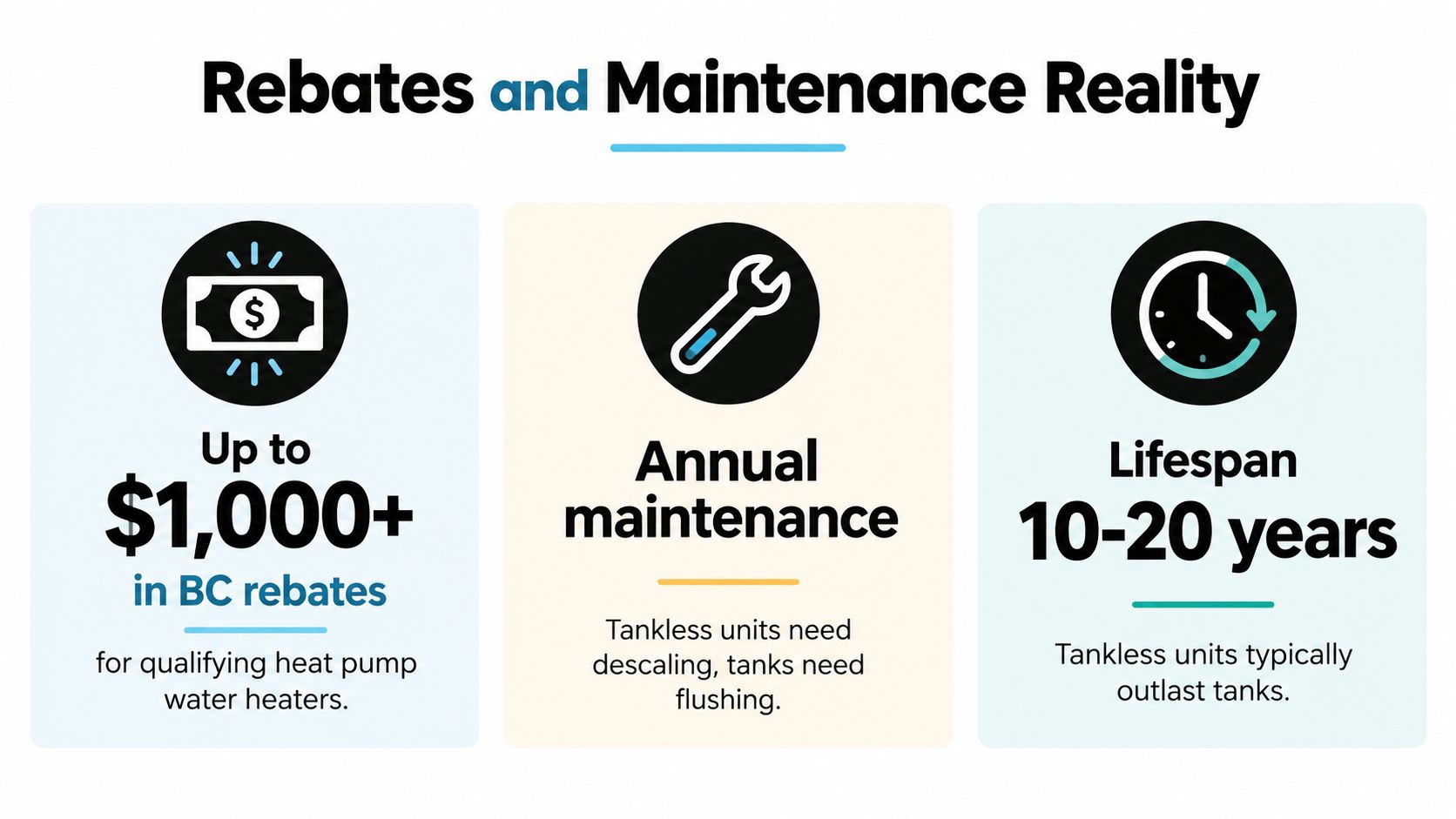
The Greater Vancouver decision is no longer limited to tank versus standard tankless. CleanBC Better Homes offers up to $1,000 for a heat pump water heater, and FortisBC offers up to $1,000 for eligible electric heat pump models, according to the CleanBC Better Homes programme requirements. Income-qualified customers may receive up to $2,500 or $3,500 in some programmes, so eligibility can materially change the project's payback.
That doesn't mean a heat pump water heater fits every Vancouver home. It needs suitable space, airflow, drainage, and an electrical supply that can support the equipment. Some models also introduce operating noise and cooler exhaust air, which can matter in a small condo utility room or an enclosed mechanical space.
Maintenance changes the ownership story
A tankless system needs attention to keep mineral deposits from restricting the heat exchanger and water flow. Descaling, filter cleaning, combustion checks, vent inspection, and control testing may require a qualified technician, particularly on gas equipment. Water quality and usage can change the service burden, so an owner shouldn't assume the maintenance schedule will match a neighbour's.
A storage tank has a different list of concerns. Sediment can collect inside the vessel, valves and connections can leak, and corrosion can eventually compromise the tank. The routine may feel simpler, but “simpler” doesn't mean “ignore it.”
FortisBC programme information indicates only limited support for tankless servicing, including a $50 maintenance rebate for eligible tankless water-heater servicing by a licensed gas contractor, as shown in this BC water-heater rebate information. Major BC incentives are directed more heavily toward heat pump water heaters, which is why a tankless quote should be compared with both the available rebate and the long-term service obligations.
For homeowners assessing heat pump water heater installation, the first step is confirming eligibility and site suitability before assuming the rebate applies. For strata managers, document who owns the equipment, who arranges servicing, where shutoffs are located, and how a failure will be handled in a tenanted unit.
Making the Right Choice for Your Home
Choose a conventional tank when low upfront complexity, familiar servicing, and a reserve of stored hot water matter most. It's often the practical answer for a household with moderate demand, an uncomplicated replacement location, and no strong reason to change the fuel or mechanical layout.
Choose tankless when your home has limited space, your household values continuous hot water, and the building can support the required gas, electrical, venting, drainage, and service access. It can be a sound long-term option, but only after the contractor sizes it around simultaneous demand and explains the maintenance plan in writing.
A heat pump water heater deserves serious consideration when the home can accommodate it and the household qualifies for available BC support. The incentives can make it more financially attractive than a conventional tank or a standard tankless replacement, but the installation environment still decides whether it will work well.
Use this final decision test:
- Budget first: If the project must stay simple and affordable today, price a like-for-like tank replacement.
- Space first: If the existing mechanical closet is the problem, assess tankless and heat pump options for clearances and service access.
- Demand first: If several fixtures run together, prioritise measured capacity over efficiency claims.
- Lifecycle first: If you plan to own the property for years, include energy, maintenance, rebates, repairs, and water-damage exposure.
Get the site assessed before choosing a model. Encano Plumbing & Drainage Ltd. provides tank and tankless water-heater installation and maintenance for homes and businesses, including diagnosis of inadequate heating and temperature fluctuations. Visit Encano Plumbing & Drainage Ltd. to arrange a practical comparison based on your home's demand, fuel service, strata requirements, and rebate options.