

Most advice about a water filtration system starts in the wrong place. People hear a sales pitch, taste a little chlorine, see a spot on a glass, and jump straight to buying hardware, even when the underlying problem might be a premise plumbing issue, a stale line, or a building-level setup that needs attention before any filter will help.
In Metro Vancouver, that diagnosis-first approach matters more than the product brochure. British Columbia reporting showed that 99.8% of population-based drinking-water systems were classified as low risk in 2021, with high-risk systems at 0.5% and medium-risk systems at 0.8% (provincial drinking-water risk-management data). That doesn't mean filtration has no place. It means the right system depends on the actual problem, not the loudest marketing claim.
Table of Contents
- Why Your Vancouver Home May Not Need a Filter Yet
- How Water Filtration Works
- The Six Main Filtration Types Compared
- Common Contaminants in Metro Vancouver Homes
- Choosing the Right System for Your Building Type
- A Real Installation Scenario in Richmond and Burnaby
- Maintenance Schedule and Real Costs
- Bringing It All Together and When to Call Encano
Why Your Vancouver Home May Not Need a Filter Yet
A lot of homeowners buy a water filtration system for the wrong reason. They're reacting to taste, odour, or one cloudy glass, when the underlying issue may be the plumbing inside the home, not the water entering the neighbourhood.
Start with the complaint, not the product
Taste and odour complaints often point to chlorine, stale water in a line, or sediment sitting in fixtures. Scale and staining point you toward hardness or fixture-related issues. Lead is different, because it's a health concern that has to be handled at the tap and in the plumbing, not just with a broader “better water” approach. Health Canada's lead guidance is aimed at reducing exposure where people drink the water, which is why the source of the problem matters so much.
Practical rule: if the complaint is isolated to one tap or one bathroom, don't assume the whole house needs filtration.
Metro Vancouver's supply is already treated and monitored, and the bigger issue in many homes is diagnosis. A house can have excellent municipal water and still deliver poor water at a sink because of old branches, long idle runs, or building materials. That's why I always ask homeowners to separate the complaint into one of four buckets, taste, odour, scale, staining, or a suspected safety issue like lead.
Use a simple self-check before you buy anything
If the water tastes bad only after sitting overnight, flushing may solve part of it. If only one fixture is affected, a point-of-use unit or plumbing repair may be the right move. If every tap has the same complaint and the building is older, then a more serious conversation about treatment or pipe condition makes sense.
A useful example is an older Vancouver condo owner who wants a whole-house unit because the kitchen water tastes flat. In many cases, the actual fix is a targeted tap-level solution or a plumbing inspection, not a large system that treats showers and laundry as well. The right answer starts with the symptom, then the piping, then the filter, not the other way round.
How Water Filtration Works
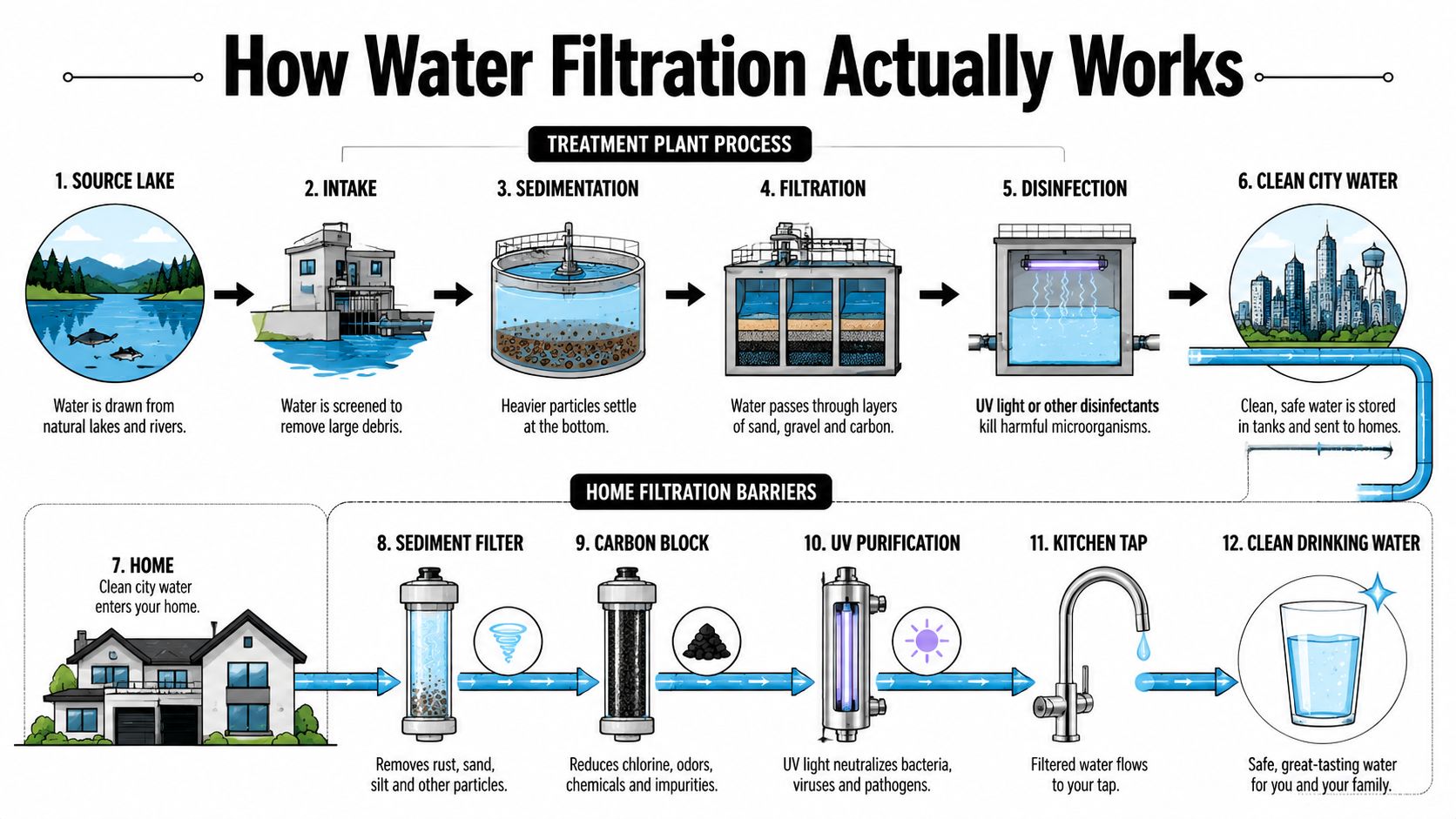
A water filtration system makes more sense when you treat it as a series of checkpoints. Water leaves the source, goes through municipal treatment, moves through the distribution network, then enters the home where one more barrier can clean up what is left before it reaches the tap.
Think in layers, not miracles
Mechanical filtration catches physical debris. That includes sand, rust, and fine particles that make water look cloudy or leave grit in a faucet screen. Activated carbon works differently, it adsorbs compounds that affect taste and odour, especially chlorine-related complaints. Reverse osmosis is a tighter barrier, and the provided technical purification specification notes RO membranes can achieve 94% to 99% ionic rejection, which is why RO is used when the goal is to reduce dissolved content rather than just remove visible sediment.
UV sits at the end of the line. It does not remove particles or dissolved contaminants, it inactivates microorganisms when the water is clear enough for the light to do its job. That is why good systems stage sediment prefilters, carbon, RO, and then a polishing step before UV if UV is part of the design.
Practical rule: the dirtier or more complex the water problem, the more important staging becomes.
Know the difference between point-of-entry and point-of-use
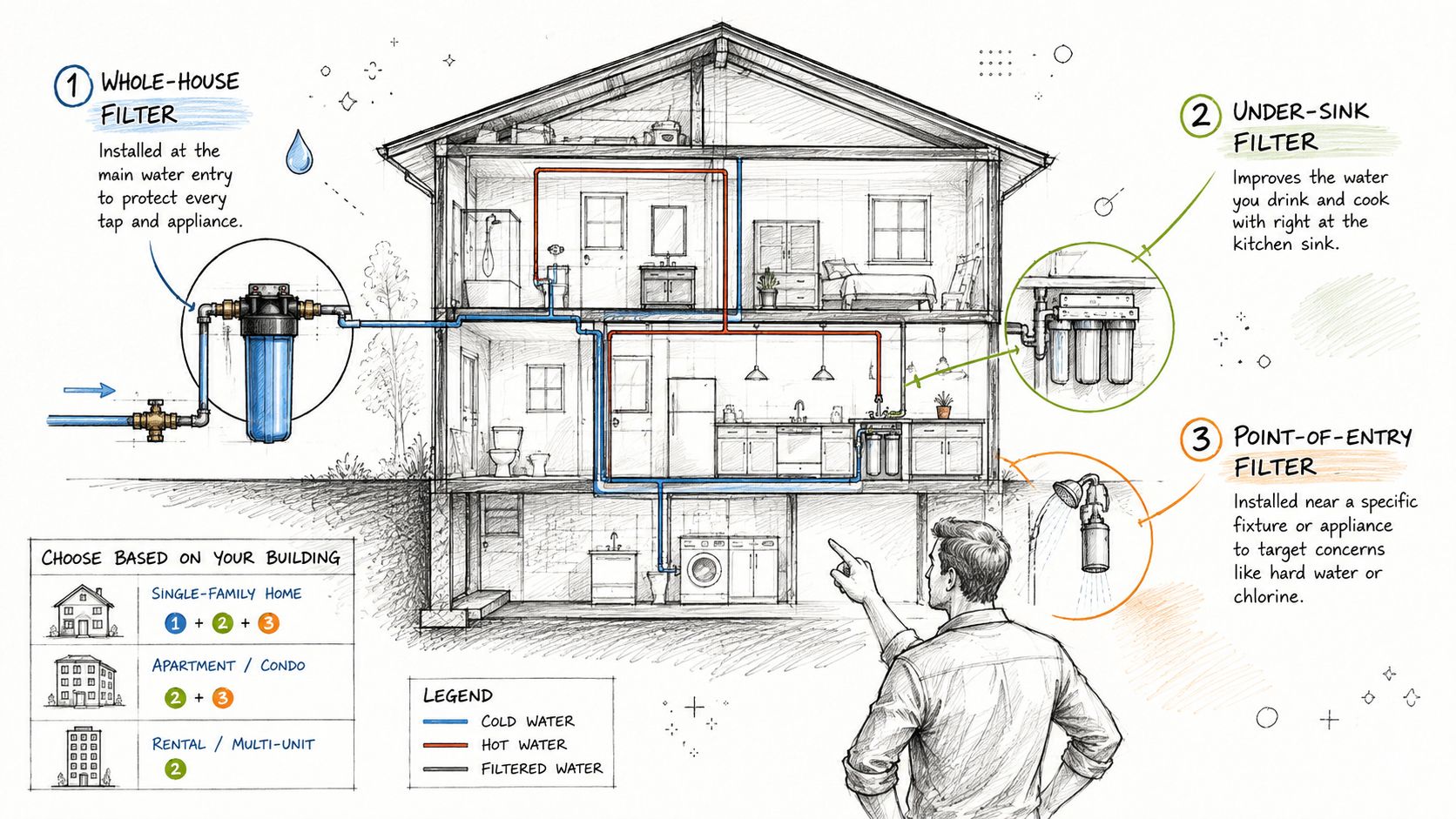
Point-of-entry treatment handles all the water entering the building. That makes sense when the whole home or strata needs protection for showers, laundry, and fixtures. Point-of-use treatment handles one sink or one drinking tap. That is the better fit when the problem is specific, such as lead concern at the kitchen tap or a household that only wants purified drinking water.
The specifications matter too. The source set for ultrapure systems notes Type I/II water at 18.2 MΩ·cm resistivity at 25°C, and another spec sets Type II water at 10 to 15 MΩ with bacteria below 1 cfu/mL using a 0.22 µm final filter at the dispensing arm. Those are lab-style benchmarks, but they show why a system that is fine for taste improvement may be nowhere near enough for sensitive applications.
The Six Main Filtration Types Compared
The mistake I see most often is buying by label instead of by job. A whole-house unit can be the right call for a building with sediment and taste complaints, but if it is undersized it will cut into flow and become a daily annoyance. An under-sink RO system can produce excellent drinking water, but it does nothing for shower water or laundry.
| Filtration Type | Best For | Key Trade-off |
|---|---|---|
| Whole-house | Treating all fixtures, showers, laundry, and all taps | Must be sized carefully or pressure loss becomes a nuisance |
| Under-sink | Drinking and cooking water at one tap | Only treats one point of use, not the whole home |
| Countertop | Renters, short-term setups, simple drinking water needs | Takes counter space and usually has lower capacity |
| Point-of-entry | Building-level treatment in strata or multi-unit properties | Needs proper design and often more planning |
| Reverse osmosis | High-level drinking water purification | Can create waste water and needs more maintenance |
| Carbon stage plus UV | Taste, odour, and microbial polishing in staged systems | Doesn't solve every dissolved contaminant issue on its own |
Matching capacity, pressure, and building demand to the complaint in front of you is the issue. Springwell's whole-house product benchmark shows service flow rates of 9, 12, or 20 GPM, operating pressure between 25 and 80 PSI, and 1-inch or 1.5-inch connections. That is a reminder to size the unit for the building, not for the marketing copy. The same source set also shows industrial filtration working from 2 bar up to 10 bar, which is why vessel sizing and media choice have a significant effect on pressure drop in use.
What each type does well
Whole-house systems work well when the same complaint shows up at multiple fixtures, especially sediment or chlorine taste through the home. They are a practical choice for showers, laundry, and general fixture protection when the building needs that level of coverage.
Under-sink RO is the right fit when the goal is drinking water at one faucet. It keeps the treatment focused where it matters most for cooking and consumption.
Countertop units suit renters or households that want a simple setup without changing the plumbing. They are easy to live with, but they usually bring less capacity and take up counter space.
Point-of-entry systems fit strata buildings and other multi-unit properties better than a patchwork of small filters. They make sense when the building needs a shared solution and there is a plan for access, servicing, and pressure control.
Carbon plus UV belongs in staged systems where taste, odour, and microbial polishing all need to be addressed together. It is a solid combination, but it does not cover every dissolved contaminant by itself.
The common mistake with RO is assuming more purification automatically means a better fit. A plumbed RO setup can be the right answer for a kitchen tap, but it is not the first thing I would put on a home that is really dealing with shower smell or hard-scaling fixtures. I would rather match the tool to the complaint, then talk about convenience.
A filter that solves the wrong problem feels impressive for a month, then becomes an expensive cabinet ornament.
This overview of filter types is a useful companion if you want a clear comparison before you book an installer.
Common Contaminants in Metro Vancouver Homes
The water complaint I hear most often in Metro Vancouver is not “my water is unsafe.” It's “my water tastes off” or “this old building has weird tap issues.” Those are not the same problem, and they don't call for the same fix.
Separate source water from premise plumbing
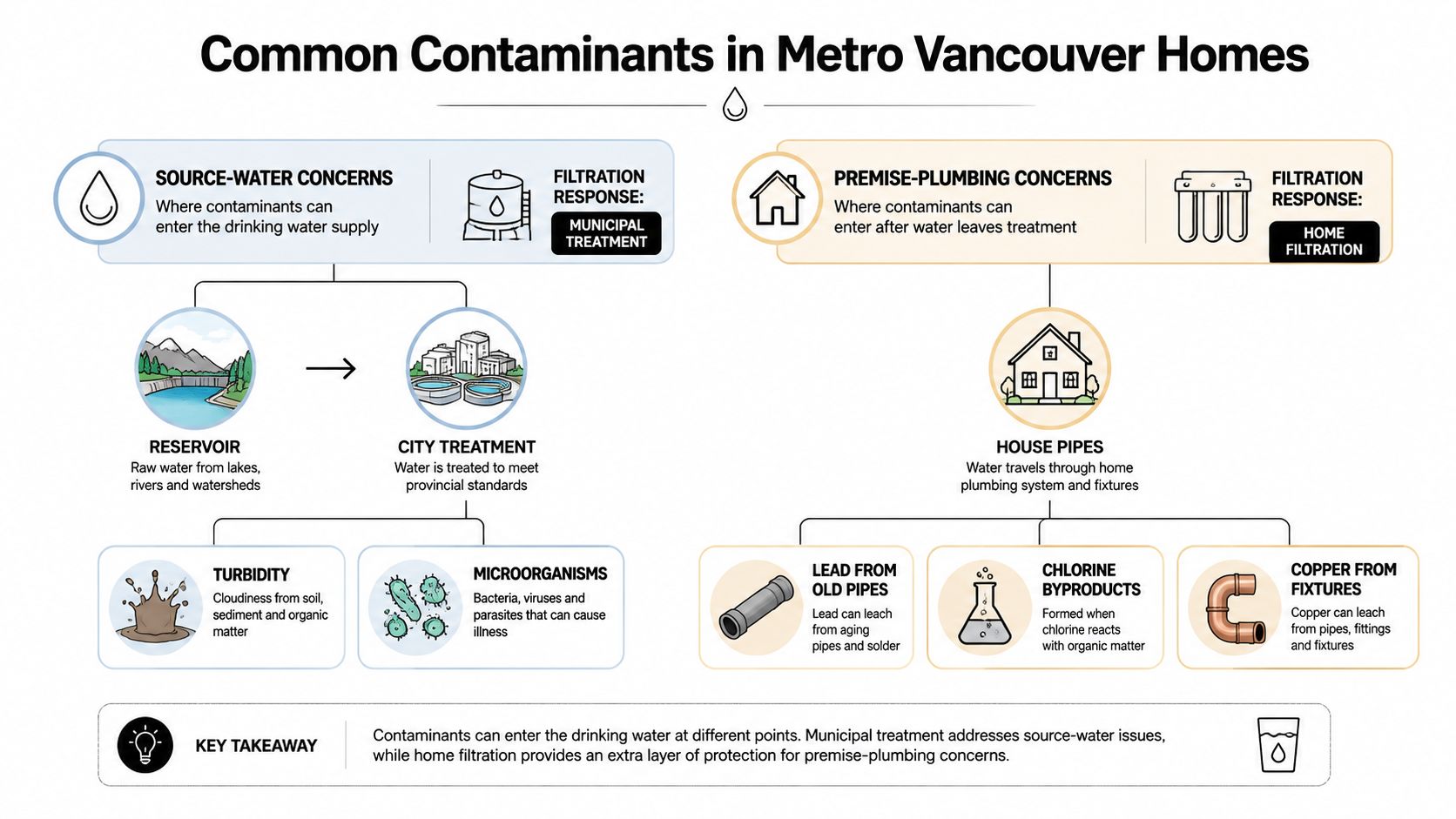
Metro Vancouver's treated supply handles the big public-health job. The issues that remain in homes often come from premise plumbing, which means the pipes, fixtures, and branches inside the property. That's why two homes on the same street can feel completely different at the tap.
Lead is the one that gets attention for good reason. In older Vancouver and Richmond homes, the risk often sits in the building materials, not in the municipal source. Health Canada's lead approach is about reducing exposure at the point of use, which is why a certified point-of-use unit or pipe work can be more important than installing a big whole-house filter at the front door.
The common complaints and what they usually point to
Chlorine taste or odour usually means the homeowner wants a taste-focused carbon stage.
Scale often points toward hardness and fixture maintenance rather than a drinking-water problem.
Sediment can come from old internal lines, disturbed plumbing, or local debris after work on the system.
Lead concern demands a more careful look at the tap, not a guess.
A Burnaby homeowner in a 1960s-era strata building might think the whole building needs filtration because the kitchen water tastes metallic. In practice, the better first move may be flushing the line, checking fixture age, and installing a lead-certified point-of-use unit where people drink. That's a diagnosis problem, not a shopping problem.
Practical rule: if the complaint changes from one tap to another, the source is probably inside the building.
The point of this distinction is not to discourage filtration. It's to keep homeowners from buying a system that can't touch the specific contaminant. A good plumber treats the symptom, traces it upstream, and then chooses the smallest solution that effectively works.
Health and water quality testing guidance for homeowners belongs on the short list before any purchase if the issue feels more serious than taste.
Choosing the Right System for Your Building Type
The building type changes the answer as much as the contaminant does. A detached home, an older townhouse, and a strata tower all create different pressure, access, and ownership issues, so a one-size recommendation falls apart quickly.
Detached homes and townhouses
In a detached house, whole-house treatment is easiest to justify when the entire home has the same problem. If the issue is just drinking water, an under-sink unit is usually the cleaner answer. In older Vancouver special townhouses, I'd be especially careful about assuming the building needs a big front-end system before checking the actual tap complaint.
Newer construction with PEX plumbing often changes the maintenance picture, because the pipe material may not be the source of taste or staining complaints. That doesn't make filtration irrelevant, it just means the homeowner should diagnose the symptom first and then choose the smallest practical fix.
Strata buildings need a different conversation
In multi-unit residential buildings, the council usually has to think at the point-of-entry level. That means the mechanical room, the common supply, and the pressure profile during peak demand all matter. A good building system has to protect more than one kitchen sink, and it can't create a pressure headache for residents at shower time.
Encano Plumbing & Drainage Ltd. installs and services whole-house and under-sink filtration in the Vancouver area, and that's the kind of contractor role that fits this decision point. The work isn't just mounting a canister, it's matching the unit to the building's demand and the complaint that started the conversation.
Decision rule: if more than one suite complains about the same issue, the building likely needs a shared solution, not a dozen separate purchases.
Whole-house installation details are useful reading if you're trying to understand what the install involves before you get quotes.
A Real Installation Scenario in Richmond and Burnaby
A Richmond homeowner with a private well called because the water looked cloudy after rain. The source-specific assessment pointed to turbidity and iron, so the answer wasn't a generic tap filter. It was a staged system sized to the measured problem, with prefiltration ahead of the main treatment so the cartridge wouldn't load up too early.
Richmond, private source, staged treatment
That owner started with testing, then chose treatment based on the result. A house on a private source isn't the same as a municipal property, because the homeowner is responsible for making sure the drinking water is safe, and the province recommends a source-specific assessment rather than a one-size-fits-all choice (private water treatment guidance). In practical terms, the system had to handle the visible complaint first, then keep the water usable for drinking and cooking.
The win wasn't a miracle transformation. It was removing the problem that was present, without overbuilding the system.
Burnaby, strata building, shared supply
A Burnaby strata council in a 1980s low-rise took the opposite route. Residents were complaining about chlorine taste, and repeated flushing didn't fix it, so the building went with a point-of-entry carbon and sediment setup in the mechanical room. That choice made sense because the complaint was shared, the supply was shared, and the building needed a common fix rather than individual appliances in every kitchen.
The maintenance pattern mattered just as much as the install. Shared systems only work if someone owns the cartridge changes and pressure checks, otherwise residents blame the wrong thing when performance drifts.
The first question isn't “what filter should we buy.” It's “what problem are we trying to remove, and where does that problem start?”
That's the difference between a system that works efficiently and one that becomes a recurring service call. In both buildings, the answer came from diagnosis, not from brand loyalty.
Maintenance Schedule and Real Costs
A water filtration system is only as good as its maintenance. The prettiest install in the world won't help if the sediment stage is overdue, the carbon is exhausted, or the UV lamp is dead.
What needs regular attention
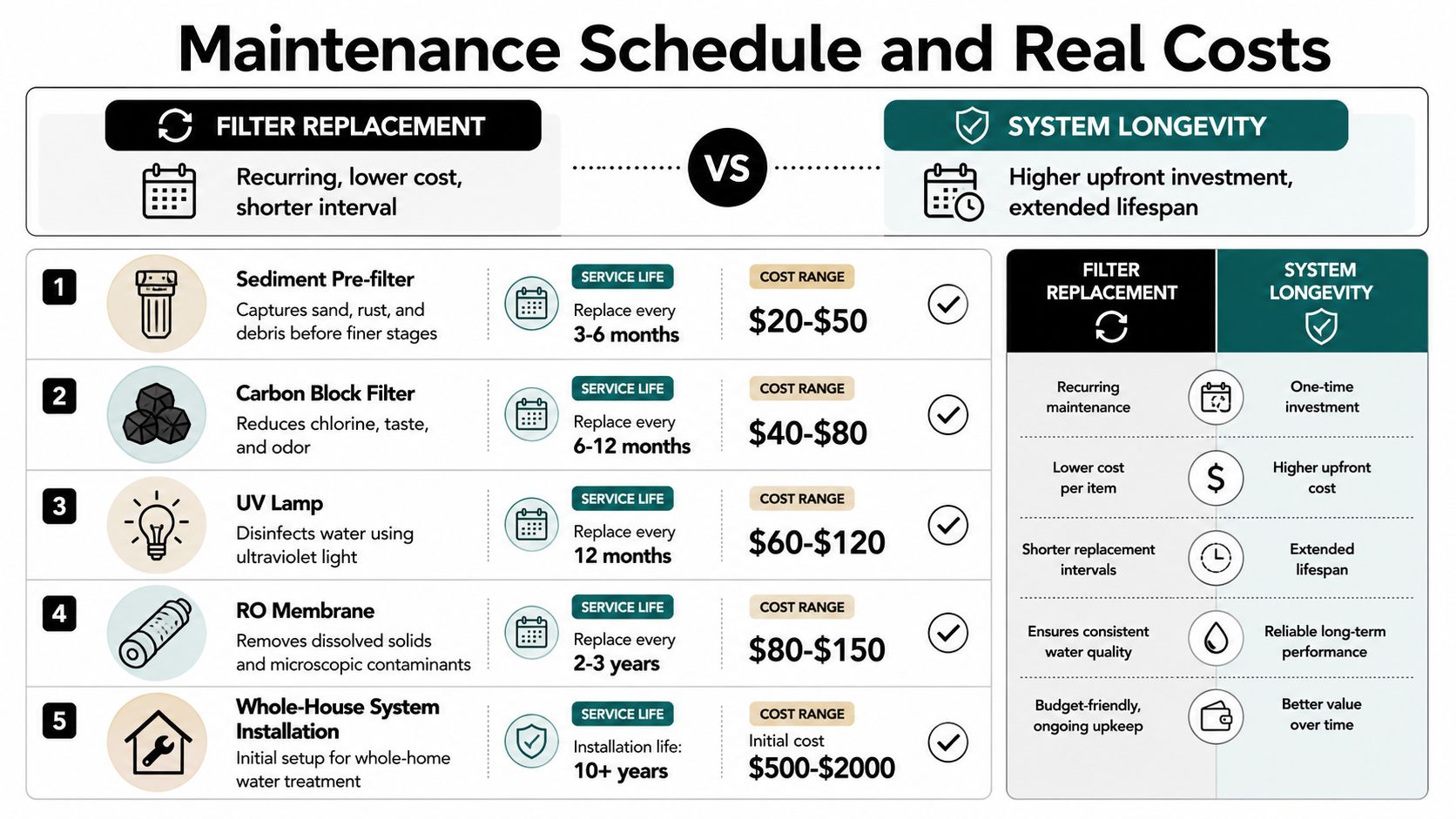
Sediment pre-filters need the most frequent attention because they take the first hit.
Carbon stages handle taste and odour, but they don't last forever.
RO membranes are the longer-cycle components that do the heavy purification work.
UV lamps need timed replacement, because they're a light source, not a passive filter.
The practical maintenance schedule is straightforward. Sediment pre-filters are often replaced every few months, carbon stages on a longer cycle, RO membranes on a multi-year cycle, and UV lamps annually. The exact interval depends on water quality and usage, but the owner has to keep a calendar and not guess.
What to check before water quality slips
- Pressure Readings: Watch for a slow drop, because that can signal loading or clogging before the water looks bad.
- Sanitisation: Keep housings and contact points clean so the system doesn't become a storage point for grime.
- Cartridge Dates: Write replacement dates directly on the unit or in a maintenance log.
- Taste Changes: Don't wait for visible problems, taste drift usually shows up first.
- Flow Rate: If the tap feels slower than usual, the system may be near its limit.
RO also carries a hidden budget item, water waste. The specification source says one benchmark system delivers 2 litres of clean water for every 1 litre of waste, while another delivers 3 litres of clean water for every 1 litre of waste (RO performance benchmark). That's not a reason to avoid RO. It's a reason to budget carefully and decide whether the purification level is worth the trade-off.
A realistic five-year budget isn't just the install price, it's cartridges, lamps, and the time needed to keep the system performing. Homeowners who plan for that upfront usually like the result much more than people who treat maintenance as an afterthought.
Bringing It All Together and When to Call Encano
The cleanest way to choose a water filtration system is to answer three questions in order. First, what is the actual problem. Second, what kind of building are you dealing with. Third, what are you realistically willing to maintain over time.
If the issue is only at one tap, a point-of-use unit may be enough. If the complaint is building-wide, the answer may be point-of-entry treatment or a piping fix before any filter goes in. If the home has a private source, the test results should drive the treatment choice, not the sales sheet.
Some jobs are safe for a homeowner to handle. Swapping a cartridge, replacing a countertop unit, or cleaning an accessible housing is reasonable for a handy owner. Other jobs need a licensed plumber, especially point-of-entry installation, strata retrofits, and pressure-loss diagnosis. Those are the kinds of jobs where an installer has to understand both water quality and how the building behaves under demand.
Best next step: if you're unsure whether your problem is source water, premise plumbing, or a building-level issue, get it assessed before you buy equipment.
Encano Plumbing & Drainage Ltd. can handle the assessment, recommend a system that fits the building, install it, and keep it maintained for Vancouver-area homes and strata properties. If your water complaint hasn't gone away with flushing, if your building needs a shared solution, or if you want a straight answer before spending money, visit Encano Plumbing & Drainage Ltd. and book a professional look at the problem.