

A lot of water heater replacement calls start the same way in Vancouver. Someone gets a lukewarm shower at 6 a.m., heads downstairs, and finds a damp ring around the tank. Or the heater still works, but the utility bill has been creeping up and the unit is old enough that nobody quite remembers when it was installed.
That's usually the moment when a simple appliance stops feeling simple. Homeowners in Vancouver, Richmond, Burnaby, Surrey, and nearby communities aren't just choosing a box that makes hot water. They're deciding whether to repair or replace, whether a tank or tankless model makes sense, whether permits are needed, and whether the existing venting, drainage, and service clearances will still pass inspection.
A practical example. A homeowner might call thinking they only need a like-for-like swap because the old tank is still heating. Then the site check shows the replacement area needs a proper drain pan, the relief valve discharge needs correcting, and the new higher-efficiency unit needs different venting support. The heater itself may be the easy part. The surrounding installation is often what determines whether the job goes smoothly.
Table of Contents
- Is It Time for a Water Heater Replacement
- Telltale Signs Your Water Heater Is Failing
- Tank vs Tankless Heaters A Vancouver Homeowner's Guide
- Understanding Water Heater Replacement Costs in 2026
- BC Building Codes and Permit Rules You Must Know
- What to Expect During Your Water Heater Installation
- Maintaining Your New Unit and Choosing a Licensed Plumber
Is It Time for a Water Heater Replacement
If your hot water has become unpredictable, the question usually isn't whether the heater needs attention. It's whether repair still makes sense.
Water heating is a major part of household energy use. ENERGY STAR says water heating is the second-largest energy end use in homes, accounting for 16.8% of residential energy consumption, and notes that qualified models can save a household $30 to $300 per year on energy bills, as outlined in its water heater market profile. That matters in Metro Vancouver, where many homes rely heavily on dependable hot water through cooler, damp months.
A common local scenario is an older tank in a basement or utility room that still technically works but shows age. The owner notices the shower goes cool sooner than it used to. The tank makes more noise than before. There may be no major leak yet, but confidence in the unit is gone. In those cases, waiting for a total failure often creates more mess and fewer options.
Practical rule: If you're already worrying about the heater every time you leave home for the weekend, you're close to replacement territory.
Another practical example. In a strata unit, a small leak from an ageing tank isn't just your problem. It can turn into flooring damage, drywall repair, and neighbour complaints. Replacing before the tank splits is often the cheaper and calmer decision.
Water heater replacement is easier when it's planned. You have time to compare tank and tankless options, check installation requirements, and choose a unit that fits your household instead of grabbing whatever is available during an emergency.
Telltale Signs Your Water Heater Is Failing
A lot of failing water heaters still make hot water. That is what catches homeowners off guard. The unit keeps limping along until the day it leaks onto the floor, trips a safety issue, or leaves the house without enough hot water.
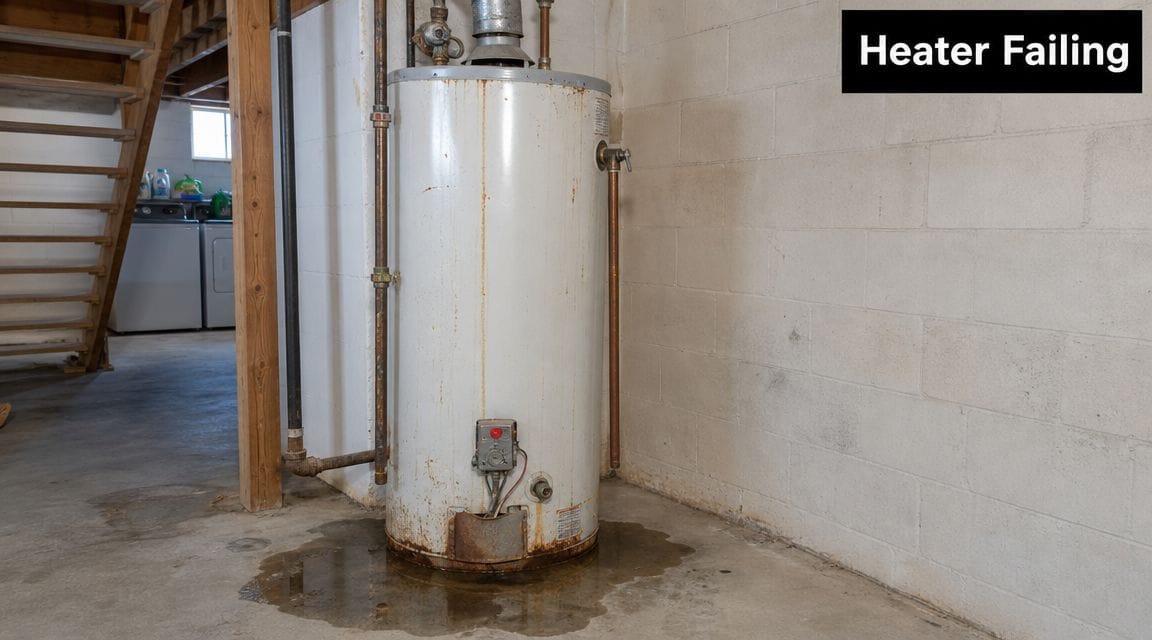
In Metro Vancouver, I tell homeowners to pay close attention to early warning signs because replacement work here is not always a same-day swap. Venting changes, permit requirements, tight utility rooms, and condo access rules can slow things down. Catching a failing heater early gives you more control and helps avoid a rushed install.
Seven warning signs that matter
Water around the base: A puddle, damp concrete, or a rust-stained ring near the tank needs a proper check. Sometimes the leak is from a valve or connection above the unit. If water is coming from the tank body or a seam, replacement is usually the practical answer.
Rust-coloured hot water: If the discolouration shows up mainly on the hot side, the tank interior may be breaking down. Homeowners often notice it first in a white tub, sink, or shower tray.
Rumbling, popping, or banging sounds: Those noises usually point to sediment buildup in the bottom of the tank. The burner or elements then heat through that layer, which reduces efficiency and puts more strain on the unit.
Hot water that runs out sooner than it used to: If the same household routine suddenly no longer works, something has changed inside the heater. It may be sediment, a failing burner, an element issue, or loss of tank performance.
Temperature swings: Water that goes hot, then lukewarm, then hot again is a warning sign. Intermittent temperature usually means a control problem, internal wear, or a unit near the end of its service life.
Visible corrosion on fittings or the jacket: Green staining, rust trails, and mineral crust around the top connections tell you moisture has been present for a while. That does not always mean the tank itself has failed, but it does mean the unit needs attention before a small issue turns into water damage.
Age plus symptoms: Once a tank water heater is into the later part of its expected lifespan, small problems matter more. An older unit with leak marks, inconsistent heat, or heavy noise is a replacement candidate, not just a repair call.
What failure looks like in a real home
A common local example is an older tank in a Burnaby or New Westminster basement that starts making popping sounds through the winter. The household puts up with it because there is still hot water. Then shower recovery gets slower, the pressure relief piping shows signs of discharge, or moisture appears under the tank. At that stage, the risk is no longer just poor performance. It is an unplanned leak and a rushed replacement under local code rules.
That popping sound usually is not harmless house noise. It often means the heater is carrying a heavy sediment load and running hotter and harder than it should.
In a detached home, that can mean damage to flooring, drywall, or stored items nearby. In a strata unit, it can also mean complaints, insurance headaches, and access coordination if the replacement has to happen fast.
If you notice one mild symptom, schedule an inspection and get clear eyes on it. If you notice several at once, especially age, noise, moisture, or erratic temperature, start planning replacement. Homeowners comparing options often find it helpful to review the differences between traditional and tankless water heaters before the old unit forces the decision.
Tank vs Tankless Heaters A Vancouver Homeowner's Guide
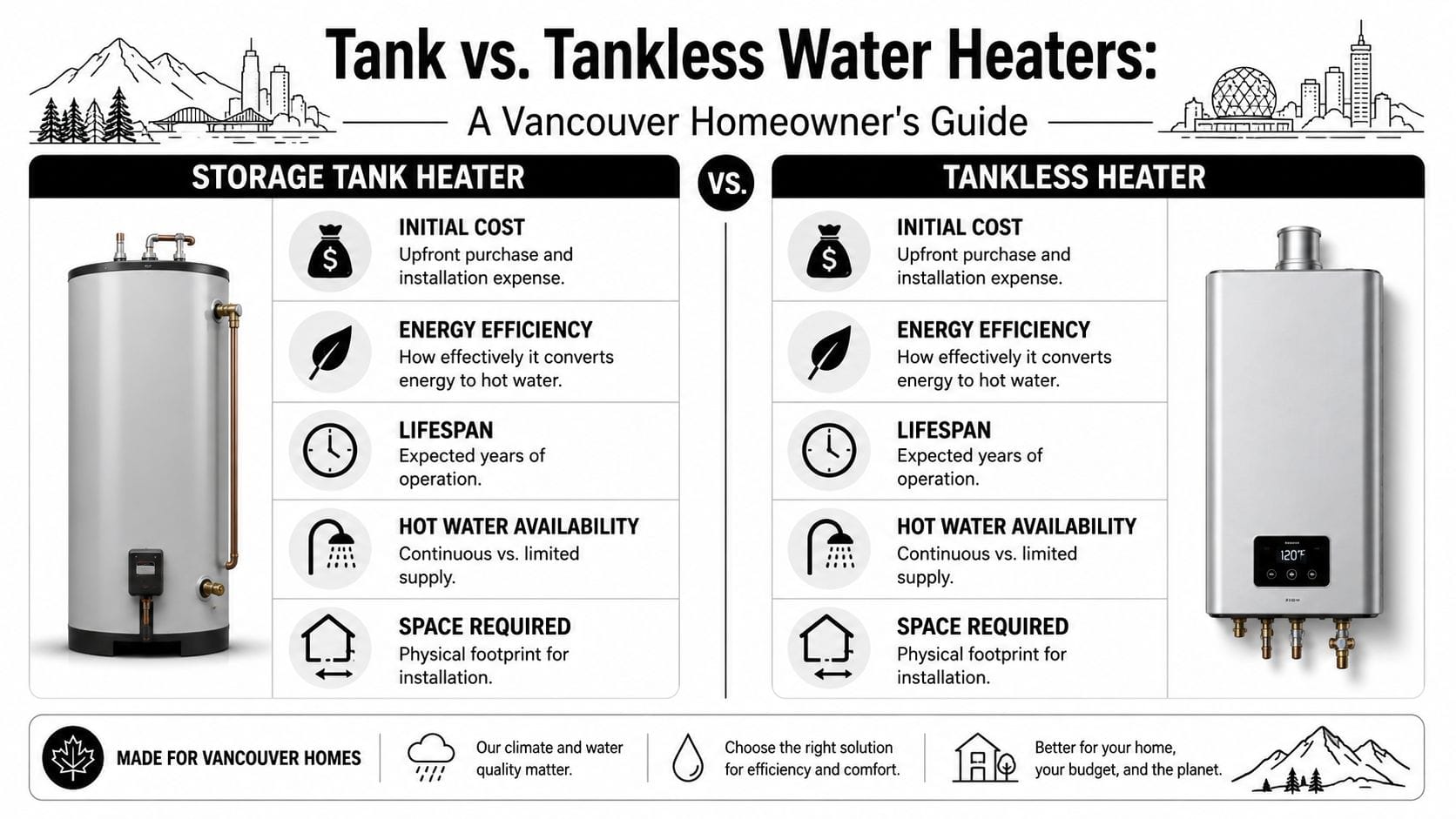
The biggest choice in a water heater replacement job is usually the system type. Both options can work well in Metro Vancouver. The right one depends on your demand, your budget, your installation conditions, and how much upgrade work the house can support.
Where a storage tank still wins
A storage tank is still the straightforward choice for many homes. If you have a typical family setup, existing tank connections, and limited interest in larger retrofit work, a tank replacement is usually the simpler path.
It tends to suit homeowners who want predictable installation and familiar performance. In many older Vancouver-area homes, that matters. The mechanical room may already be set up for a tank footprint, and changing system type can add venting, gas, or electrical complications.
A practical example. If your current tank sits in a utility area with decent access and the household's routine hasn't changed much, replacing it with a properly sized modern tank often keeps the project cleaner and more manageable.
Where tankless earns its keep
Tankless units appeal to homeowners who want hot water on demand and are willing to treat the project as a system upgrade, not just an appliance swap. They can be a strong fit where floor space is tight or where the household has high, uneven hot water demand across the day.
For colder coastal climates, though, sizing and installation details matter. The decision hinges on the new unit's energy factor or UEF, and a proper retrofit must account for local climate while making sure venting, combustion air, and condensate management are upgraded to code, as outlined in this replacement guidance on water heater efficiency and retrofit conditions.
That point gets missed online all the time. A tankless heater that looks great on paper can disappoint in real use if the incoming water is colder, the unit is undersized, or the venting setup isn't appropriate.
If you're considering tankless, don't buy based on brochure language alone. Buy based on demand, inlet conditions, and what the installation area can actually support.
For a deeper side-by-side look, this guide on traditional vs tankless water heaters is useful if you're comparing both paths for your home.
Tank vs Tankless Water Heaters at a Glance
| Feature | Storage Tank Water Heater | Tankless Water Heater |
|---|---|---|
| Initial cost | Usually easier to budget for on a standard replacement | Usually higher upfront, especially if upgrades are needed |
| Energy efficiency | Improved modern models are available | Often chosen for efficiency-focused replacements |
| Lifespan | Solid choice for routine household use | Often considered when owners want a longer-term system upgrade |
| Hot water availability | Limited by stored volume and recovery | Better suited to ongoing demand when correctly sized |
| Space required | Needs floor space for the tank | Good option when footprint matters |
There isn't a universal winner. If your priority is lower disruption, a tank often wins. If your priority is space saving and on-demand performance, tankless may be the better fit, but only when the home is ready for it.
Understanding Water Heater Replacement Costs in 2026
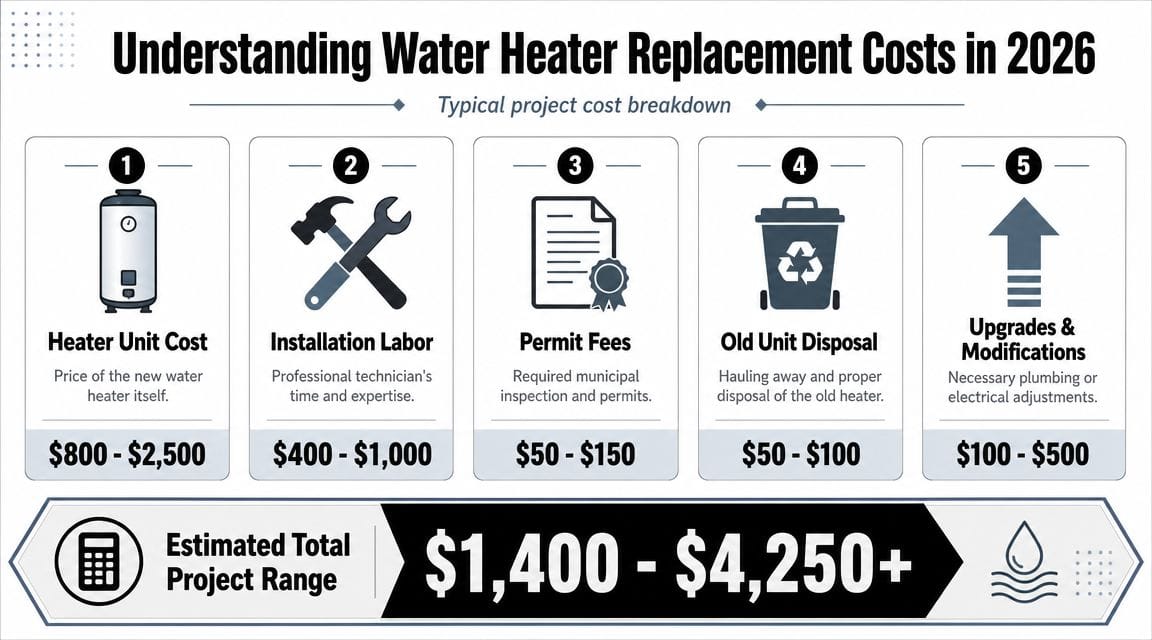
A lot of Vancouver-area homeowners start with the tank price they saw online, then get blindsided by the rest of the job. The heater is only one line on the invoice. Removal, venting, connections, access, permit-related corrections, and disposal often decide whether the replacement stays straightforward or turns into a larger project.
What drives the total price
National pricing ranges can give a rough starting point, but they rarely reflect Metro Vancouver conditions very well. Labour rates, municipal permit requirements, older venting layouts, strata access rules, and tighter mechanical spaces can all push a local replacement above the number a homeowner expected from a generic online calculator.
The biggest cost difference usually comes from whether the job is a true like-for-like swap.
If the existing installation is clean, accessible, and already set up to support the new unit, the quote is usually easier to control. If the old heater is tucked into a finished closet, served by outdated venting, or missing protective details that now have to be corrected, the labour portion rises quickly. In this area, I often see the price change because the heater itself was not the problem. The surrounding installation was.
A common example is a homeowner pricing a standard tank replacement based on retail heater cost alone. Then the site visit shows narrow stair access, a vent connection that does not suit the replacement model, and drainage protection that should be added because the unit sits near finished materials. The replacement still makes sense, but it is no longer a simple drop-in job.
Why one home gets a basic quote and another does not
Two houses can need the same size heater and still get very different estimates. The difference usually comes down to the work around the unit, not the badge on the front.
Watch for these cost drivers:
- Access and removal: Tight utility rooms, crawlspaces, condo service areas, and stair carries add time and labour.
- Fuel or service changes: Gas line adjustments, electrical upgrades, or revised venting can shift the job well beyond a standard replacement.
- Drainage and protection details: A drain pan, relief valve discharge correction, or condensate handling may need to be added depending on the location and unit type.
- Building type: Detached homes, townhouses, and strata buildings all come with different shutdown, scheduling, and work-area constraints.
- Unit selection: Tankless equipment usually costs more upfront, and the installation can involve more changes to gas, venting, and service capacity.
Metro Vancouver climate also affects real-world cost decisions. Colder incoming water means sizing mistakes show up fast, especially in larger households expecting strong back-to-back hot water performance. Choosing a cheaper unit that struggles in winter often saves less than people think.
For a more local budgeting breakdown, this guide to water heater replacement cost in Metro Vancouver helps homeowners compare quotes with a clearer view of what is included.
BC Building Codes and Permit Rules You Must Know
A water heater replacement in Metro Vancouver often looks simple from the outside. Disconnect the old one, connect the new one, turn the water back on. That's the version homeowners hope for. It's not the version inspectors care about.
Why permits matter on replacement jobs
Local municipal requirements in the Vancouver area commonly require permits for new and replacement water heaters. Installation details are also tightly controlled. A storage-tank heater may need an auxiliary drain pan where leakage could damage finishes, the relief valve discharge must be routed by gravity to an approved receptor or exterior termination, and the pan drain must terminate full-size to an approved location, as outlined in this water heater installation guide covering permit and drainage requirements.
Those aren't paperwork details. They're damage-control details.
A practical example. A Richmond townhouse owner replaces a heater in a finished utility closet. The tank itself is installed correctly, but there's no compliant pan and the discharge piping is poorly routed. The heater works, but a small future leak can still damage flooring and adjacent walls. That's exactly the kind of preventable risk code requirements are meant to address.
Common details that get missed
The failure points on replacement jobs are usually boring details. They're also the details that separate a safe installation from a problem waiting for a weekend or holiday.
- Drain pan requirements: If a leak can damage finished areas, the pan isn't optional.
- Relief valve discharge routing: The T&P discharge line has to be installed so it drains properly by gravity to an approved termination point.
- Service access: If the heater is boxed in too tightly, future service becomes difficult and inspection can become an issue.
- Venting and related support systems: Higher-efficiency equipment only performs properly when the surrounding installation is built to support it.
Code work isn't about making the job harder. It's about stopping a small heater problem from becoming a large home-repair problem.
For strata managers, this matters even more. A non-compliant replacement can expose multiple suites or common areas to avoidable water damage. That's why permit handling and code review should be part of the job from the start, not an afterthought.
What to Expect During Your Water Heater Installation
Most homeowners don't replace water heaters often, so the day itself can feel uncertain. A professional installation should feel organised, methodical, and easy to follow.
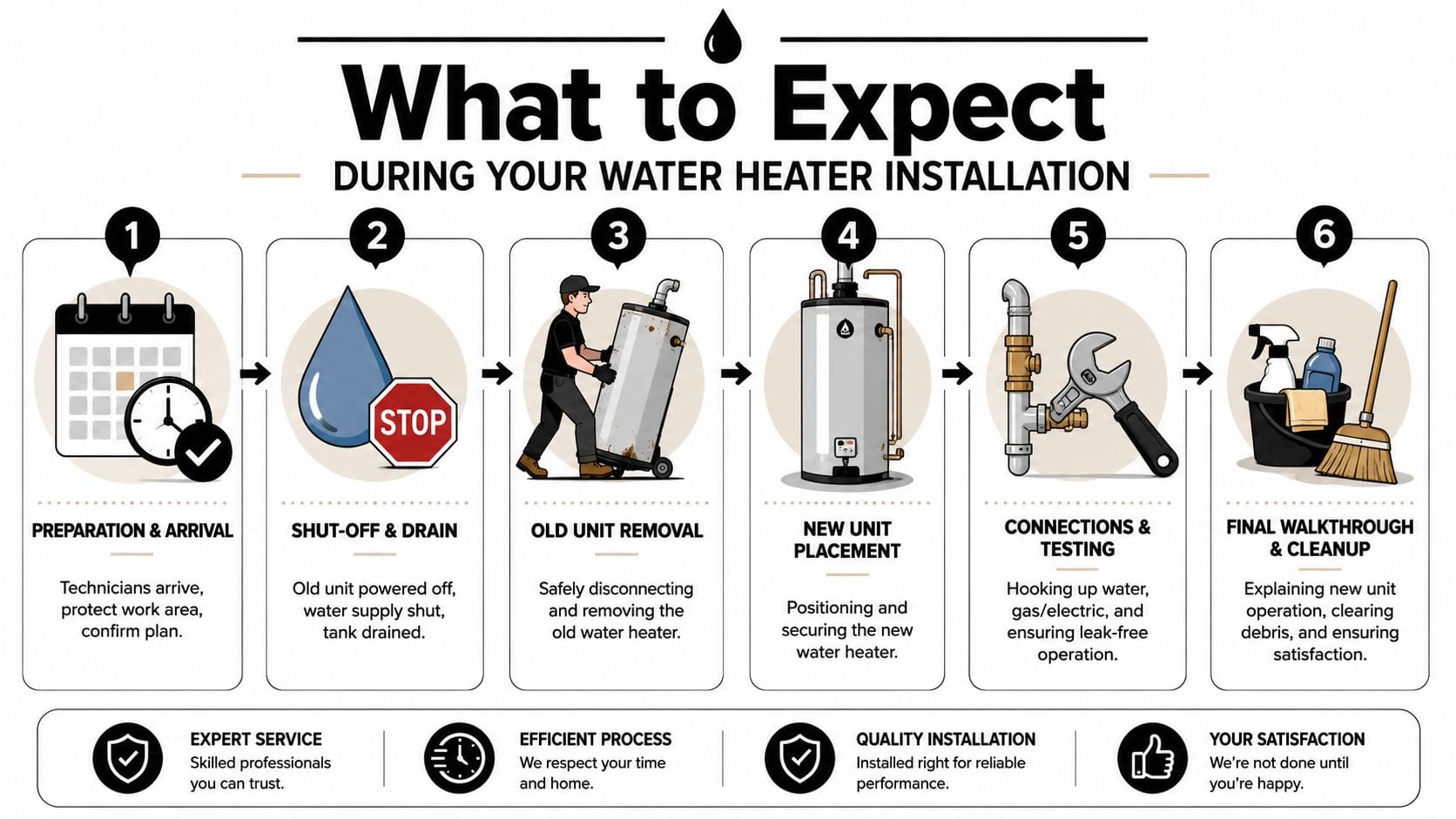
Early in the appointment, the technician confirms the replacement plan, checks access, and protects the work area before any disconnection starts.
How the day usually goes
Arrival and site check
The first step is confirming the unit, the location, and any site-specific concerns. In an older Vancouver home, that may include narrow access, existing venting conditions, or drainage concerns near finished flooring.Shutdown and draining
Water and power or gas are safely shut off. The old tank is drained before removal. This part can take longer when the old unit is heavily sedimented or when shutoff valves are stiff or worn.Removal of the old heater
The old heater is disconnected and moved out without damaging walls, flooring, or stairs. In condos and townhomes, this stage needs extra care because hallways, elevators, and shared areas are in play.
Before the new unit is fully connected, it helps to see the process visually:
Placement and connection of the new unit
The new heater is set in place and aligned properly. Water lines, venting or electrical supply, gas connection where applicable, and required discharge piping are installed or corrected as needed.Fill, fire, and test
The system is filled and checked for leaks before being put into operation. Then the technician verifies proper heating, stable operation, and safe connection points.
A good install day is usually quiet. No rushing, no guessing, and no “we'll come back later to fix that pipe.”
What a good final walkthrough includes
The last part should not be a quick signature at the door. It should include a homeowner walkthrough.
That usually covers:
- Operation basics: How the heater turns on, what normal sounds are, and what signs should prompt a service call.
- Safety points: Where shutoffs are and what to do if you notice moisture, unusual odours, or performance changes.
- Cleanup and removal: The old unit, packaging, and debris should leave with the crew unless another arrangement was discussed.
A practical example. In a strata suite, the best final walkthrough includes more than showing the thermostat. It includes confirming the drain pan area is clear, explaining what to monitor over the next day, and making sure the resident knows who to call if anything changes after the install.
Maintaining Your New Unit and Choosing a Licensed Plumber
A new heater can last well when it's installed correctly and checked occasionally. Neglect shortens that runway.
A simple maintenance routine
You don't need a complicated schedule. You do need consistency.
- Watch for moisture early: Check around the base, nearby fittings, and discharge piping once in a while. A small drip is easier to correct than hidden water damage.
- Pay attention to sound changes: If a tank that used to run normally starts popping or rumbling, book service before the issue grows.
- Don't ignore performance shifts: Hot water that fades faster, takes longer to recover, or changes temperature unexpectedly deserves a professional check.
- Ask about periodic servicing: Depending on the system type and local water conditions, a plumber may recommend maintenance that helps preserve efficiency and operating life.
A practical example. A homeowner installs a new unit, then stores paint cans and boxes tightly around it. Months later, a minor drip goes unnoticed because nobody can see the base. Keeping the area around the heater clear makes inspection easier and service safer.
Why installer choice matters
The installer matters because replacement isn't just plumbing. It touches safety, code compliance, property protection, and long-term reliability. A licensed plumber should be able to assess the site, explain the trade-offs plainly, handle the work to code, and leave you with a system you understand.
If you're comparing providers, ask who handles permits, who checks venting and discharge details, who removes the old unit, and who you call if the installation needs follow-up. For homeowners who want a local reference point, licensed plumber services in Vancouver from Encano Plumbing & Drainage Ltd. outline the kind of scope a qualified contractor should be prepared to manage.
The best water heater replacement jobs are rarely the fastest-looking ones. They're the ones that solve the hot water problem, pass inspection, and don't create a new leak, venting, or access problem six months later.
If your current heater is leaking, unreliable, or nearing the point where you don't trust it anymore, it's worth getting a proper assessment before it turns into an emergency. Encano Plumbing & Drainage Ltd. helps Vancouver-area homeowners, landlords, and strata managers replace water heaters with attention to code, installation conditions, and long-term reliability.