

You might be staring at a notice from the City of Vancouver, or trying to figure out whether your older home, duplex, or strata building is next. Either way, water meter installation has stopped being a background utility issue and become part of how Vancouver, Burnaby, and the rest of Metro Vancouver manage water use, billing, and service upgrades.
For a homeowner, the practical questions are simple. Where does the meter go, what does the work involve, what does the city expect, and how do you hire someone who won't create inspection problems later? A good installation is about more than swapping a device. It has to fit the property, meet municipal rules, and keep the system easy to service for years.
Table of Contents
- Why Water Meters Are Becoming Standard in Vancouver
- How a Water Meter Benefits Your Home
- Metro Vancouver Installation Rules and Placement
- The Professional Installation Process Explained
- Budgeting for Installation Costs and Disruptions
- Using and Maintaining Your New Water Meter
- How to Choose a Plumbing Contractor in Vancouver
Why Water Meters Are Becoming Standard in Vancouver
A lot of homeowners first deal with this topic after a notice arrives. That notice usually means the property is in a rollout area, or the home is being brought into a newer service standard through renovation, rebuilding, or a city program.
The City of Vancouver has been rolling out accelerated city-wide water metering since 2024, installing meters on all remaining unmetered homes neighbourhood by neighbourhood, and the city also states that since 2012 all new single- and 2-family homes, as well as existing residences that are renovated or rebuilt, must have a water meter installed. That matters because the work is no longer optional in the same way it once was for many properties. It is part of how the city manages water service across its system. City of Vancouver water metering rollout
Practical rule: if your project changes the service connection, don't treat meter work like a quick plumbing add-on. It usually has to fit the city's approval process.
For strata councils and property managers, the timeline can feel disruptive, but the direction is clear. Metering is moving from a niche retrofit to a standard utility expectation. That shift also explains why older homes and multi-unit properties need careful planning, because the existing piping, room layout, and service access often weren't designed with modern meter service in mind.
The provincial picture points the same way. Budget 2024 included $50 million for water-metering pilot programs in 21 communities, which shows the province is backing broader adoption, not just talking about conservation in the abstract. BC Budget 2024 water-metering funding report
A homeowner who gets ahead of the work usually has fewer surprises than one who waits for a rushed deadline.
For anyone in Vancouver, Richmond, or Burnaby, the smart move is to treat the notice as a planning trigger. Check the property's current metering status, confirm whether the work is tied to a permit or renovation, and build the installation into your schedule before the city or utility forces the pace.
How a Water Meter Benefits Your Home
A water meter gives you a clear reading of how much water moves through the service line. For a homeowner or strata manager, that means less guessing and more accountability at the point where the water enters the property.
The practical value shows up in two places. It supports fair billing, and it helps you catch abnormal use sooner. A hidden leak in a line, fixture, sprinkler loop, or outdoor service run can keep wasting water long before anyone sees a puddle, so a meter gives you a chance to spot the pattern earlier.

Mechanical and digital meters work differently
A mechanical meter uses internal moving parts to register flow. It is still common in residential service, and many plumbers know it well because it is straightforward to inspect and maintain. A digital or automated meter adds remote reading or monitoring features, which can make utility access easier and reduce the need for manual reads.
Mechanical meters register flow through physical movement, while digital meters add remote reading capabilities. That difference matters because the right choice depends on the property type, the service program, and what the municipality is already installing. A single-family home, a duplex, and a larger strata building do not always need the same setup.
For Vancouver homeowners and strata councils, the primary question is not which meter sounds more advanced. It is which meter fits the city's service expectations, the existing piping, and the room available around the meter setting. That is also where related work, such as backflow preventer installation, can come into the conversation if the service layout needs added protection.
Metering also changes the way people manage water use day to day. A homeowner gets a clearer picture of consumption. A strata council gets better data for shared services. A municipality gets a cleaner record of how water is moving through the system, which helps with service management and conservation planning.
If you want the blunt version, a meter does not save water on its own. It gives you the information needed to make better decisions, and that is where the benefit starts.
Metro Vancouver Installation Rules and Placement
Where the meter goes is not a detail you can leave until the end. In Metro Vancouver, the space around the meter affects inspection success, long-term serviceability, and whether the installation protects the meter from damage.
Burnaby's design guidance is a good example of how tight the tolerances can be. The meter setting must be within 1 metre of floor level, there should be no more than 2 metres of pipe between the building entry point and the meter unless approved, and the meter should be near a floor drain sized for testing and servicing flows. Other utility guidance is just as strict, with at least 1.5 m of unobstructed clearance in front of the meter and 600 mm behind it, plus a 2.0 m clear head height in some cases. Burnaby water-meter design guidelines
Why clearance matters
Those dimensions aren't bureaucratic clutter. They help keep pressure loss low, make testing and servicing possible, and reduce the odds that an inspector rejects the work because the meter can't be reached properly. A cramped room, stacked storage, or a badly chosen corner can turn a routine job into a failed inspection.
For Vancouver properties, the permitting process reinforces that this is formal infrastructure work, not just a simple fixture swap. The city's water-connection permitting workflow is issued by the Engineering Services Waterworks Design Branch, so meter work tied to a new or altered service connection needs to go through the proper engineering approval process. Vancouver water-connection permitting procedure
If the meter can't be reached, read, or serviced without moving half the room, the installation is wrong.
Placement also affects utility add-ons. Where backflow prevention is part of the setup, the meter and protection devices need to work together as a compliant system. Backflow preventer installation details
For homeowners, the easiest mistake is assuming there's one universal location. There isn't. Older basements, suite conversions, and small mechanical rooms each create different access issues. A good contractor checks the pipe route, drain location, clearances, and inspection path before cutting anything.
Practical example, a Burnaby townhouse with a finished utility closet may need the meter repositioned so the front clearance stays open for service. A Richmond strata building may have enough room for the device itself but not enough working space for reading and maintenance. In both cases, the meter can be code-compliant only if the layout is thought through before installation starts.
The Professional Installation Process Explained
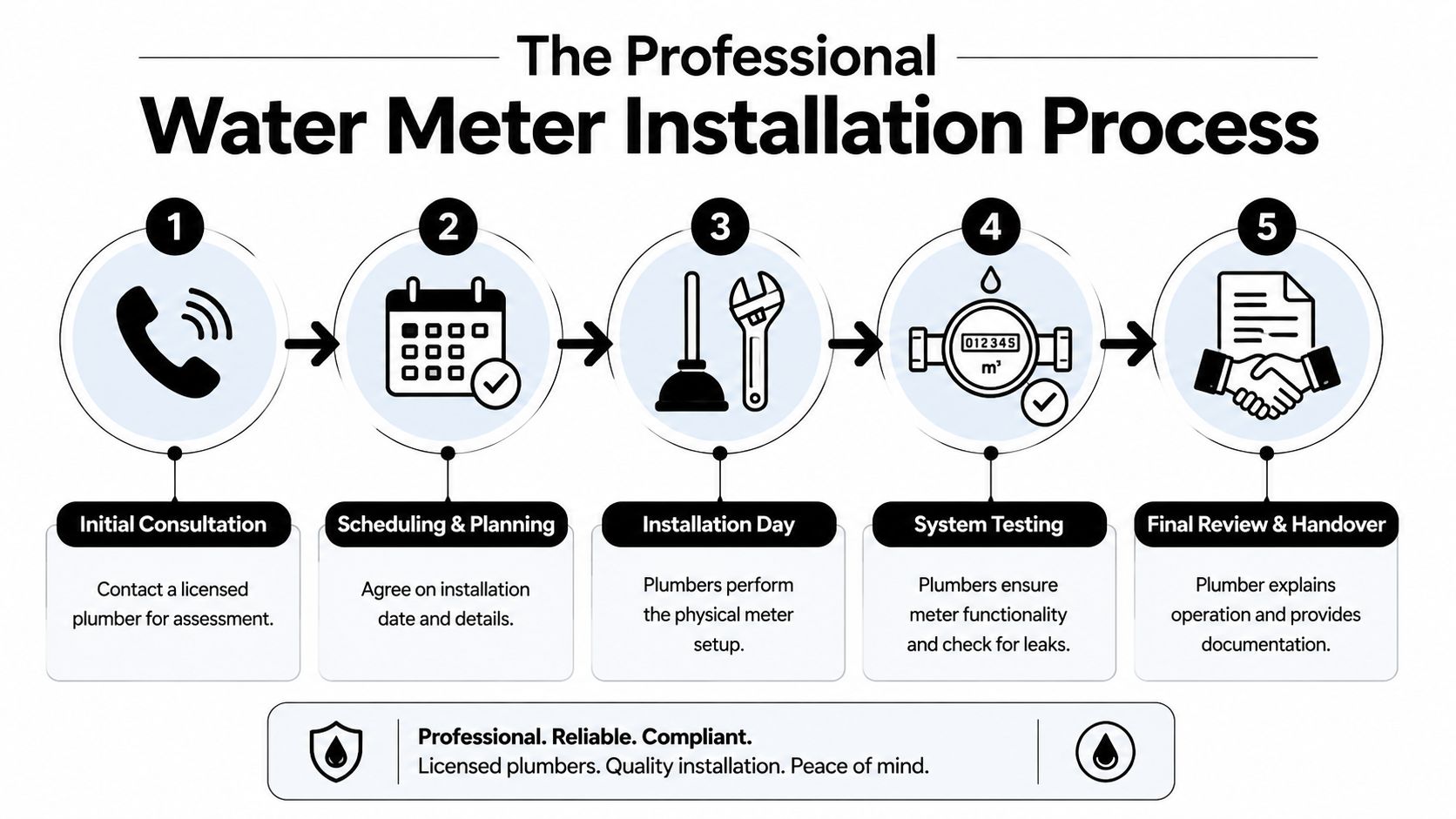
A clean water meter installation starts before anyone cuts into the line. On a proper job, the first visit is about measuring the space, checking access, and confirming the meter can sit where it can be read, serviced, and inspected without creating new problems for the homeowner or strata.
In Greater Vancouver, the compliance side matters as much as the plumbing. If the work is tied to a new or altered service connection in Vancouver, it has to follow the city's permitting workflow through the Engineering Services Waterworks Design Branch. A professional contractor plans for that process instead of treating it like a last-minute detail.
What a normal job looks like
A typical project begins with a site review. The plumber checks the entry point, existing valves, nearby drainage, and the space needed for testing and future access. If the meter needs a better location, that decision is made before any pipe is opened.
Installation day is usually orderly when the planning is sound. The main line is shut down, the existing section is opened, fittings are prepared, and the new meter is installed in the correct orientation. The system is then brought back online and every visible joint is checked for leaks. The work goes smoothly because the layout was confirmed first, not because the job itself is simple.
Testing and handover come next. The contractor confirms that the meter responds correctly, the valves stay accessible, and the owner understands how to read or observe the unit. On strata properties, that part matters even more, because someone needs to know where the shutoff is and how to tell whether the reading makes sense.
A Vancouver homeowner rebuilding under permit should expect the installer to work around the permit path, not around it. A rushed same-day install can miss access problems or inspection issues, which usually turns into more disruption later. A better job is planned so the service connection, the meter location, and the final inspection all line up from the start.
A clear process also keeps the site usable. Good crews protect floors, remove debris promptly, and leave the mechanical area tidy enough for the inspector to work without obstacles. That may sound basic, but in a tight basement or utility room it often decides whether the sign-off is smooth or whether someone has to come back for a second look.
Budgeting for Installation Costs and Disruptions
Most homeowners ask the same two questions first. How much will it cost, and how much disruption should I expect? The honest answer is that both depend on the site.
The biggest cost drivers are usually access to the main line, how much pipe needs to be altered, whether the meter can fit into the existing space, and whether permits or inspection steps are part of the job. A straightforward replacement in an open mechanical area is very different from a retrofit in a tight basement, a strata utility room, or a property with old piping that needs correction before the meter can even go in.
A related issue is whether the job is part of a retrofit or new construction. In California, metering is often framed around conservation pricing and customer behaviour, and existing properties commonly raise the harder question of who pays for the upgrade and how the billing changes afterward. That same retrofit-versus-new-build distinction matters in Vancouver too, even though local rules are different. The key point is that a retrofit usually takes more coordination than a brand-new prepared service. California metering retrofit and policy discussion
What to expect on site
A well-planned residential installation is usually a controlled half-day type of project, but the site conditions decide how quickly the team can move. If the meter location is easy to reach, the work goes faster. If the pipe is corroded, the access is cramped, or the line needs to be rerouted, the project naturally takes longer.
The cheapest quote is often the one that leaves out the hard parts.
Preparation helps reduce both cost and mess. Clear storage away from the mechanical area, make sure someone can access the shutoff, and confirm where the plumber can stage tools and parts. If the installation is in a strata or shared building, notify the people who will be affected by the water shutoff so no one gets surprised.
Practical example, a homeowner in Richmond who has a clear utility room and a sound main shutoff will usually see a cleaner process than a homeowner whose meter area is blocked by shelving, stored boxes, or a patchwork of old valves. The plumbing itself may be similar, but the site conditions are not.
When you compare quotes, look beyond the bottom line. Ask what the estimate includes, whether it covers access work, permit coordination, and testing, and whether the contractor has handled municipal meter work in Metro Vancouver before. A detailed scope usually saves money by preventing rework.
Using and Maintaining Your New Water Meter
Once the meter is in, its most useful job starts. It becomes a diagnostic tool, not just a billing device.
West Vancouver's meter brochure gives a simple leak check that works well for homeowners. Turn off all water-using appliances and fixtures inside the home, then watch the meter. If the indicator still moves, water is being used somewhere on the property. That can point to a leak outdoors, in a sprinkler line, or in another service branch that isn't obvious from inside the house. West Vancouver leak-detection brochure
A practical leak test
Turn off taps, dishwashers, laundry fixtures, and anything else drawing water. Then look at the meter indicator without letting any fixtures run. If it keeps moving, the issue is real and worth tracing before it turns into a larger repair.
Shut everything down first. If the meter still moves, the problem is on the property, not in your imagination.
That same method helps after a new install, because it gives you a baseline. If the meter is installed correctly and the home is quiet, the reading should settle. If you see movement when nothing is on, you've got a starting point for troubleshooting.
A second practical task is keeping the meter area accessible. Don't box it in with storage after the job is done. The meter needs to remain reachable for reading, inspection, and future service, especially in shared buildings where maintenance access matters.
Practical example, a Vancouver homeowner who notices unexplained use after installation can isolate the issue by shutting down the indoor system first and then checking the outside irrigation side separately. That's faster than tearing open walls or guessing at the source.
For general safety around the main shutoff, use a plumber's guidance before turning valves that haven't been moved in years. A simple shutdown is useful, but a seized valve or brittle fitting can create a second problem if it's handled roughly. Safe water main shut-off guidance
How to Choose a Plumbing Contractor in Vancouver
A meter install can go wrong for simple reasons, a crew misses the access requirements, the shutoff plan is unclear, or the finished work does not match what the city or utility expects. In Vancouver, Burnaby, and Richmond, that usually means delays, extra visits, and a frustrated owner or strata manager.
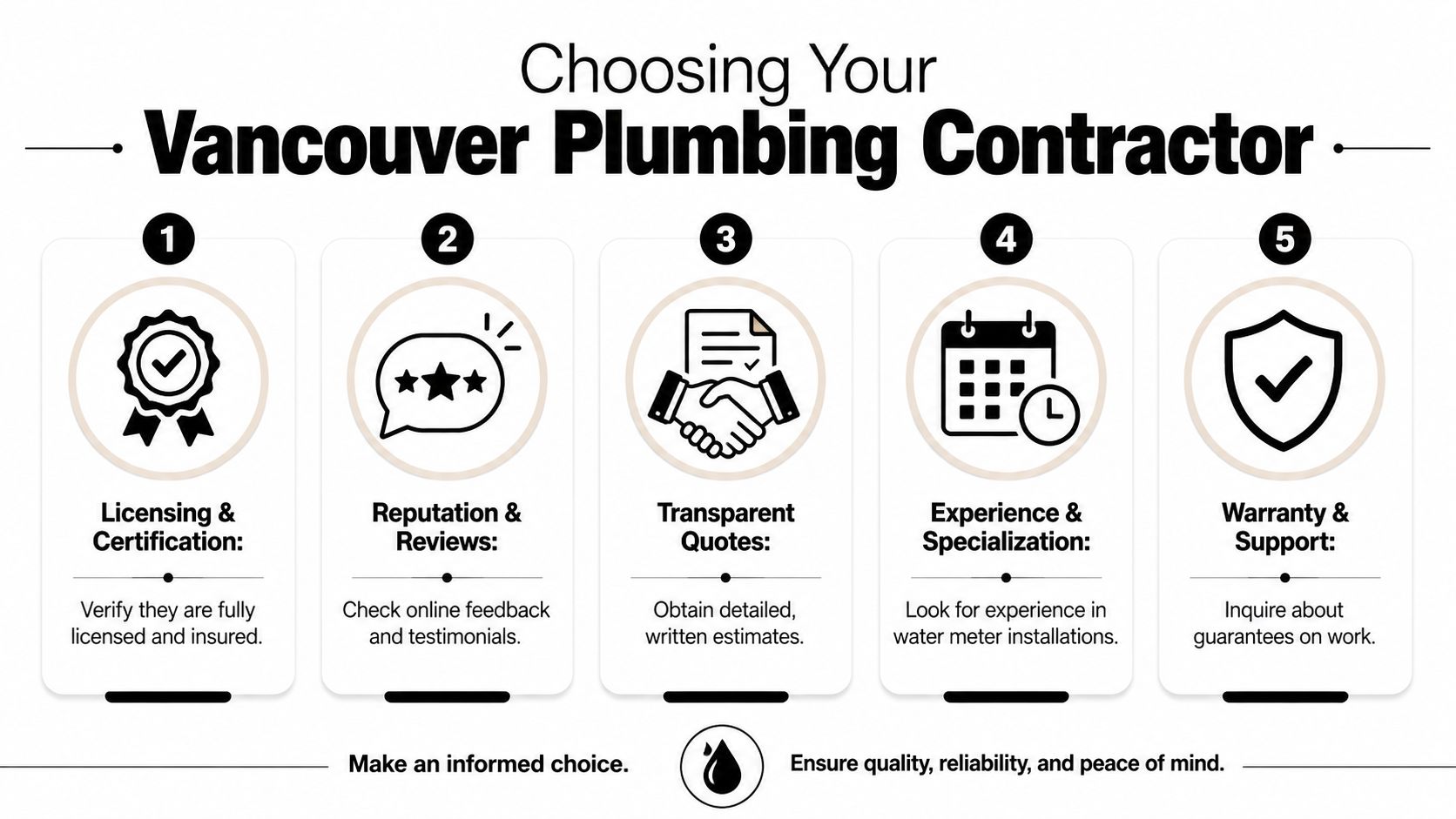
Choose a contractor who is licensed and insured, familiar with Metro Vancouver service conditions, and able to explain how the work fits local permit and inspection requirements. If they cannot speak clearly about placement, access, and sign-off, that is a warning sign. If you need a place to start, licensed plumbing help in Vancouver is the level of contractor you want for this kind of job.
What to ask before you hire
- Licensing and insurance: Verify both before anyone starts work.
- Local experience: Ask whether they have handled meter installs in Vancouver, Burnaby, or Richmond.
- Written scope: The estimate should spell out access work, testing, and permit-related coordination.
- Serviceability focus: They should understand clearances, future access, and inspection requirements.
- Warranty and support: Ask what happens if the installation needs adjustment after sign-off.
The contractor's process matters as much as the final connection. A rushed site review, vague permit answers, or uncertainty about municipal constraints usually means avoidable trouble later. A proper review should cover where the meter sits, how the work will be isolated, and what the inspector will need to see before approval.
One Vancouver property manager described a recent job in plain terms. The first crew gave a low quote but did not account for access. The second crew measured the room properly, coordinated the shutoff, and left the meter area clear enough for inspection. The cheaper option would have cost more in delays.
Local experience is what keeps the job on track. A contractor who understands Vancouver's permitting workflow, Burnaby's spacing expectations, and the practical realities of older homes in Richmond is less likely to create rework. For licensed, compliant plumbing support in the region, contact Encano Plumbing & Drainage Ltd. for a professional consultation and quote.