
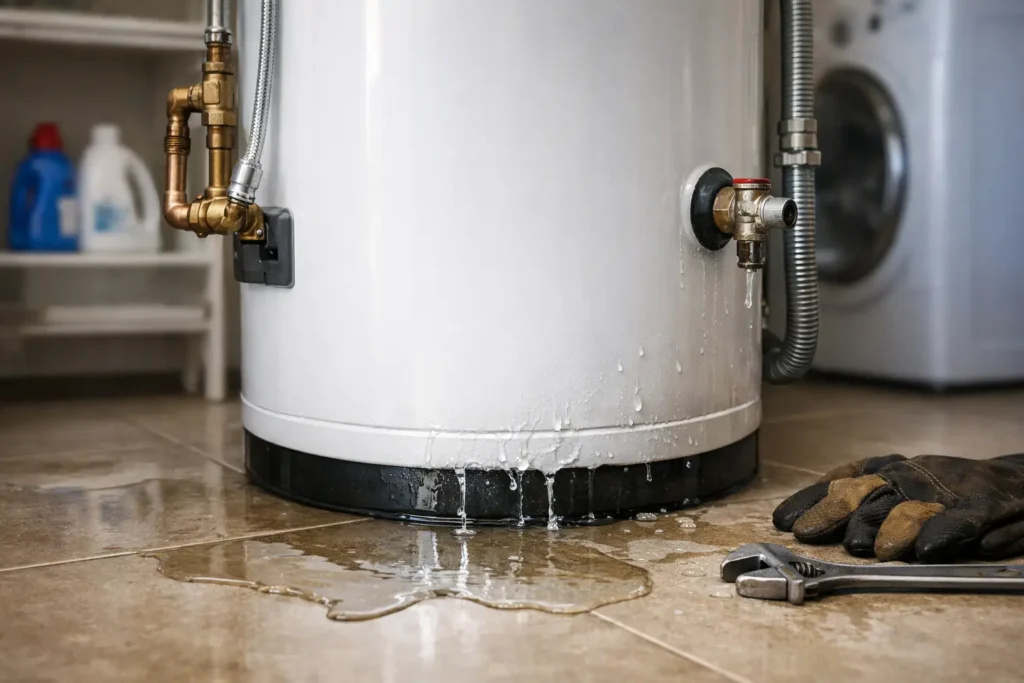
A puddle around the tank usually shows up at the worst time – before work, during a tenant call, or right when you realize the hot water is acting strange. If you’re asking why is water heater leaking, the answer can range from a loose connection to a failing tank, and the right next step depends on where the water is coming from.
Some leaks are minor and repairable. Others are a warning that the unit is near the end of its life. The key is not to assume every leak means replacement, but also not to wait and hope it stops on its own.
Why is water heater leaking from the top, side, or bottom?
The location of the leak tells you a lot. Water heaters can leak from fittings above the tank, valves mounted on the side, or the tank itself near the bottom. In some cases, the water only appears to be coming from one spot when it actually started somewhere else and ran along the jacket before dripping down.
That is why a quick visual check matters. Dry the outside of the unit if it is safe to do so, then watch carefully for fresh moisture. Start at the top and work your way down.
Leaks from the top are often the best-case scenario
If water is forming around the top of the heater, check the cold water inlet and hot water outlet connections. Over time, fittings can loosen slightly, seals can wear out, or corrosion can develop around the threads. These leaks are often straightforward to repair if caught early.
Another common source is the venting area on gas units, where condensation or improper drafting may create moisture that looks like a plumbing leak. That is a different issue than a cracked tank, but it still needs attention because venting problems affect both performance and safety.
Side leaks often involve valves or fittings
A leak from the side of the heater may point to the temperature and pressure relief valve, often called the T&P valve, or to nearby plumbing connections. This valve is designed to release water if pressure or temperature inside the tank gets too high. If it is dripping, the valve itself may be faulty, but it can also mean there is a larger pressure problem in the system.
That distinction matters. Replacing the valve may solve it, or it may only cover up what is really causing the pressure buildup.
Bottom leaks are more serious
If water is pooling from underneath the tank, sediment buildup or internal tank failure are common reasons. Sediment settles at the bottom over time, especially in areas with mineral-heavy water. As that layer thickens, it traps heat, strains the tank, and can speed up corrosion.
Sometimes the leak is from the drain valve near the bottom, which is better news because that part may be replaceable. But if the inner tank has rusted through, replacement is usually the only practical option.
The most common reasons a water heater leaks
Most leaking water heaters fall into a handful of categories. The trick is understanding which ones are relatively minor and which ones signal a larger failure.
Loose pipe connections
This is one of the simplest causes. The pipes that carry hot and cold water in and out of the heater can loosen from vibration, age, or past service work. Even a slow drip can create noticeable pooling over time.
A connection leak is often manageable if addressed early. Left alone, it can lead to corrosion around the fittings and damage nearby flooring or walls.
A faulty drain valve
The drain valve is used for flushing sediment from the tank. If it does not fully close, or if it has become worn, cracked, or bumped, it may drip steadily. This can look alarming, but it does not always mean the whole heater is failing.
That said, drain valves can be tricky. Overtightening or forcing them can make the problem worse.
A leaking T&P relief valve
The T&P valve is a safety device, so when it leaks, it should never be ignored. Sometimes the valve is worn out and simply needs replacement. In other cases, the heater is running too hot, system pressure is too high, or an expansion issue is forcing the valve to discharge.
This is one of those it-depends situations. The valve may be the problem, or it may be reacting exactly as it should.
Condensation mistaken for a leak
Not every wet water heater is actually leaking. Newer high-efficiency units and changing temperature conditions can produce condensation, especially when the heater is first warming a tank of cold water. In a cooler mechanical room, that moisture can collect and drip enough to look like a plumbing issue.
Condensation is more likely if the water appears briefly and then stops. A true leak usually continues or worsens.
Internal corrosion in the tank
This is the problem homeowners hope not to find. Traditional tank-style water heaters rust from the inside over the years. Once the steel tank itself is compromised, repairs are generally not cost-effective or reliable.
An aging tank that leaks from the body or base is typically ready for replacement. If the unit is already around 8 to 12 years old, a tank leak becomes much more likely.
What you can check safely before calling a plumber
A calm first response can prevent more damage. If the leak is active, start by turning off the power source. For an electric water heater, switch it off at the breaker. For a gas unit, use the gas control setting if you know how to do so safely. Then shut off the water supply to the heater.
Once the unit is safe, inspect the area around the top connections, the side valves, and the drain valve near the bottom. Look for rust streaks, mineral buildup, or active dripping. If the leak is clearly coming from a fitting or valve, that is useful information to share when you call.
Avoid taking apart gas lines, pressure relief components, or electrical covers. Water heaters involve heat, pressure, and sometimes fuel gas. A simple leak can quickly become unsafe if the wrong part is handled casually.
When a leaking water heater needs immediate service
Some leaks can wait a few hours for a scheduled appointment. Others should be treated as urgent.
If water is spreading across finished flooring, reaching electrical components, or leaking fast enough to keep pooling after you mop it up, it is time to act quickly. The same goes for heaters making popping noises, producing discolored hot water, or failing to deliver consistent hot water along with the leak.
For landlords and property managers, a leaking water heater is rarely just a plumbing issue. It can become a property damage claim, a tenant disruption, and a scheduling problem all at once. Fast diagnosis usually saves money compared with waiting for a minor leak to become a major cleanup.
Can a leaking water heater be repaired, or does it need replacement?
This depends on the source of the leak and the age of the unit. A bad valve, worn connector, or minor fitting issue can often be repaired without replacing the entire heater. Those are the outcomes everyone prefers.
If the tank itself is leaking, replacement is the honest answer. Tank repairs are not a durable fix. Even if one weak spot could be patched, another is often close behind.
Age matters here too. Putting money into repeated repairs on an older heater may not make sense, especially if efficiency is dropping and hot water supply is becoming less reliable. In many cases, replacement is the more cost-effective long-term move.
How to reduce the chance of future leaks
Water heaters usually give some warning before they fail completely, but only if someone is looking. Regular inspection helps catch corrosion, valve issues, and small drips before they turn into a larger problem.
Periodic flushing can reduce sediment buildup in tank-style heaters, although the value of flushing depends on the age and condition of the unit. On a heavily neglected older heater, aggressive flushing can sometimes reveal existing weakness rather than prevent it. That is why maintenance should be done with a bit of judgment, not as a one-size-fits-all routine.
It also helps to know how old your unit is and where the shutoff is located. Those two details make a real difference in an emergency.
If you are dealing with a leak in Vancouver or nearby and you are not sure whether the problem is a valve, a connection, or the tank itself, getting it checked sooner is the safest move. A small puddle can be a simple fix, or it can be the first sign that the heater is on borrowed time. Either way, the best next step is the one that protects your home before the damage spreads.