
You're already in the worst part of an AC failure. The house feels sticky, the air isn't moving right, and every room that used to be tolerable now feels like it's holding heat in the walls. In the Lower Mainland, that can turn from annoying to urgent fast, especially when a unit quits during a hot spell and the people inside aren't just uncomfortable, they're stuck waiting for the temperature to settle back down.
Emergency ac repair in Greater Vancouver isn't a generic summer service problem. It's tied to a climate where the normal July daily maximum in Vancouver is about 22.2°C, yet the city reached a record 34.4°C on 29 June 2021 during the Pacific Northwest heat wave, while BC Hydro later reported an all-time peak system demand of 8,112 megawatts on 28 June 2021 (Environment and Climate Change Canada and BC Hydro context). That's why a cooling breakdown in Vancouver, Richmond, Burnaby, Surrey, Delta, or nearby communities can turn into a genuine after-hours call instead of a wait-and-see issue.
Table of Contents
- Why AC Failures Hit Harder in the Lower Mainland
- Four Checks You Can Safely Do Right Now
- Secondary Risks Beyond the Compressor
- Deciding If Your Situation Justifies After-Hours Service
- Preparing for the Technician Visit
- Getting Fast Help from Encano Plumbing and Drainage
Why AC Failures Hit Harder in the Lower Mainland
A lot of people file AC trouble under a July annoyance. In the Lower Mainland, it is usually a timing problem. The system may hold on through most of the season, then one sharp heat event pushes the building, the electrical load, and the occupants all at once.
That is why a late-night call makes sense here. If a condo in Richmond or a townhouse in Burnaby loses cooling while the outside temperature has jumped far above the usual summer baseline, the indoor temperature does not stay comfortable for long. The 2021 Pacific Northwest heat wave is the clearest reminder of that, because Vancouver hit 34.4°C on 29 June 2021, and BC Hydro's system reached 8,112 MW the day before, on 28 June 2021 (regional heat benchmark and grid demand context). That combination matters. It shows how fast extreme weather can strain cooling systems and service capacity at the same time.
Why the local climate changes the repair timeline
Emergency service is often about the window, not just the fault. In a mild month, a weak system might stay a comfort problem. During a heat event, the same fault becomes a health and property issue because occupants are living inside the heat load, not outside it.
Practical rule: if the home is warming steadily and the unit has stopped responding after basic checks, treat it as time-sensitive rather than inconvenient.
The other reason this hits harder in the Lower Mainland is the concentration of occupied housing. Condos, rental suites, and strata buildings often rely on shared systems or tightly packaged equipment, which leaves less room for delay when cooling fails. The first move is to judge the environment carefully. If the unit failed during a heat spike, do not wait just because the calendar says “summer.”
A useful local comparison is the ordinary summer day versus the rare extreme one. Vancouver's normal July maximum is around 22.2°C, but the 2021 benchmark shows what happens when conditions go well past normal (local climate context). That gap is why fast-response service matters. In plain terms, ac emergency repair in this region is about matching the response to the weather, the building, and the people inside, not just the machine on the wall.
For homeowners who want a broader cooling and heating overview, a local guide to heating and cooling systems in the region is a useful starting point for understanding how the pieces fit together.
Four Checks You Can Safely Do Right Now
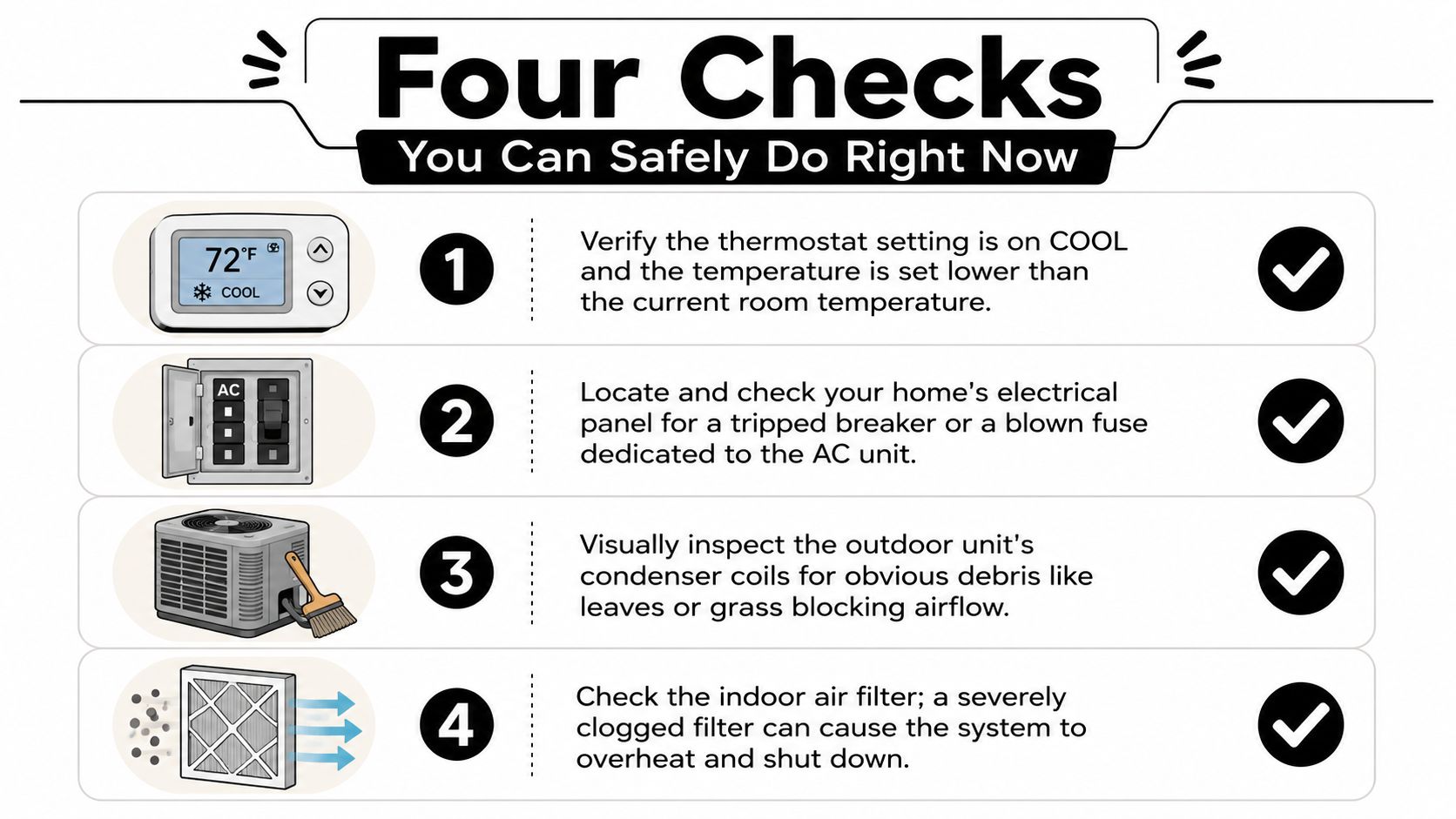
Start with the basics before you assume the worst. In the field, those first checks are often what separate a nuisance from a real failure, and they don't require tools, parts, or guesswork. The key is to look once, carefully, and stop if the issue looks electrical or mechanical.
Thermostat, breaker, filter, condenser
First, confirm the thermostat is on COOL and the setpoint is below the current room temperature. That sounds basic, but it's still the cleanest way to rule out a control issue. If the settings are right and the system still won't respond, move to the electrical panel and check for a tripped breaker dedicated to the AC. Do not keep resetting it if it trips again.
Next, inspect the indoor air filter. A heavily clogged filter cuts airflow and can make the whole unit behave like it's failing when it's really choking for air. Then step outside and look at the condenser. Clear leaves, grass, and anything else crowding the unit so the coil can breathe. A dirty or blocked outdoor unit can't dump heat properly, and that turns a simple complaint into a bigger service call.
If the filter is packed, the breaker is tripping, or the outdoor unit is buried in debris, you've already learned something useful. That information helps the technician move faster when they arrive.
A practical example helps here. If a Surrey townhouse stops cooling after a yard cleanup, and the outdoor condenser is half-covered in clippings, the fix might be simpler than it first looked. If a Richmond condo still doesn't respond after those checks, the problem is more likely deeper in the system, and that's when you stop testing and call for help.
Use the same logic with the air-conditioning repair guide if you want a broader sense of how service calls are usually triaged. The main thing is not to start opening panels or trying to bypass safety controls. Those are licensed-service jobs, not homeowner experiments.
Secondary Risks Beyond the Compressor
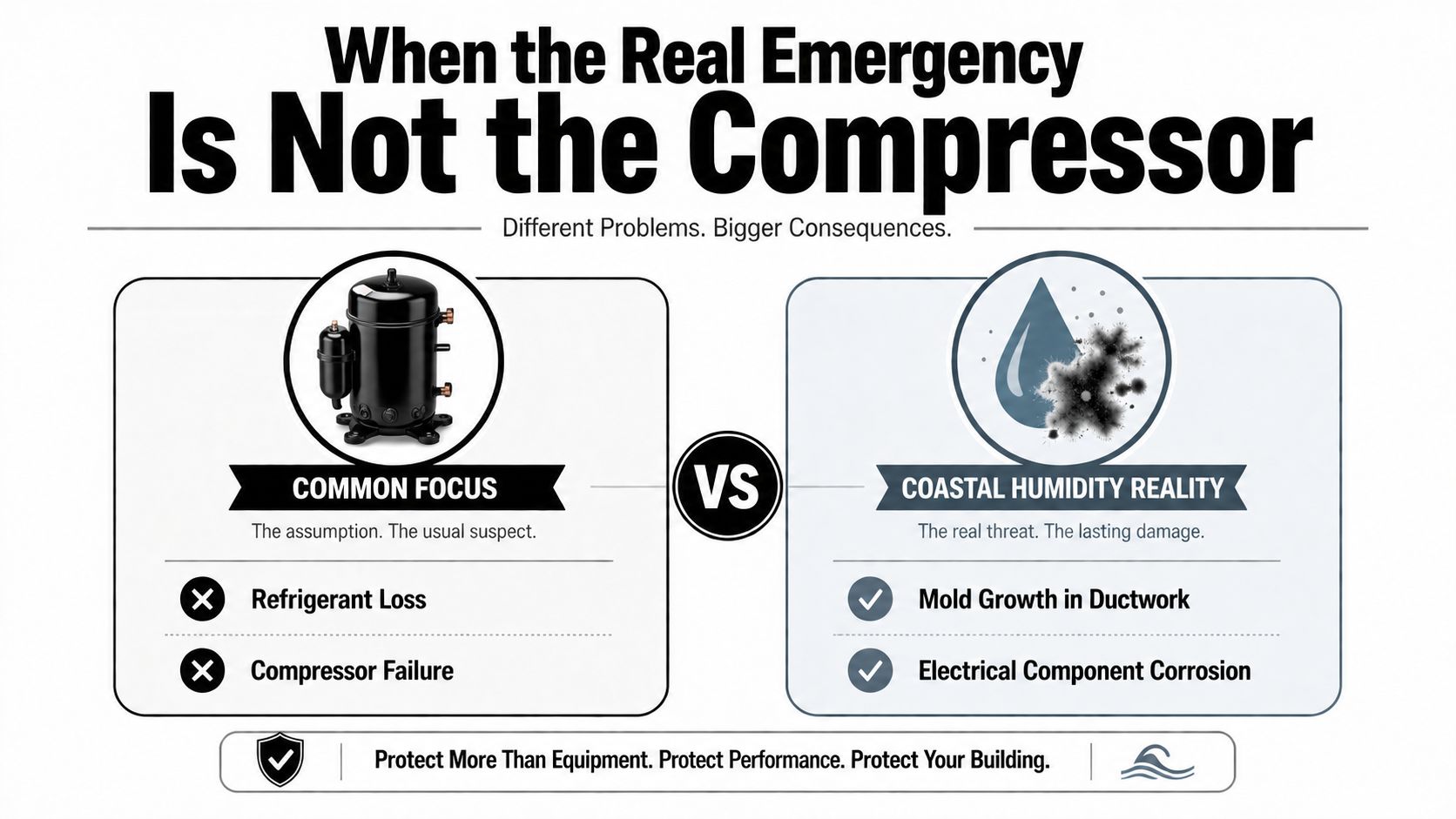
A lot of people hear “AC failure” and go straight to compressor concerns. That reaction makes sense, but in humid coastal housing the bigger danger is often the damage building up around the cooling system, not inside the compressor itself. Moisture, drainage, and electrical load are what usually turn a manageable fault into an after-hours call.
Drainage and airflow failures cause hidden damage
One benchmark detail matters here, duct leakage can waste up to 30% of energy (duct leakage benchmark). A complaint that sounds like “the AC is weak” may be an airflow delivery problem instead. In a Vancouver condo or a strata-heavy building, that is not just an efficiency issue. It can become a humidity and water-management problem too.
When condensate does not drain properly, water can back up into places it should never reach. In a unit with hidden drainage lines or a clogged trap, the first visible sign may be pooling, ceiling staining, or damp cabinetry, not a noisy mechanical failure. That is why coastal repair work often starts with water paths, not refrigerant assumptions.
What matters in the field: a unit that is still running but leaking, icing, or tripping repeatedly can be more urgent than a system that has simply stopped blowing cold air.
The electrical side is just as serious. In British Columbia, repeated breaker trips and burning smells are safety signals, not maintenance quirks. If you notice a hot-plastic smell or visible scorching, shut the system off and leave it off until a licensed technician inspects it. A Burnaby home with repeated trips does not need another reset. It needs a safe diagnosis.
For a related look at installation and control issues in tighter systems, this mini-split installation page gives a useful sense of how carefully these systems need to be handled in the first place.
The practical takeaway is direct. In humid, strata-heavy housing, the emergency is often secondary damage, not the headline part failure. Water damage, corrosion, repeat tripping, and indoor humidity spikes deserve the same urgency as a dead compressor because they can affect the building long after the room starts feeling cool again.
Deciding If Your Situation Justifies After-Hours Service
Not every cooling problem needs a midnight dispatch. Some do. The line comes down to people, building type, and what the system is doing to the space right now.
Health risk and building risk come first
If older adults, infants, or people with chronic conditions are in the home, the tolerance for delay drops fast. BC public-health guidance on heat risk makes it clear that indoor heat can become dangerous during extreme weather, especially for vulnerable occupants. That means a condo with no cooling during a heat event is not the same as a vacant suite with a mild airflow complaint.
Building type matters too. A central system failure in a strata common area, amenity room, or shared corridor can affect many residents at once, and that creates a different decision than a single-bedroom issue in a detached house. In strata settings, repair timing also intersects with responsibility under the Strata Property Act and related bylaws, because common-property systems need prompt attention when safety or habitability is on the line. A New Westminster property manager should document the fault, the impact, and the time the issue became apparent before waiting for business hours.
| Situation | Call immediately | Can likely wait until morning |
|---|---|---|
| Occupants | Older adults, infants, or people with chronic illness | Healthy adults with no heat sensitivity |
| Building type | Common-property system, corridor, amenity space, or critical use area | Vacant or lightly occupied space |
| System behaviour | Breaker trips, burning smell, active leak, rapid temperature rise | Mild comfort loss, unit still stable |
Use the room, not the calendar, as your guide
A practical example helps. If a Vancouver condo loses cooling during a heat spike and the indoor temperature is climbing while the unit keeps tripping the breaker, that's an after-hours call. If a second home in Delta is empty and the system is running weakly but the space is stable, waiting may be reasonable.
Document the decision. Note the time, the indoor conditions, the symptoms, and who was affected. That's useful for strata records, landlord notes, and any later repair discussion.
This is also where you avoid false urgency. A system that is less efficient is not the same as one that is threatening health or property. AC emergency repair becomes justified when the failure creates a safety issue, a moisture issue, or a meaningful habitability problem, not just when the room feels warmer than you'd like.
Preparing for the Technician Visit
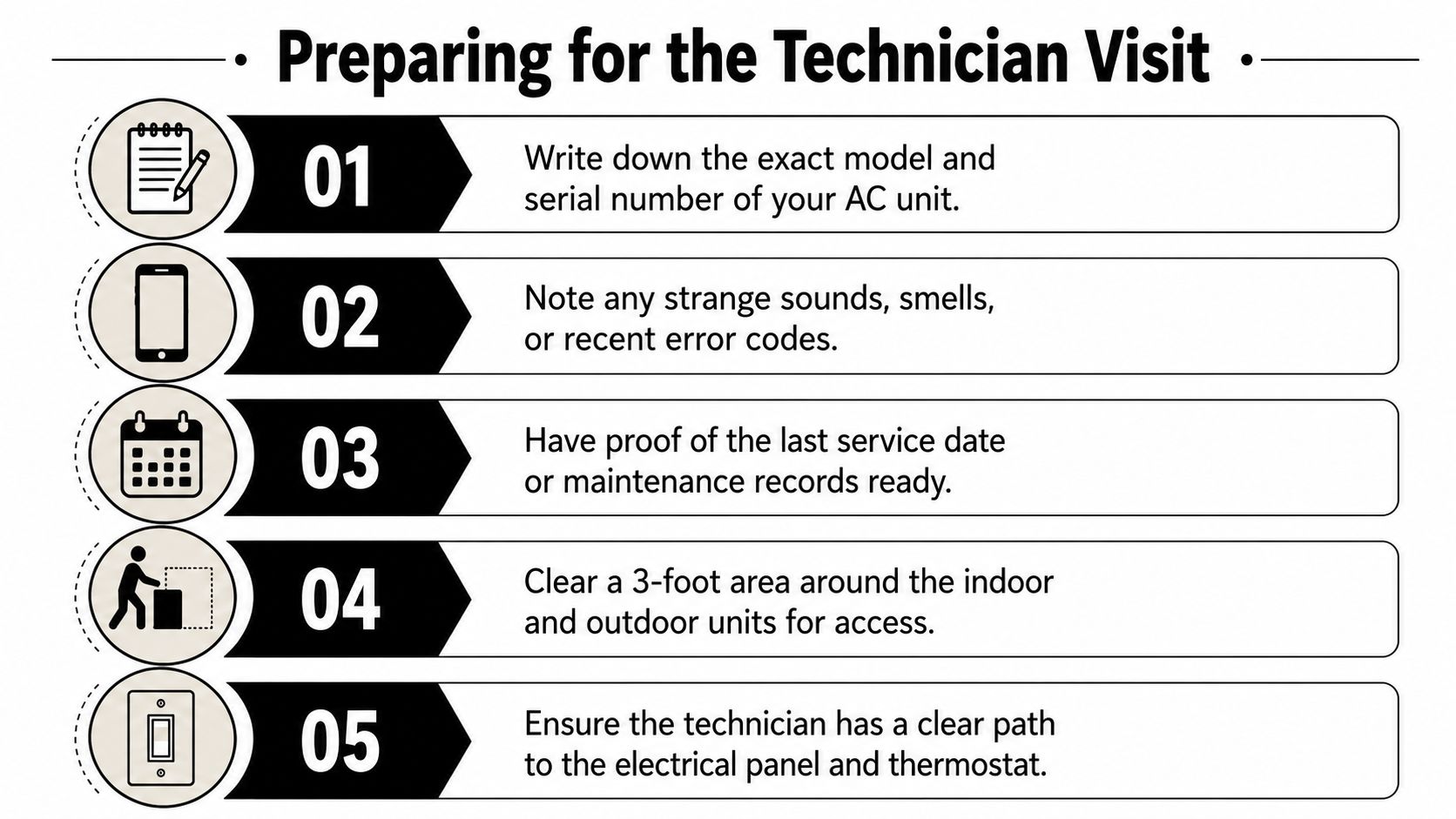
The fastest repair jobs usually start before the technician arrives. A clean access path, a few notes, and the right records cut down on back-and-forth and help the diagnosis land faster.
What to gather before the truck pulls up
Write down the exact model and serial number if you can find them. Keep the last service date handy, and note any recent maintenance, filter changes, or odd behaviour. The most useful symptom notes are the plain ones, like strange sounds, a burning smell, repeated breaker trips, weak airflow, or water around the unit.
- Model and serial information: Copy it from the equipment label so the technician can verify parts and system type quickly.
- Symptom timeline: Note when the problem started and whether it got worse after a heat spike, power blink, or filter change.
- Access and clearances: Make space around the indoor and outdoor units, and keep pets secured so the visit doesn't turn into a delay.
- Building records: For strata or rental properties, keep notes ready for the manager, owner, or insurer if water or electrical issues are involved.
- Panel and thermostat access: Make sure the technician can reach the electrical panel and thermostat without hunting through locked rooms or storage areas.
A practical example: if a Burnaby condo has both a leak and a breaker issue, a photo of the water location and the tripped breaker position can save time on site. If the building manager also has a maintenance log from the last visit, the technician has a better shot at narrowing the cause on the first pass.
Clear notes beat vague ones every time. “It stopped working” is less useful than “it tripped twice after ten minutes and there was a hot smell near the vent.”
If you're dealing with a strata building, this is also where records matter for responsibility. Keep the repair request, the time of the call, and the visible impact on the unit or common area. That documentation helps separate a building-system issue from a local one.
Getting Fast Help from Encano Plumbing and Drainage
Encano Plumbing & Drainage Ltd. fits this kind of call because the work often isn't just about cooling. Their team serves Vancouver, Richmond, Burnaby, New Westminster, Delta, Surrey, and nearby communities, and they handle 24/7 emergency response for residential, commercial, and government buildings. They also work with modern diagnostic tools such as video inspection and acoustic leak detection, which matters when the issue is hidden drainage, not just “no cooling.”
That's the right kind of service model for strata-heavy housing and coastal conditions. A technician can use the symptom trail you've already gathered, then check for the kind of secondary failure that turns into damage if it's left alone. For a practical example, a condo with water around the air handler and repeated electrical trips needs a service approach that looks at both the cooling system and the building conditions around it.
Encano also lets customers book online or by phone, which is useful when you're juggling property access, occupant safety, or a repair note for a strata file. Their team has more than 10 years of experience, and they use transparent pricing so you know what's being addressed before work starts. That combination is what matters in an urgent call, clear diagnosis, clear options, and a response that treats the building as part of the problem, not just the machine.
If your cooling has failed and you're seeing leaks, breaker trips, or rising indoor heat, contact Encano Plumbing & Drainage Ltd. for 24/7 help across Greater Vancouver. Their team handles emergency HVAC and drainage-related issues with the tools and response timing that fit this kind of problem.