
You're probably dealing with one of two situations right now. Either your condo gets uncomfortably hot every summer and you're tired of fighting it with fans and closed blinds, or your building already has some form of cooling and it isn't performing the way it should. In Metro Vancouver, both are common.
The tricky part is that air conditioning for condos isn't the same as buying a system for a detached house. In a house, the question is usually what to install. In a condo, the first questions are often what the building allows, where equipment can go, whether the electrical system can support it, and how you'll manage condensate without creating a leak risk for the suite below.
A lot of owners start by comparing products. Strata councils start by thinking about noise, façade changes, and maintenance responsibility. Both are reasonable. Good condo cooling decisions sit in the middle, where comfort, building rules, and installation reality all line up.
Table of Contents
- Why Condo Cooling Is a Necessity in Vancouver
- Decoding Your Condo Air Conditioning Options
- Navigating Strata Bylaws and Building Permits
- Estimating Costs and Finding the Right Value
- The Installation Process What to Expect
- Long-Term Maintenance for Condo AC Systems
- Your Path to a Cooler Vancouver Condo
Why Condo Cooling Is a Necessity in Vancouver
A common Vancouver scenario goes like this. The unit looks great on paper: large south or west exposure, generous glazing, concrete construction, clean modern finishes. Then summer hits, afternoon sun pours through the windows, and the place turns into what owners often describe as a glass box in the sky.
That's no longer a niche complaint. In Canada, air conditioning has moved into the mainstream. Statistics Canada data cited in a national housing analysis shows that 77% of households reported having some type of air conditioner in 2023, up from 64% in 2021. That shift matters because it changes what buyers, tenants, and councils treat as normal housing infrastructure, not just an optional upgrade, as noted in this Statistics Canada benchmark discussion.
For condos, that creates pressure in a very specific way. Detached homes usually have more freedom for equipment placement, power upgrades, and duct changes. Condo owners don't.
Practical rule: In a condo, cooling problems are usually solved by building-compatible planning, not by picking the most powerful unit on a product shelf.
A west-facing one-bedroom in Yaletown, for example, may need cooling badly, but that doesn't mean any system is installable. The owner still has to deal with exterior appearance rules, limited balcony space, potential noise complaints, and whether the electrical panel can take a new load. In older buildings, even a simple drain route can become the detail that makes or breaks the project.
That's why the condo conversation in Vancouver has changed. The question isn't whether cooling matters. It does. Instead, the question is which solution the building can support without creating a bylaw fight, a water issue, or an expensive do-over.
Decoding Your Condo Air Conditioning Options
Not every condo can take every type of AC system. The practical shortlist is usually smaller than most owners expect.

Ductless mini-splits
For many retrofits, the ductless mini-split is the first serious option worth looking at. It works well when the condo has no existing ductwork and needs targeted cooling in one or more zones.
Its strength is flexibility. You can cool the living area, add a head in a bedroom if the layout supports it, and avoid opening ceilings for large duct runs. The weakness is that it still needs an outdoor condenser, a route for refrigerant lines, power, and condensate drainage. In condos, that's where projects get complicated.
Independent condo retrofit guidance notes that electrical and installation feasibility are often the main constraints, and it gives practical sizing ranges of about 8,000 to 12,000 BTU for studios and one-bedrooms and 18,000 to 30,000 BTU for larger two-bedroom units, with actual selection adjusted for window area, solar gain, and exposure, as outlined in this condo AC retrofit guide.
Best for: Older low-rise condos, suites without ducts, and owners who have a workable condenser location approved by strata.
Fan coil systems in condo towers
In many BC towers, the building already has a shared cooling architecture. The most common setup is a fan coil unit, or FCU, tied to a central chilled-water plant.
Owners sometimes assume poor cooling indicates a need for a new in-suite AC system. Often, the problem is within the existing fan coil setup. Coil fouling, a sticky valve, poor balancing, drain issues, or building-side chilled-water performance can all reduce comfort. Replacing the in-suite box without looking at the shared system can miss the underlying fault.
Independent condo HVAC guidance also notes that fan coil systems commonly last about 20 to 25 years, which makes replacement planning relevant in older towers, as explained in this fan coil unit overview.
A practical example: a strata council gets several complaints that upper-floor units aren't cooling well. The first instinct is to blame individual fan coils. Sometimes that's right. But if multiple suites are reporting the same thing, the better first move is to review building-side chilled-water conditions and service history before authorising suite-by-suite replacements.
Best for: Buildings that already use central hydronic cooling and need maintenance, replacement planning, or better diagnostics rather than a brand-new standalone system.
Heat pumps for owners thinking beyond one hot season
A heat pump often enters the conversation when the owner wants both cooling and heating from one system. In condo retrofits, that usually means a mini-split style system rather than a conventional ducted house setup.
The key trade-off is value over time, not just immediate relief. In the Lower Mainland, the decision can be less straightforward than it sounds because some suites mainly overheat due to orientation, glazing, and envelope conditions. In that case, the question isn't only which unit is best. It's whether the installation cost makes sense for how the suite behaves through the year.
The U.S. Department of Energy notes that ductless mini-splits provide zoned cooling without ducts and are widely used in multifamily buildings, which is why many condo owners start there when comparing electrified heating and cooling options through this ductless mini-split overview.
A heat pump can be the right answer for a condo, but it won't fix bad sun exposure, poor shading, or glazing-heavy heat gain on its own.
Best for: Owners replacing aging equipment, suites that need both heating and cooling, and buildings where the installation path is already realistic.
Portable and window units
These are the fallback options when permanent installation isn't allowed or isn't worth the complexity.
Portable units are simple to get running, but they take floor space, create noise inside the suite, and usually feel like a compromise rather than a proper solution. Window units can cool a room effectively, but they're often a problem in condos because of appearance rules, window configurations, safety concerns, and blocked views.
There's also the governance issue. Generic product advice often ignores the basic condo reality that exterior equipment and visible alterations may not be allowed at all. Condo-specific guidance consistently points owners back to association rules and condenser location first, because that usually determines what is possible, as discussed in this condo cooling restrictions article.
Best for: Temporary relief, rentals, or buildings where permanent exterior equipment isn't approved.
Condo AC options at a glance
| System Type | Typical Installed Cost | Cooling Performance | Strata Approval Likelihood |
|---|---|---|---|
| Ductless mini-split | Varies by layout, line routing, electrical work, and condenser location | Strong when properly sized and installed | Moderate if exterior placement and penetrations are allowed |
| Shared fan coil system | Varies by whether work is in-suite service, component replacement, or broader building mechanical work | Good when the central plant and in-suite components are both working properly | Usually tied to existing building infrastructure and process |
| Heat pump | Usually higher than a temporary solution because installation complexity matters | Strong, with added heating capability | Moderate, depends on condenser placement and building rules |
| Portable AC unit | Lowest barrier to entry in many cases | Limited compared with fixed systems | Often easier, but bylaws may still affect venting and appearance |
| Window AC unit | Product cost may be simple, but condo suitability often isn't | Room-level cooling only | Often low in many strata buildings |
If you're comparing retrofit paths and want a broader look at building heating and cooling system types, this overview of heating and cooling solutions is a useful starting point.
Navigating Strata Bylaws and Building Permits
For most condo owners, this is the step that decides everything. If the strata won't approve the work, the equipment choice doesn't matter.

What strata usually cares about
Strata councils rarely object to cooling in principle. They object to unmanaged risk.
The usual concerns are straightforward:
- Exterior appearance: Will the condenser be visible from the street, courtyard, or neighbouring units?
- Noise impact: Will another owner hear the unit cycling on at night?
- Building envelope risk: Will wall penetrations be sealed correctly?
- Water risk: Where will condensate go, and what happens if the drain blocks?
- Service responsibility: Who maintains the unit, and who pays if it causes damage?
A practical example helps here. An owner submits a one-page request asking to install a mini-split on the balcony. No drawing. No mention of drain routing. No contractor insurance. No equipment details. Councils usually delay or reject that kind of application because it leaves too many unanswered questions.
Councils approve clear plans faster than vague intentions.
What a strong application package looks like
A good submission answers the council's real worries before they have to ask.
Include items like these:
Equipment details
Provide the make and model of the indoor and outdoor units, plus dimensions so the council can understand visual impact and space requirements.Placement drawing
Show exactly where the condenser will sit or mount. If it's on a balcony, show clearances. If it's on a roof or common area location allowed by the building, show access and support method.Condensate plan
Explain how water will drain. In condos, this isn't a minor detail. A poor drain setup can affect your suite and the one below.Penetration and sealing method
If the installation requires drilling through an exterior wall, state how the opening will be sealed to protect the building envelope.Contractor credentials
Attach licence, insurance, and contact information. Councils want to know that qualified trades are doing the work.Electrical review
Confirm that the panel and circuit capacity have been checked and that any required electrical work will be done properly.Maintenance responsibility statement
Clarify who is responsible for servicing the system, keeping drains clear, and handling repairs if something fails.
Some buildings will also want written acknowledgement that the owner is responsible for future removal or damage related to the installation. That's common and sensible.
When councils see a complete package, the tone of the conversation changes. It becomes a review of a managed project instead of a debate about an unknown risk.
Estimating Costs and Finding the Right Value
Condo AC pricing is rarely about the box itself. The equipment matters, but the installation variables usually decide whether a quote feels reasonable or surprisingly high.
What drives the real price
A simple condo job stays simple only if several things line up. The electrical panel has room. The condenser location is approved. The line set route is short and accessible. The drain can be run safely. Access to the suite and work area is straightforward.
Costs tend to climb when those conditions aren't there. Concrete drilling, longer line runs, difficult balcony access, tighter finishing requirements, and additional electrical work all add labour and coordination. In high-rises, even moving tools and materials through elevators and booking building access can slow the job down.
If you're comparing system budgets, it helps to understand how broader cooling projects are priced, including labour and system scope, in guides such as this overview of the cost to install central air.
Value isn't only about equipment
The better question in Vancouver isn't always “What's the cheapest way to get cold air?” It's “What solves the overheating problem in a way that fits the suite and the building?”
That matters because some suites overheat mainly due to afternoon exposure, large windows, and building-envelope conditions. In those cases, a high-end system may still leave the owner unhappy if the layout, shading, or control strategy aren't addressed. The value proposition in the Lower Mainland is different from inland markets with a more obvious cooling load profile.
A practical example: two similar condos may not justify the same system. One has manageable heat gain and needs dependable bedroom cooling at night. A single-zone solution may be enough. The other gets hammered by west sun across the main living space and still feels warm well into the evening. That owner may need a different layout, better zone planning, or a decision that includes heating benefits as well.
Good value comes from matching the system to the suite's actual problem, then making sure the building will support the installation cleanly.
The Installation Process What to Expect
A proper condo installation should feel organised, controlled, and boring in the best way. There shouldn't be guesswork about where lines are going, how the drain will run, or whether the condenser location complies with strata conditions.
Before tools come out
The first part of the job happens before installation day. The contractor confirms equipment placement, checks access rules with the building, reviews the approved plan, and verifies electrical readiness.
This step matters because condo retrofits are often limited more by installation feasibility than by cooling demand. Practical sizing guidance for these projects commonly lands around 8,000 to 12,000 BTU for studios and one-bedrooms and 18,000 to 30,000 BTU for larger two-bedroom units, but the final choice still needs to reflect solar gain, window area, and exposure, as described in the earlier retrofit guidance.
What happens on installation day
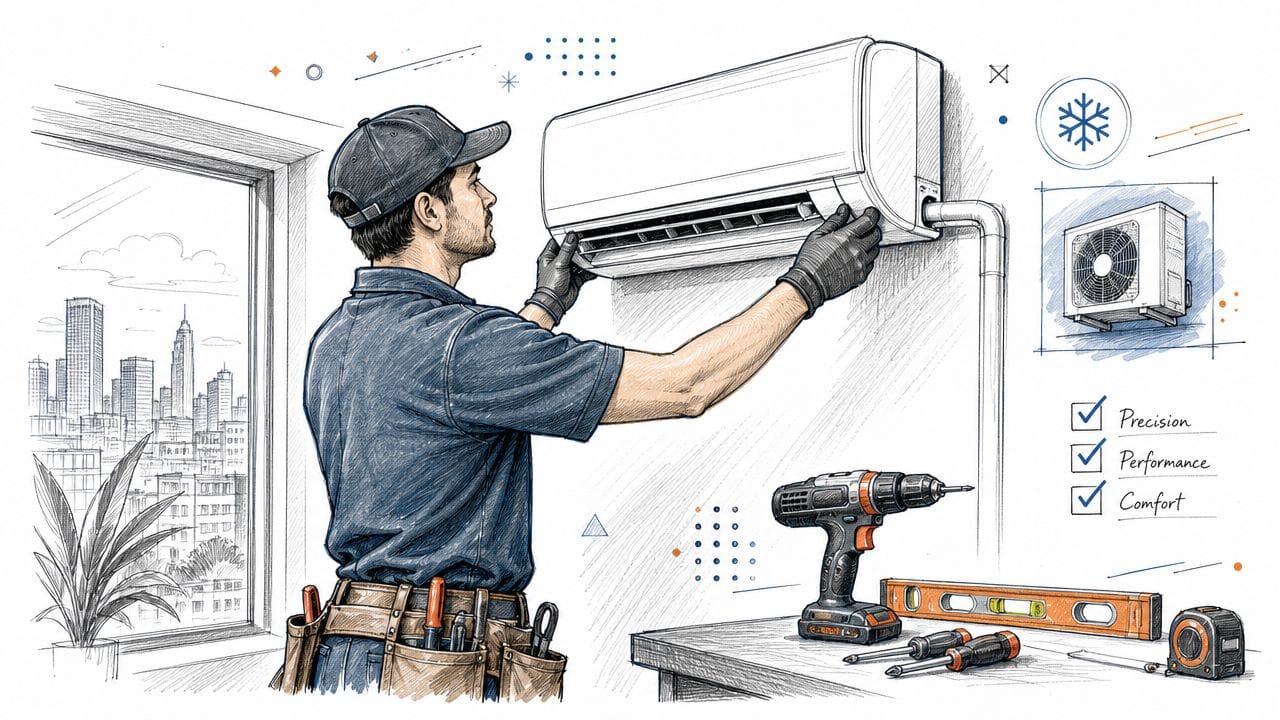
The sequence is usually fairly consistent for a ductless system:
- Protection first: Floors, walls, and work areas are covered. In condos, technicians also need to keep common areas clean and follow elevator or move-in booking rules if the building requires them.
- Indoor unit layout: The wall-mounted head is positioned where airflow makes sense and service access remains possible.
- Core drilling or wall penetration: If the line set needs to pass through an exterior wall, the opening has to be placed carefully and sealed properly afterward.
- Line set and drain routing: Refrigerant lines, control wiring, and condensate drainage are run together in the cleanest workable path.
- Outdoor unit placement: The condenser is mounted or set where the approved plan says it will be, with attention to clearance, vibration control, and service access.
- Electrical connection: The dedicated power supply and disconnect arrangement are completed by the appropriate trade.
A practical example: in a concrete tower, the nicest-looking indoor location may not be the best installation choice if it forces a long drain route with poor fall. In that case, moving the head slightly can prevent future water issues. That's the kind of decision experienced installers make early, not after a leak.
Here's a visual example of the type of installation work condo owners often see during a ductless project:
The final checks that matter in condos
The closeout matters as much as the rough-in.
A professional team should pressure-test, commission, and verify operation. Just as important in a condo, they should confirm the drain is moving properly, the wall penetration is sealed, and the system location still matches the approved strata plan.
Field note: In multi-unit buildings, a small condensate mistake can turn into a neighbour complaint, a ceiling stain, or an insurance problem very quickly.
This is also where a qualified local contractor helps. A company such as Encano Plumbing & Drainage Ltd. handles plumbing, heating, and HVAC work in Greater Vancouver, which is relevant when a condo project involves both cooling equipment and condensate management details.
Long-Term Maintenance for Condo AC Systems
A condo AC system doesn't need constant attention, but it does need routine care. The owners who stay ahead of small maintenance items usually avoid the bigger headaches.
What owners can handle
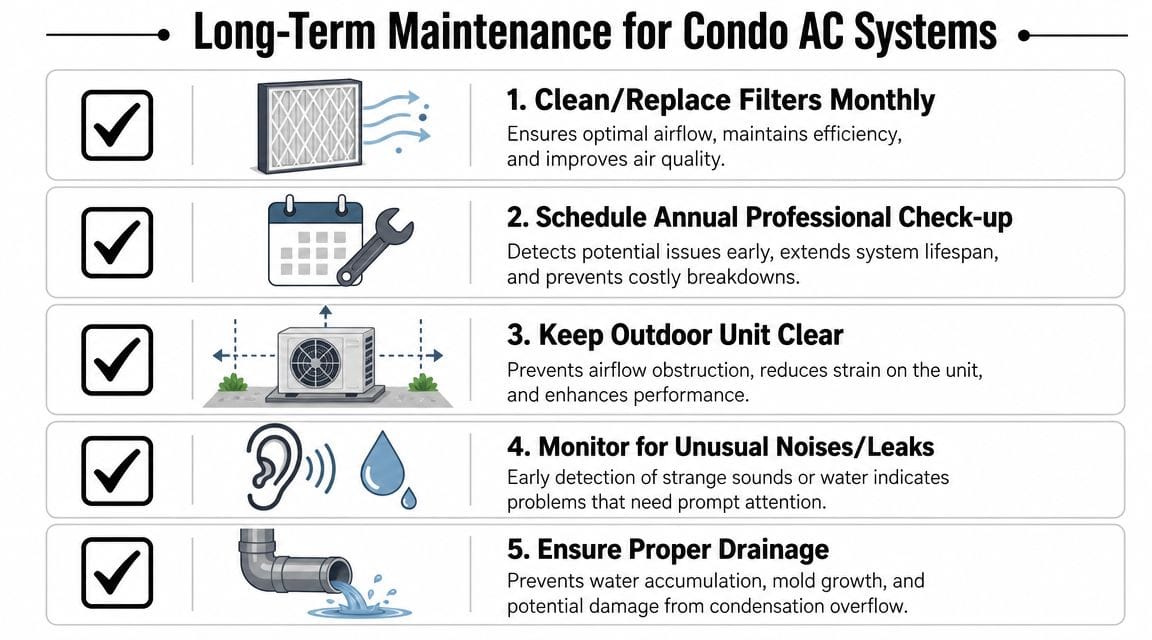
Keep the basic upkeep simple and consistent:
- Clean or replace filters: Dirty filters reduce airflow and make the system work harder.
- Watch for water: If you see dripping, staining, or moisture near the indoor unit, don't wait.
- Listen for changes: New rattles, buzzing, or drain sounds often mean something needs attention.
- Keep access clear: Don't crowd the indoor unit with shelving, curtains, or stored items.
A practical condo example is the drain line. When it starts clogging, the first sign may be minor dripping. If that gets ignored, it can become cabinet damage, flooring damage, or a complaint from the unit below.
What should be left to a technician
Annual professional service is where the system gets a proper check. That typically includes coil condition, electrical connections, drainage, controls, and overall performance.
If your building uses shared equipment or older in-suite components, regular service becomes even more important because one comfort complaint can involve both suite-level and building-level issues. If you need troubleshooting or service support, this page on air conditioning repair covers the kinds of issues technicians are commonly called to address.
If a condo AC system is making noise, leaking, or cooling unevenly, early service is cheaper and simpler than waiting for a breakdown in the middle of hot weather.
Your Path to a Cooler Vancouver Condo
Good air conditioning for condos starts with realism. Not every system fits every building, and the best product on paper can still be the wrong choice if the strata won't approve it or the suite can't support the installation cleanly.
The owners and councils that get this right usually follow the same pattern. They identify the actual overheating problem, review what the building allows, confirm electrical and installation feasibility, and choose a system that can be maintained without creating future risk. That's what keeps a cooling project from turning into a bylaw dispute or a leak claim.
If you're a condo owner, don't buy equipment first and ask questions later. If you're on a strata council, ask for complete submissions with placement, drainage, and service details before approving anything. The process is more important than the product brochure.
A cooler condo is absolutely achievable in Vancouver. It just takes the right plan for the building you have, not the one a generic AC article assumes you live in.
If you need help assessing what's installable in your suite or building, Encano Plumbing & Drainage Ltd. can review the cooling approach, the drainage and electrical considerations, and the practical constraints that come with strata-governed condo work in Greater Vancouver.