
It's late, the house is holding heat, and the AC has gone quiet right when the baby finally fell asleep. In Richmond, Burnaby, or anywhere else in Greater Vancouver, that moment feels different in July than it would on a mild spring night, because a cooling failure can move from annoyance to safety issue fast. The right response is calm triage, not panic, and not blind resetting.
Table of Contents
- When a Cooling Failure Stops Being a Comfort Problem
- Immediate Safety Steps Before You Touch Anything
- Four No-Tools Checks That Solve Most After-Hours Calls
- Deciding Between Emergency Dispatch and a Scheduled Visit
- What Happens When an Emergency HVAC Truck Arrives
- Repair or Replace and How to Prevent a Repeat Emergency
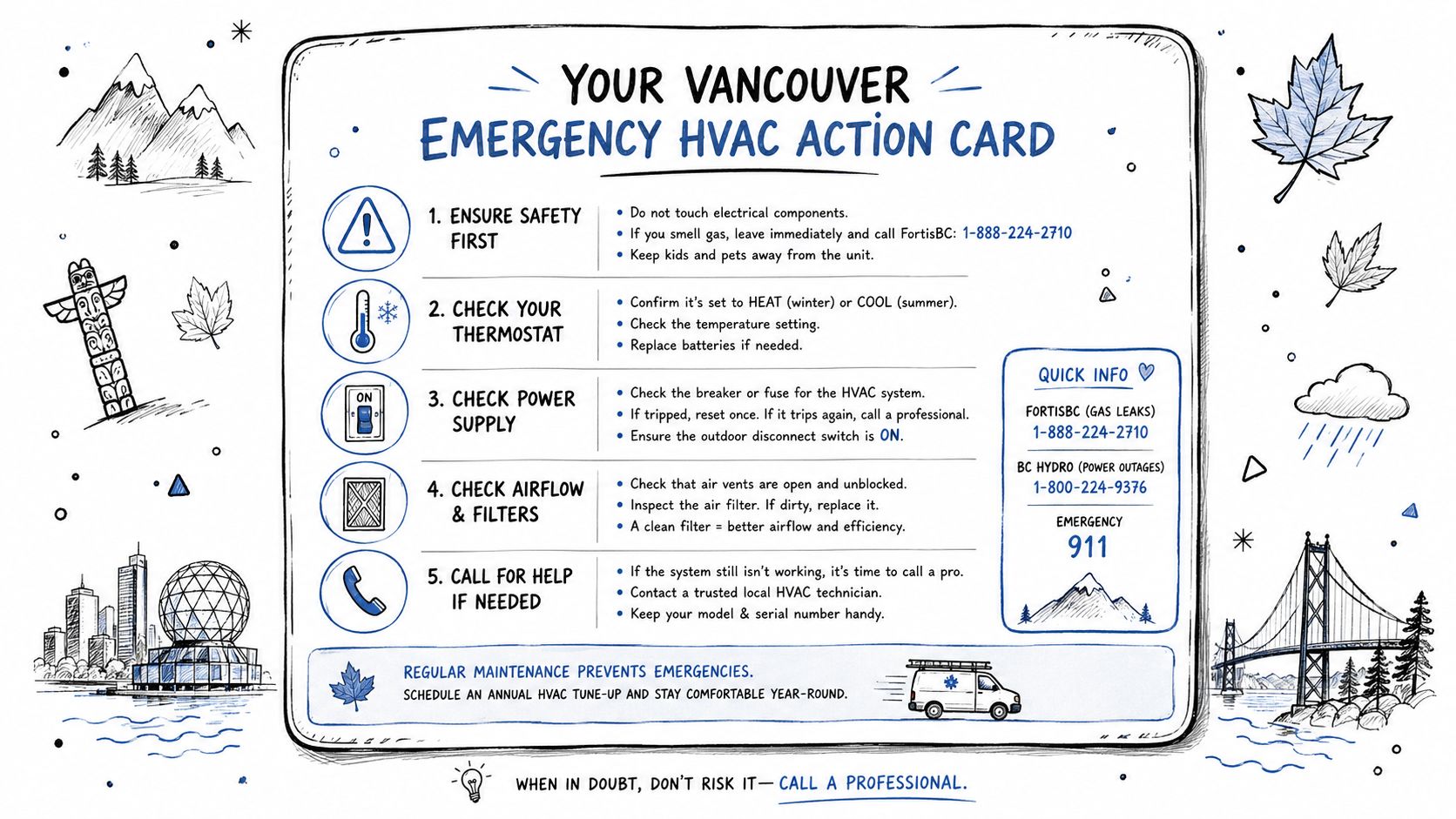
- Your Vancouver Emergency HVAC Action Card
When a Cooling Failure Stops Being a Comfort Problem
A Richmond townhouse on a July evening can turn uncomfortable in under an hour. The upstairs bedrooms start to hold the day's heat, a sleeping infant gets restless, and the thermostat keeps calling for cooling while the outdoor unit sits silent. That's the moment most homeowners start asking the key question, is this an emergency, or can it wait until morning?
The answer depends on more than the machine itself. In California, public-health reporting cited by the UCLA Luskin Center for Innovation and the California Environmental Protection Agency's Office of Environmental Health Hazard Assessment recorded 7,118 heat-related deaths from 2010 to 2020, and more than 4,000 of those happened during the 2020, 2021, and 2022 heat seasons alone. That data is not from British Columbia, but it shows the basic point clearly, prolonged heat turns cooling into a life-safety issue, not a luxury. California research also notes that in 2022, roughly two-thirds of households had central air conditioning, yet access was much lower in older and disadvantaged housing stock, which is exactly the kind of gap that makes a failed system feel urgent in the wrong building at the wrong time. California heat and cooling context
Why Greater Vancouver feels different at night
Richmond and Burnaby don't need desert-level heat to create a problem. The BC Centre for Disease Control says extreme heat can be dangerous even in temperate coastal climates, and Environment and Climate Change Canada's regional climate data show Metro Vancouver has seen increasing heat extremes, including the 2021 heat wave that contributed to hundreds of heat-related deaths across British Columbia. A top-floor suite, a townhouse with limited airflow, or a home with an older system can become a health risk before the temperature outside feels outrageous. Metro Vancouver heat risk context
The practical question isn't, “Is the air conditioner broken?” It's, “Who's inside, how hot is it getting, and can we keep people safe until a technician arrives?” If you have older adults, infants, chronic illness, or a poorly cooled unit, the threshold for calling shifts fast.
Practical rule: if cooling loss starts affecting sleep, breathing, medication tolerance, or basic safety, treat it like a real emergency, not a comfort complaint.
What an Encano truck is assessing at 11 p.m.
An emergency call in Greater Vancouver usually starts with the dispatcher asking about symptoms, then the technician arriving ready to separate a simple control problem from a real mechanical failure. The first job is to figure out whether the system is unsafe, whether it's fixable on the spot, or whether the only honest answer is a temporary stabilisation and a follow-up quote. That's the same logic that matters in your house before anyone touches a panel or cover.
Practical example: if a Burnaby townhouse is heating up through the evening, the family has one infant upstairs, and the AC won't restart after one breaker trip, that's not the same as a detached home in Surrey on a cool night with no vulnerable occupants. The same broken system can be an emergency in one case and a next-day appointment in the other.
Immediate Safety Steps Before You Touch Anything
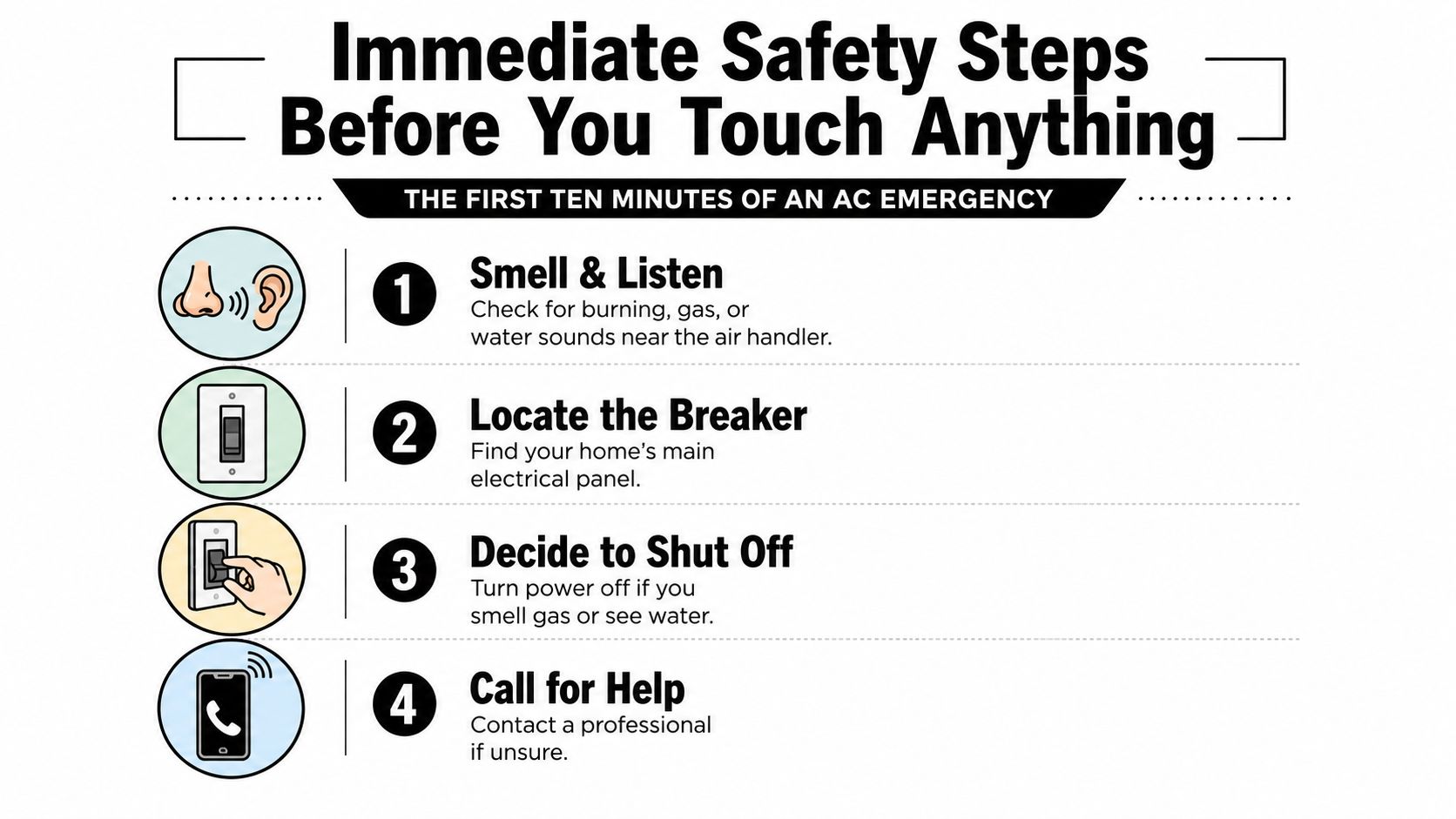
The first ten minutes decide whether you're dealing with a service call or a safety event. Start with your senses, not the thermostat. If you smell burning, hear crackling, see smoke, or notice water around energized equipment, stop right there and isolate the area.
Deal with hazards before airflow
If there's a burning smell, electrical damage, sparking, or repeated breaker trips, shut power off at the breaker if you can do it safely. If you smell gas, suspect combustion backdraft, or hear alarms, leave the area and call the gas utility or emergency services rather than trying to diagnose the HVAC equipment yourself. Health Canada's indoor air quality guidance says suspected carbon monoxide exposure means getting fresh air immediately, because carbon monoxide is colourless and odourless and symptoms can include headache, dizziness, nausea, and confusion. Carbon monoxide safety guidance
Water changes the rule too. A pooled leak around an air handler or condenser can be a plumbing issue, a drain issue, or an electrical hazard if the breaker is still live. In BC, employers must provide a working environment that is safe and without risks to health, and WorkSafeBC expects hazards to be identified, assessed, and controlled. That logic applies cleanly in a condo mechanical room or a home utility closet, if water and electricity meet, the risk comes first, the repair second. WorkSafeBC hazard control context
Practical example: a Burnaby top-floor suite has water pooling around a ceiling air handler and the breaker keeps tripping. The right response is to isolate power once, keep people away from the area, and call for service. Repeatedly resetting the breaker can hide the fault and put the equipment back into a live failure state.
Know when the situation is already beyond DIY
BC emergency guidance treats indoor temperatures above 95°F or below 50°F as unsafe, and that's the point where you stop treating the problem like a casual comfort issue. If the home is becoming dangerously hot, if someone feels unwell, or if the system is making abnormal noises and refusing to restart, step back and call a technician. A professional can evaluate what's safe to try next, but the homeowner shouldn't keep testing protection devices or opening live components.
If there's smoke, gas, or carbon-monoxide alarm activity, don't troubleshoot the unit. Get people out first.
Four No-Tools Checks That Solve Most After-Hours Calls
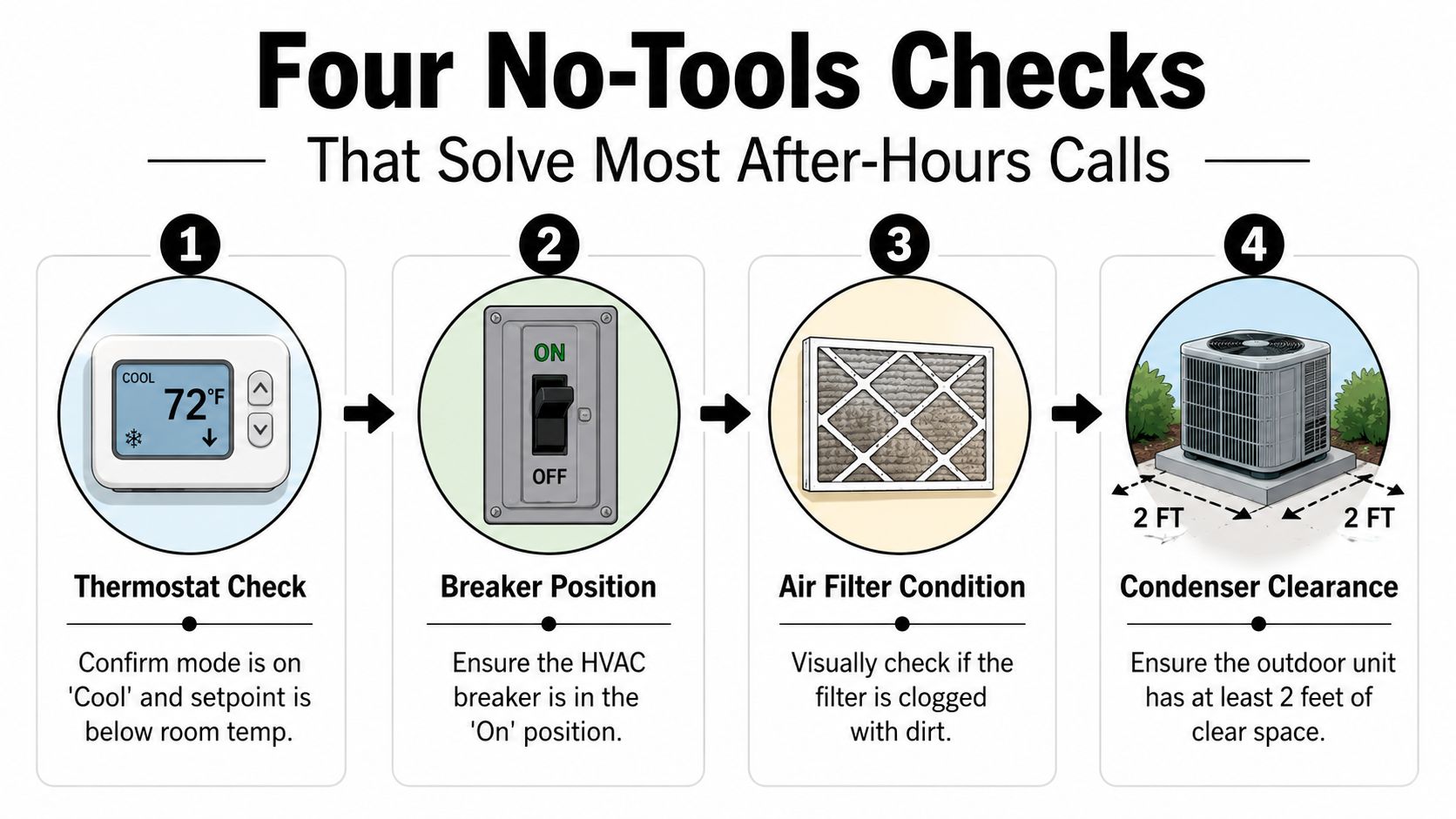
Once the space is safe, the highest-yield checks are simple and fast. Field guides consistently start with thermostat mode, breaker position, air filter condition, and outdoor condenser clearance because those four checks eliminate a surprising number of false emergencies before a truck rolls.
Start at the thermostat, not the roof
Set the thermostat to Cool, lower the setpoint below room temperature, and listen for the system to respond. If the display shows an error code or the temperature reading looks wrong, write it down before you call. One emergency-service guide reports that about 40% of emergencies begin with a thermostat malfunction, which is why this is the first check worth doing. Thermostat-first emergency triage
Next, inspect the electrical panel. A tripped breaker often sits in the middle or slightly off the ON position, not neatly flipped one way or the other. Reset it once if there's no burning smell, no water intrusion, and no other hazard. If cooling doesn't return, stop there and move on to service.
Practical rule: one breaker reset attempt is enough. Repeated resets can hide an electrical problem or a compressor fault.
Clear the easy airflow problems
A clogged filter can make a healthy system look failed. Replace it if it's dirty, and clear around the outdoor condenser so air can move freely. Emergency guidance recommends about two feet of clearance around the outdoor unit, because restricted airflow can trigger shutoffs and icing even when the refrigerant circuit is intact. Airflow and clearance guidance
The order matters because it helps the dispatcher help you. Tell them the thermostat reading, the error code, whether the breaker tripped, whether the filter was plugged, and whether the condenser area was blocked. That information lets the technician arrive with a better sense of parts and likely failure points instead of guessing from a vague “it's not working” call.
Practical example: a Vancouver special with no cooling looked like a compressor failure until the panel showed a tripped 30-amp breaker. A single reset brought the system back, and that avoided an after-hours charge for a problem that wasn't the compressor at all.
Deciding Between Emergency Dispatch and a Scheduled Visit
The cleanest triage rule in Greater Vancouver is simple. If the outage is creating a health risk, a safety hazard, or an occupied-space problem in hot weather, call now. If the system is uncomfortable but stable, and nobody vulnerable is at risk, it may be reasonable to monitor overnight and book the first available appointment.
Use the occupant, weather, and symptom test
Health Canada says heat is more dangerous for older adults, infants, people with chronic illness, and people in poorly cooled housing. The BC CDC adds that indoor temperatures can become a health hazard during heat events. Put those together with WorkSafeBC's expectation that hazards be controlled, and the decision gets clearer, a hot suite with a vulnerable person inside deserves a faster response than a mild-night outage in an empty condo. Heat risk and occupant vulnerability WorkSafeBC first-aid and emergency planning context
Hard-stop warning signs that always justify an emergency call:
- Sparking or smoke: Shut power down and call immediately.
- Gas or burning odour: Leave the area and contact emergency help or the utility.
- Repeated breaker trips: Stop resetting and have the fault traced.
- Water near the air handler: Treat it as an electrical and damage risk.
- Carbon-monoxide alarm or symptoms: Evacuate and get fresh air right away.
What a realistic emergency visit looks like
An emergency technician usually starts with a safety check, then a visual inspection, then measurements. You should expect the tech to look at airflow, electrical condition, and system behaviour before deciding whether the issue is a quick repair, a temporary fix, or a bigger replacement conversation. If they can repair the unit on site, the estimate should separate labour, parts, and any after-hours response charge in plain language.
For a single-family home, a same-night fix might be as simple as a capacitor or contactor swap, drain clearing, or a restart after airflow is restored. For occupied commercial or strata spaces, the decision may involve a temporary shut-down and safety notice before anyone talks about comfort restoration. If you're planning a new cooling system or comparing equipment, the team can also review options like the ones outlined in this mini-split installation overview.
| Triage Signals for Greater Vancouver Homeowners | What it usually means | Recommended response |
|---|---|---|
| System won't start, no warning signs | Control issue, breaker, or thermostat fault | Try the no-tools checks, then book service |
| Burning smell, smoke, or sparking | Electrical hazard | Shut off power if safe, call emergency help |
| Water around the air handler | Drain issue or leak with possible electrical risk | Isolate the area, stop resets, call now |
| Hot occupied suite during a heat warning | Health risk may be developing | Move vulnerable occupants, arrange urgent service |
| Repeated breaker trips | Underlying electrical or compressor problem | Stop resetting and dispatch a technician |
What Happens When an Emergency HVAC Truck Arrives
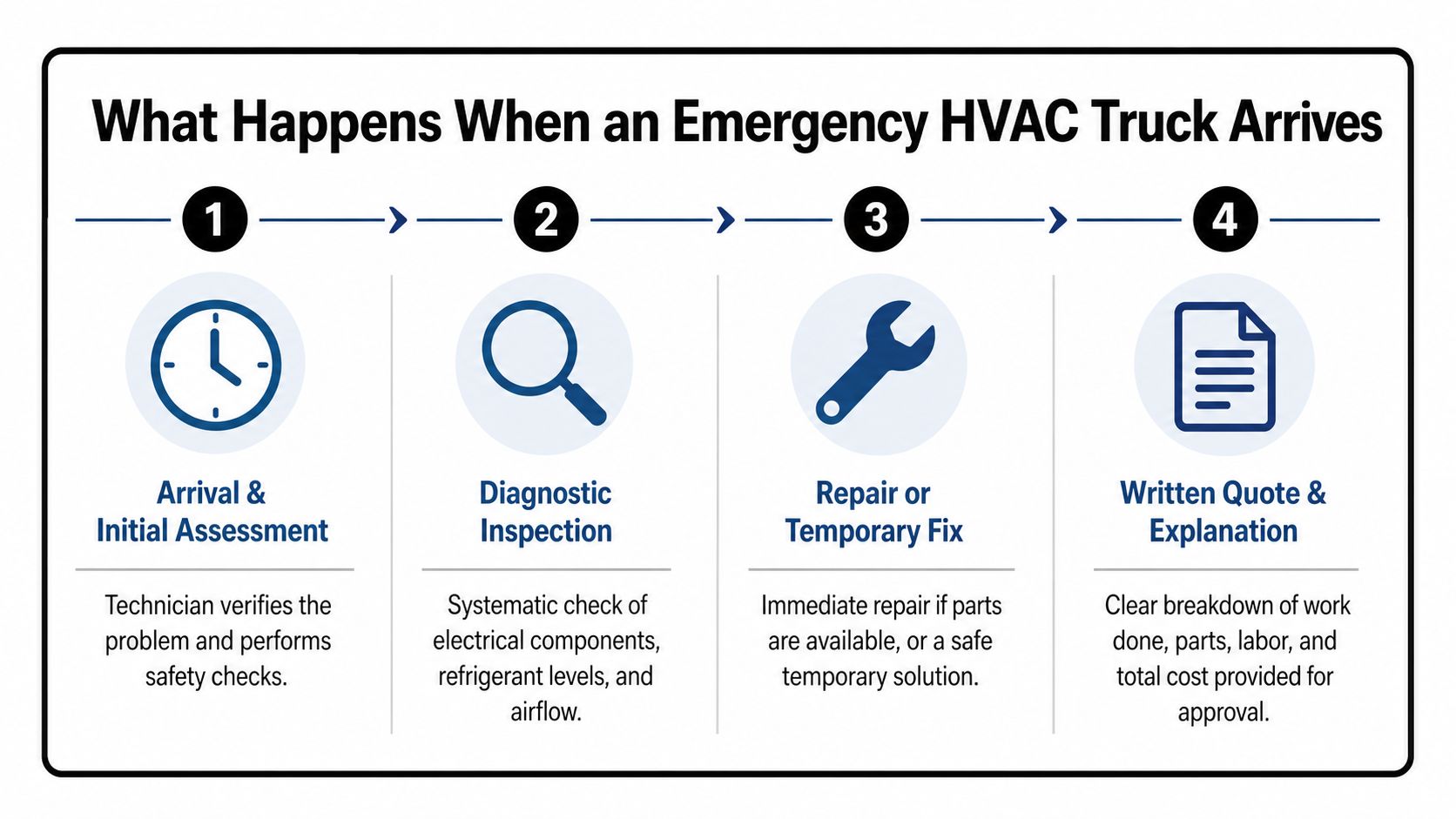
A midnight truck doesn't arrive to guess. The technician should verify the complaint, check safety conditions, and then test the system in a sequence that narrows the fault without wasting time or your money. That usually means visual inspection first, then pressure, temperature, and electrical measurements, and, where needed, a closer look at drains or duct paths with video inspection tools.
The diagnostic sequence
The first pass is visual. The tech checks for obvious damage, tripped protection devices, loose wiring, icing, water, and signs of overheating. After that, they measure electrical performance and look at how the system is moving air and handling refrigerant, because a cooling failure can come from several different places that feel identical from the thermostat.
If the drain line is clogged or the condensate system is backing up, that gets cleared before the unit is put back into normal service. If the issue is electrical, the technician may replace a capacitor or contactor. If the blower motor is failing, that's a different repair path entirely. For serviceable systems, a refrigerant correction may be possible, but a technician should also explain whether low refrigerant points to a leak that needs more than a top-up.
What parts a Vancouver tech usually carries
A well-prepared emergency truck in the Lower Mainland commonly carries the kinds of parts that solve the most common same-night problems. That includes capacitors, contactors, drain-clearing tools, and replacement components for select blower and control issues. It doesn't mean every failure can be fixed on the spot, but it does mean many common breakdowns don't need a second visit if the diagnosis is solid.
A midnight Richmond call with a 14-year-old unit and low refrigerant is a good example of the line between repair and honesty. If the tech sees age, low charge, and a pattern that points toward a larger system issue, the right recommendation may be a replacement estimate instead of another temporary patch. That isn't upselling, it's avoiding a short-term fix on equipment that's already near the end of its practical life.
Practical example: an Encano technician may arrive, isolate the fault, give you the repair option if the part is on hand, then quote the temporary or permanent fix in writing before any work starts. If the issue is broader, they should tell you clearly that the repair is a bridge, not a cure.
Repair or Replace and How to Prevent a Repeat Emergency
The emergency for a lot of Greater Vancouver homes isn't the night the AC fails. It's discovering, during the heat wave, that the system had no backup plan, no maintenance history, and no room left for another breakdown. That's why the repair-or-replace call needs to be practical, not emotional.
The on-site decision rule
Technicians usually look at three things. First, the age of the system, because the repair economics start to shift in the 10-to-15-year range. Second, the refrigerant type, because older systems may rely on refrigerants with tighter supply or availability. Third, the failure pattern, because one isolated breakdown is different from repeated August failures.
If the unit is newer and the fault is contained, repair usually makes sense. If it's older, has recurring issues, and needs larger parts, budgeting for replacement may be the more rational move. For central-air planning and equipment budgeting, the cost to install central air overview is a useful starting point when you're comparing a repair bill against a new system path.
Prevention that actually changes the odds
There's no mystery to repeat-failure prevention. Change or clean the filter regularly, rinse the coil when appropriate, keep about two feet of clearance around the outdoor unit, and make sure the condensate drain stays clear. A pre-summer inspection is worth more than a desperate July call because it catches weak parts before the first real heat spike or wildfire-smoke week.
Practical rule: if the system failed once this season, don't wait for the second failure to think about maintenance.
Practical example: in a New Westminster duplex, a routine annual visit stopped the third August breakdown in a row before it happened again. That kind of preventive visit doesn't make headlines, but it's often the difference between a manageable service call and another midnight emergency.
If you also want to reduce dust, odour, and airflow problems that can make an AC work harder than it should, a professional ductwork cleaning review can help determine whether the system is fighting a hidden restriction or contamination issue. The point isn't to buy every add-on. It's to match the fix to the actual failure pattern.
Your Vancouver Emergency HVAC Action Card
A cooling failure at midnight in Richmond or Burnaby calls for a fast split, safety problem, or comfort problem. Safety first. If you smell burning, gas, or smoke, or you see water near equipment, stop there and treat it as a hazard. If the house is safe, run the four no-tools checks before you book anything.
Do four checks. Start with the thermostat, then the breaker, then the filter, then the outdoor unit clearance. If the thermostat is set correctly and the breaker has not tripped, a clogged filter or blocked condenser can still make the system act like it has failed. For details on improving airflow and reducing strain on your system, see our guide on ductwork cleaning.
The next question is who is in the house. Call now if there is a vulnerable occupant, if indoor heat is climbing into unsafe territory, or if the system is tied to health risks you cannot manage with fans and ventilation. Book soon if the home is uncomfortable but stable, the unit is still running, and there is no sign of fire, gas, or active water damage. That is the point where a scheduled visit usually makes more sense than an after-hours dispatch.
When an Encano truck pulls up late in the evening, the first job is diagnosis, not guesswork. Encano Plumbing & Drainage Ltd. provides 24/7 emergency response for Richmond, Vancouver, Burnaby, New Westminster, Delta, Surrey, and nearby communities, with HVAC service, diagnostics, and repair support when a cooling failure cannot wait. A technician checks the fault, confirms whether the unit is safe to keep running, and tells you if the problem is a simple repair, a temporary workaround, or a replacement decision. You can book online through Encano Plumbing & Drainage Ltd. or call when the house is heating up and you need a straight answer about what can be fixed tonight.
Prevent repeat breakdowns with maintenance before the next heat warning. If the system has failed once, the odds of another call are worse when the filter stays dirty, airflow stays restricted, or the outdoor unit keeps working in a tight space. A pre-summer inspection usually costs less trouble than another late-night shutdown, because it catches weak parts before they fail again.
If you also want to reduce dust, odour, and airflow problems that can make an AC work harder than it should, a professional ductwork cleaning review can help determine whether the system is fighting a hidden restriction or contamination issue. The point is not to buy every add-on. It is to match the fix to the actual failure pattern.