

Metro Vancouver's municipal water is already very soft, with treated hardness reported at 20.5 mg/L as CaCO3, and it's already disinfected, so most homes don't need whole-house filtration for baseline safety. Here, the smarter choice is usually targeted treatment for chlorine taste, odour, sediment, or a specific building-level concern.
That challenges the most popular advice in this market. Many filtration guides start with the product and work backwards to a problem. A Vancouver plumber should do the opposite. Test the water, identify what bothers you, then decide whether the right answer is a whole-house system, an under-sink filter, or no upgrade at all.
Table of Contents
- Why Vancouver Homeowners Rarely Need Whole House Filtration
- How a Whole House Filtration System Actually Works
- Common Filtration Technologies and What They Actually Remove
- Whole House Versus Under Sink and Countertop Filters
- Signs a Whole House System Is Worth It in Greater Vancouver
- Costs, Installation, and a Realistic Homeowner Example
- A Quick Decision Checklist Before You Call a Plumber
- Frequently Asked Questions About Whole House Filtration
Why Vancouver Homeowners Rarely Need Whole House Filtration
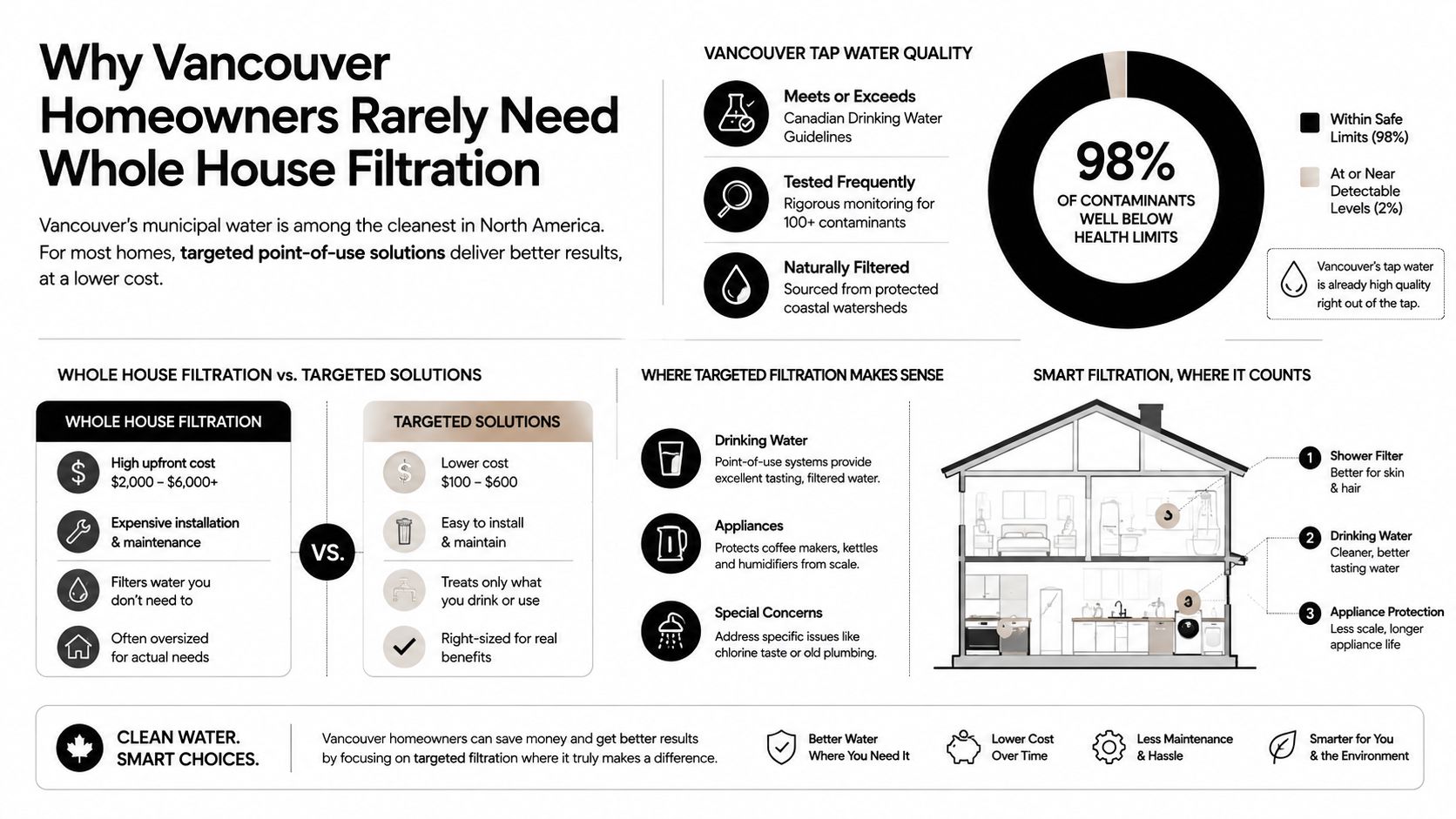
Whole-house filtration is often the wrong starting point for Vancouver homes. Metro Vancouver's 2025 water-quality report lists treated-water hardness from 18.8 to 22.2 mg/L as CaCO3, including a reported value of 20.5 mg/L (Metro Vancouver's annual water-quality report). That is soft water, so the heavy calcium scale that prompts softener installations elsewhere is not usually the local problem.
The Seymour and Capilano systems also disinfect the municipal supply. Metro Vancouver reports a target chlorine residual of 0.80 mg/L leaving the Seymour–Capilano Filtration Plant. That chlorine protects the distribution network from microbial regrowth and contamination. It does not indicate that the treatment plant has failed.
Start with the complaint, not the catalogue
A faint chlorine taste at one kitchen tap calls for a different solution than sediment coming through older galvanized plumbing. Carbon at that drinking-water outlet may address the first issue. Sediment treatment on the main line may suit the second, particularly when several fixtures show the same problem.
A Richmond homeowner who dislikes chlorine in drinking water does not need the same equipment as a strata building dealing with particles from aging shared pipes. A countertop or under-sink carbon filter may resolve the household complaint. The strata property should undergo incoming-water testing, a building-level inspection, pressure monitoring, and maintenance planning before anyone selects a filter.
Practical rule: If the complaint affects one tap, begin with point-of-use treatment. If it affects showers, laundry, appliances, and every fixture, investigate point-of-entry treatment.
Whole-house filtration can still earn its place in Greater Vancouver. It may improve taste and odour throughout a home, protect fixtures from sediment, or treat an unusual private source. Soft, disinfected municipal water is not, by itself, a reason to install a large system. Identify what needs removal and where the problem occurs before choosing equipment.
How a Whole House Filtration System Actually Works
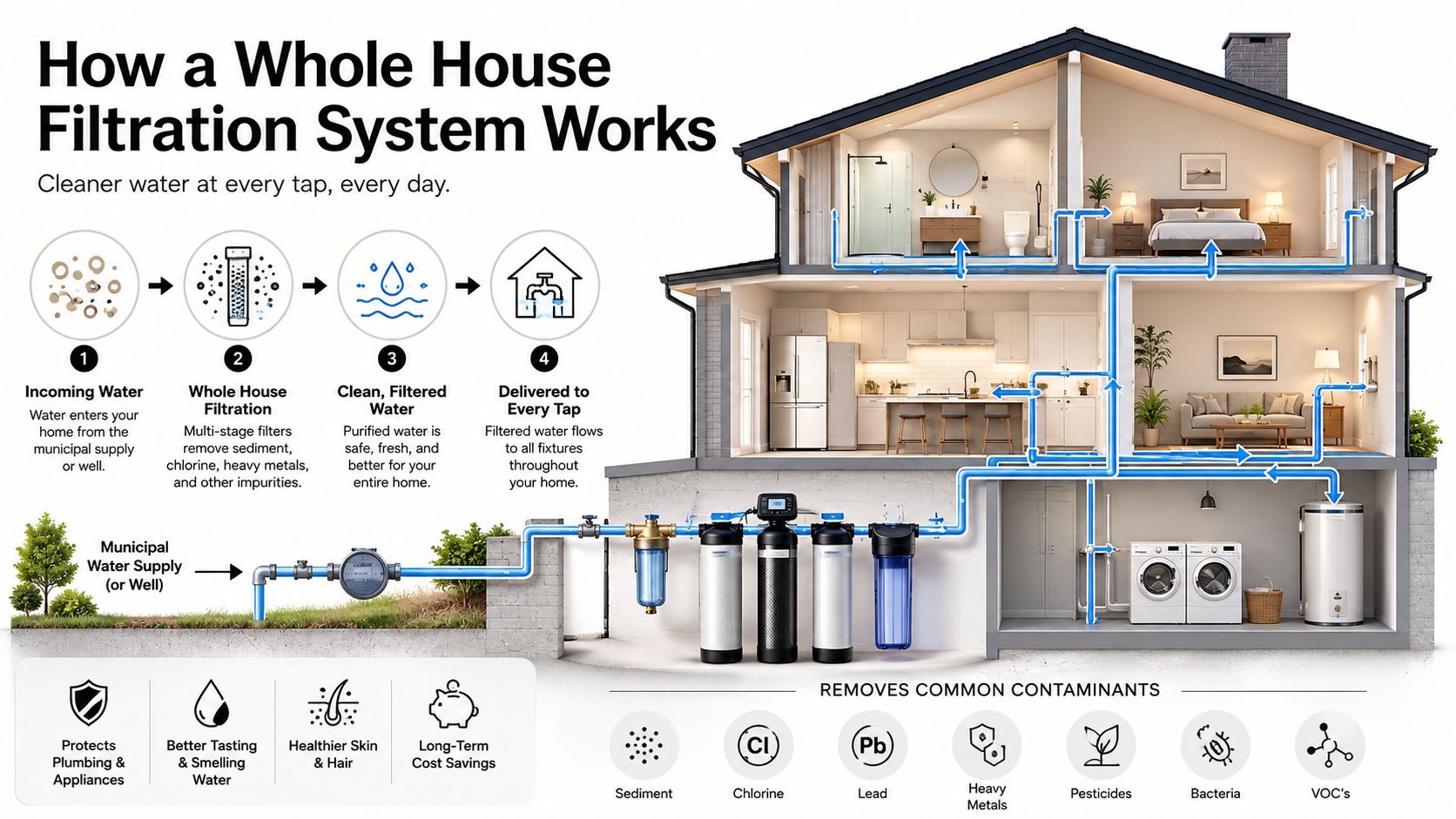
Think of the main water service as the front door of the house. A whole-house filter sits on the incoming cold-water line, usually after the meter and before the pipe branches toward the water heater, kitchen, bathrooms, laundry, and outdoor fixtures. Every drop entering the building passes through that checkpoint.
The order of treatment matters because each stage protects the next one. A typical setup looks like this:
- Sediment pre-filter: catches sand, rust flakes, silt, and visible particles before they reach finer media.
- Activated carbon or KDF stage: reduces chlorine, taste, odour, and selected organic contaminants, depending on the media and certification.
- Conditioning stage: addresses a defined mineral or scaling concern, but it isn't automatically a softener.
- Final polish stage: provides additional particulate or taste treatment when the design calls for it.
- UV treatment, where required: disinfects water that has already been cleared of turbidity. UV doesn't replace pre-filtration because particles can shield microorganisms from the ultraviolet light.
Where point-of-use treatment fits
An under-sink reverse-osmosis system takes water from one cold-water branch, treats it at the cabinet, and sends purified water to a dedicated faucet or refrigerator connection. It doesn't treat shower water, toilet supply, laundry water, or the line feeding a steam appliance.
A whole-house system does the reverse. It covers the building but must support the combined demand of multiple fixtures without creating an unacceptable pressure drop. That's why cartridge size, pipe diameter, media volume, flow rating, and bypass design matter more than a long list of treatment claims.
The filter should also have service access. Installers need room to remove cartridges, isolate the equipment, relieve pressure, and check fittings. A filter placed where nobody can reach it often becomes a neglected restriction in the main line.
Common Filtration Technologies and What They Actually Remove
Filter names can make a quote sound more thorough than it is. Each technology has a defined job, and each leaves some dissolved substances untouched.
| Technology | What it removes | Typical placement | Useful in Metro Vancouver? |
|---|---|---|---|
| Sediment cartridge | Rust, sand, silt, and visible particles | First stage on the main line | Useful where plumbing or a private source introduces sediment |
| Activated carbon | Chlorine, taste, odour, and selected organic compounds | Main-line tank or cartridge housing | Often useful for whole-home taste and odour complaints |
| KDF media | Selected chlorine and metal-related treatment duties, depending on design | Combined with carbon or in a dedicated stage | Sometimes useful, but the media claim must match the test result |
| Water softener | Calcium and magnesium hardness | Point of entry | Usually overkill for Metro Vancouver's soft municipal supply |
| Conditioner or descaler | Attempts to reduce scale behaviour without conventional softening | Point of entry | Consider only for a specific scale complaint, not as a default |
| UV | Microorganisms, when water is clear enough for the system | Final stage on private or vulnerable sources | More relevant to wells and cisterns than ordinary municipal service |
| Reverse osmosis | Broad reduction of many dissolved substances, including TDS | Under a sink or at a dedicated drinking-water point | Excellent for one drinking tap, but not a whole-home solution |
Carbon and sediment are the common pairing because sediment can load a carbon bed or cartridge prematurely. A carbon filter also isn't a universal dissolved-salt remover. California guidance, for example, lists recommended TDS at 500 mg/L and an upper consumer-acceptance level of 1,000 mg/L, illustrating why TDS requires a treatment approach different from ordinary carbon filtration (California's secondary drinking-water standards).
What Vancouver homeowners should question
A softener can be a poor fit where the supply is already soft. It adds equipment, discharge requirements, salt handling, and maintenance without solving a meaningful hardness problem. A UV unit can also be unnecessary on a well-maintained municipal connection, while it becomes important when a private source introduces microbiological uncertainty.
The most useful way to compare media is to check the contaminant claim against a water test and the manufacturer's performance documentation. For a broader overview of water filtration system types, look for the difference between mechanical filtration, adsorption, ion exchange, membrane treatment, and disinfection. Those categories tell you more than a label such as “multi-stage.”
Whole House Versus Under Sink and Countertop Filters
The right comparison isn't “large system versus small system.” It's every fixture versus one fixture, and taste and odour treatment versus deeper dissolved-contaminant reduction.
A whole-house carbon system treats water as it enters the property. That makes it useful when the complaint follows the water into showers, baths, laundry, and every sink. It also means the system must handle simultaneous demand. A cartridge that performs well at a single faucet may become restrictive when several fixtures run together.
An under-sink reverse-osmosis system serves a narrower job. It can provide highly treated drinking water at one dedicated outlet and is often the stronger choice when the homeowner cares primarily about drinking and cooking. It won't remove chlorine from shower water, and it won't treat the supply to a steam oven, washing machine, or ice maker unless those connections are specifically routed through it.
Compare the job before comparing equipment
| Decision factor | Whole-house system | Under-sink RO | Countertop or faucet filter |
|---|---|---|---|
| Fixtures served | Most or all fixtures after installation | One dedicated outlet, sometimes connected appliances | Usually one outlet |
| Flow requirement | Must support building demand | Designed for a small drinking-water flow | Designed for a single outlet |
| Chlorine taste | Can address it throughout the home with suitable carbon | Addresses the treated drinking line | Addresses the selected tap |
| TDS reduction | Carbon doesn't provide RO-level TDS reduction | Designed for broad dissolved-solids reduction | Depends on the cartridge |
| Maintenance | Main-line cartridges or media require scheduled service | Filter changes and membrane maintenance | Frequent small-cartridge attention |
| Installation impact | Requires work on the incoming service | Requires cabinet and drain connections | Usually the least invasive |
A countertop filter may be enough for a tenant, a homeowner testing whether taste is the issue, or a kitchen where the rest of the building water is acceptable. The under-sink water filter options are more practical when the household wants better drinking water without modifying the main service.
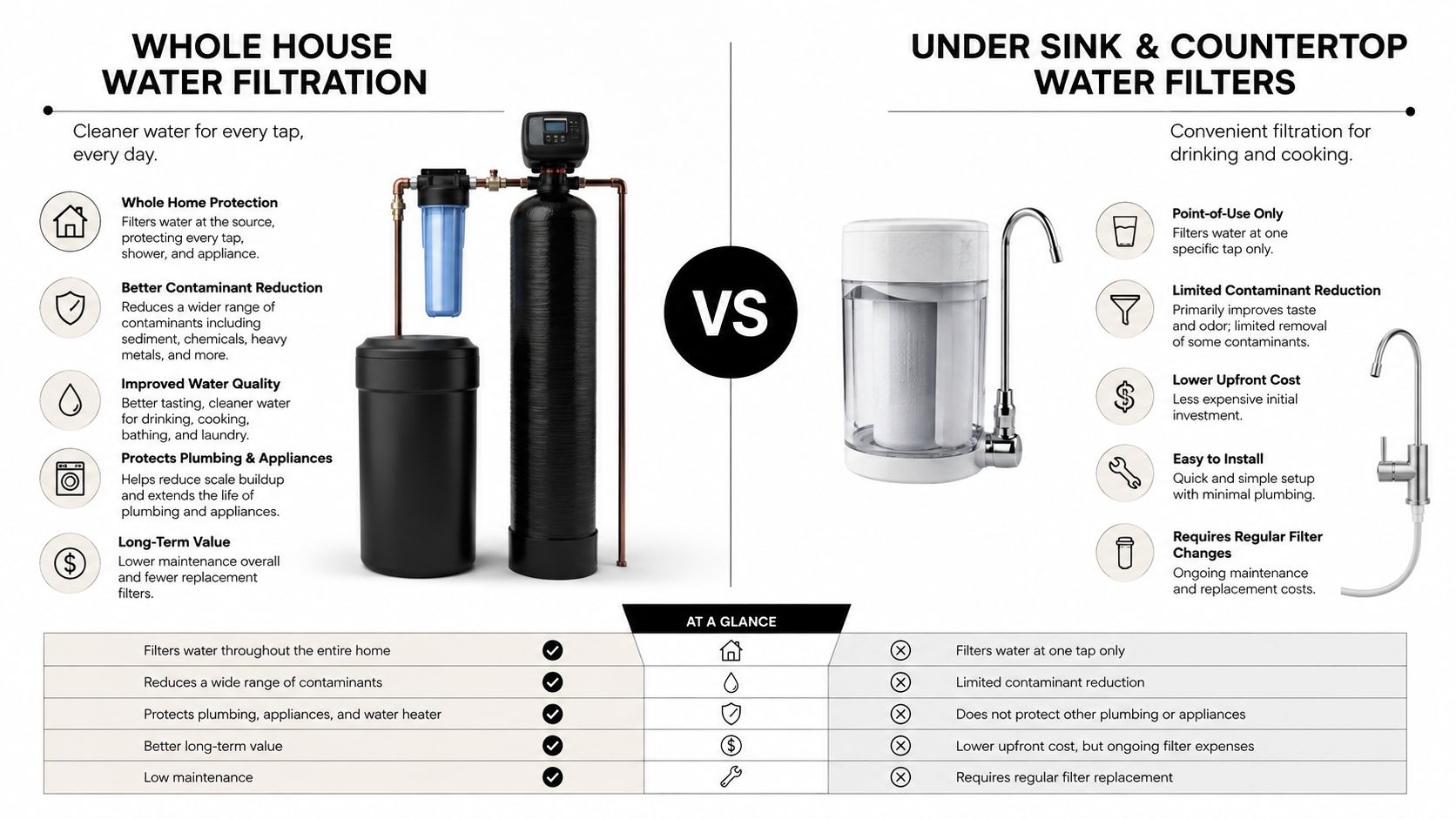
Five-year cost isn't only the purchase price. A whole-house system may require larger media service and professional access, while a small filter may require more frequent cartridge purchases. Ask for the equipment cost, installation, replacement media, service visits, drain requirements, and bypass arrangement before comparing totals.
Signs a Whole House System Is Worth It in Greater Vancouver
The best candidates are households with a building-wide complaint or a water source that deserves treatment before it enters the plumbing. The filter should be selected after identifying the problem, not because a sales page lists many media stages.
The taste follows every tap
If chlorine taste appears in the kitchen, bathroom, and shower, point-of-use treatment leaves part of the complaint untouched. A whole-house carbon stage can make sense when the objective is consistent taste and odour treatment throughout the property.
Health Canada says free chlorine in most Canadian distribution systems ranges from 0.04 to 2.0 mg/L (Health Canada's drinking-water summary table). That doesn't mean every Vancouver home needs chlorine removal. It means a homeowner with a persistent taste complaint should measure the incoming water and size carbon treatment for the actual building demand.
The plumbing sheds particles
Older galvanized lines can release rust-coloured particles or sediment when flow changes. If the material appears at several fixtures, a main-line sediment stage may provide a practical improvement, although it won't repair deteriorated pipe. A plumber should distinguish source-water sediment from material generated by the building's own plumbing.
The property has shared plumbing
A strata or rental building has a different risk profile from a detached house. One undersized or poorly maintained filter can create pressure complaints across multiple suites. Building managers need a service plan, isolation valves, pressure checks, replacement records, and a clear answer about who owns the equipment.
A private source changes the baseline
Homes on wells or cisterns at the edge of the municipal network shouldn't rely on a generic Vancouver recommendation. Testing may identify sediment, hardness, microbial concerns, or dissolved contaminants that require different equipment. A water-quality assessment, such as the service described through water-quality testing guidance, should come before selecting UV, carbon, resin, or membrane treatment.
Chlorine-sensitive occupants may also value whole-home carbon because the concern extends beyond drinking water. That's a comfort decision, not proof that municipal water is unsafe. The system still needs correct sizing and maintenance, especially if it treats water for a shared building.
Costs, Installation, and a Realistic Homeowner Example
A useful filtration budget has three parts: equipment, installation, and ownership. Equipment pricing varies by media, capacity, flow rating, controls, and whether the system uses cartridges or a larger tank. Installation depends on access to the main line, pipe material, shut-off condition, drainage, bypass requirements, and how much room the plumber has to work.
I won't attach invented price bands to a Richmond installation. The final cost depends too heavily on the property and the treatment objective. A small cartridge assembly on an accessible service line is a different project from a carbon tank, softener, UV unit, or multi-stage system integrated into a crowded mechanical room.
A Richmond example
Consider a single-family Richmond home on municipal water. The owners notice chlorine taste at several taps and have an older water heater. Their first step should be testing and inspection, not automatically adding a softener. Richmond's municipal baseline is soft, so hardness treatment may add complexity without addressing the complaint.
A sensible design discussion would examine a main-line carbon system, a sediment pre-filter if the inspection finds particles, and the available flow at peak household use. The older water heater may justify checking for existing scale or corrosion, but the filter shouldn't be sold as a repair for an appliance that already needs service.
The five-year comparison should include:
- Initial equipment: media type, housing or tank, control valve, mounting, and manufacturer documentation.
- Installation: pipe alterations, shut-offs, bypass valves, pressure relief, and access improvements.
- Routine service: sediment cartridges, carbon replacement, inspection, and flushing.
- Unexpected work: leaks, damaged isolation valves, blocked cartridges, or a media bed that needs replacement.
- Alternative path: the cost of treating only the kitchen tap, or doing nothing after confirming the water is acceptable.
Installation details affect ownership
The filter needs a proper bypass so the home can retain water service during maintenance. The installer should also confirm shut-off placement, support the equipment, protect against pressure problems, and leave enough clearance for future service.
Softener discharge requires particular care. California's documented requirements include demand-initiated regeneration and suitable discharge and air-gap provisions for installations subject to those rules (California drinking-water treatment requirements). Local plumbing requirements still need to be checked for the specific British Columbia property.
A Quick Decision Checklist Before You Call a Plumber
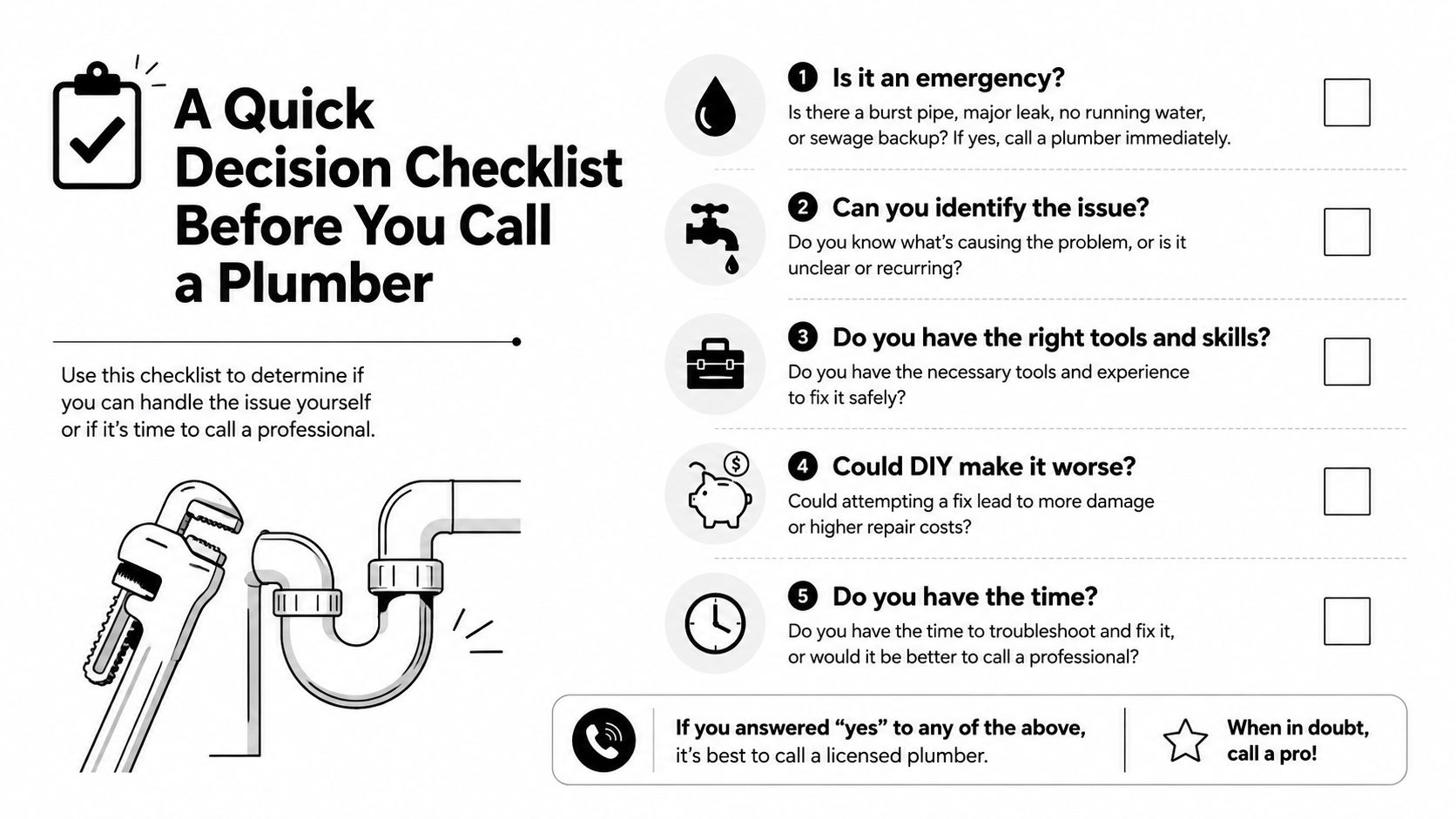
Use this checklist before comparing systems or booking installation:
- Name the complaint. Is it chlorine taste, odour, sediment, hardness, or a confirmed contaminant?
- Confirm the source. Is the property connected to municipal water, a well, or a cistern?
- Map the problem. Does it affect one drinking tap, or every fixture in the building?
- Check the plumbing. Could old galvanized pipe, a water heater, or a local valve be generating the problem?
- Choose the treatment scale. One tap usually points to countertop or under-sink treatment. Every fixture may justify point-of-entry treatment. No verified complaint may justify no upgrade.
- Plan maintenance. Identify who will replace cartridges, inspect pressure, and record service, especially in a strata or rental property.
- Ask for a bypass. A system that can't be isolated is harder to maintain and more disruptive when service is required.
For homeowners in Vancouver, Richmond, Burnaby, and nearby communities, the useful first step is a water-quality assessment and a conversation about the building, not an automatic quote for a large filter. The goal is to match treatment to the water and the complaint.
Frequently Asked Questions About Whole House Filtration
How often do whole-house filters need changing?
There isn't one honest interval for every property. Sediment load, household demand, cartridge capacity, source water, and the manufacturer's rated service life all affect replacement timing. A pressure drop, visible loading, reduced flow, or returning taste and odour can signal that service is due.
What happens if I skip replacement?
A loaded cartridge restricts flow and can make showers, appliances, and fixtures perform poorly. Neglected equipment also becomes harder to inspect, and a carbon stage that no longer performs can create false confidence. A bypass and pressure checks make maintenance safer.
Does a BC strata need approval?
A building-wide installation may affect common plumbing, mechanical rooms, water pressure, maintenance duties, and operating budgets. The strata council and property manager should review the proposal, access requirements, service responsibility, and any alteration rules before work begins.
Can removing chlorine affect shared plumbing?
Yes, the treatment objective needs care. The City of Vancouver says chlorine is used to disinfect water and safeguard against microbial regrowth or contamination, while chlorine levels in its distribution system remained within recommended operational guidelines (the City of Vancouver's waterworks report). A multi-unit property shouldn't remove disinfectant without considering residual protection, plumbing conditions, treatment design, and maintenance.
Is whole-house filtration automatically necessary in Vancouver?
No. Metro Vancouver water is already soft and disinfected, so many homes need targeted taste and odour treatment rather than broad filtration. A plumber should verify the complaint and source before recommending equipment.
Book a Vancouver-area assessment with Encano Plumbing & Drainage Ltd. to review your water source, test results, plumbing layout, and realistic treatment options. The team installs and maintains whole-house and under-sink filtration for homes and buildings, with the aim of solving the actual water problem rather than adding equipment you don't need.