

You usually start thinking about a new water heater after the old one annoys you for the third or fourth time. One person showers, someone starts the dishwasher, and the next person gets lukewarm water. In a lot of Vancouver homes, that's the moment the idea of an instantaneous water heater starts to sound a lot more practical than fancy.
A tankless unit fixes one very specific frustration. It heats water when you open the tap instead of storing a tank of hot water and hoping your household doesn't outpace it. That sounds simple, but the decision gets more complicated once you factor in Greater Vancouver's colder inlet water, older housing stock, venting paths, municipal permits, and strata rules.
Homeowners ask the same questions all the time. Will it keep up in winter? Will it work in a condo? Is gas better than electric? Is the higher install cost worth it? If you're comparing options, this guide on traditional vs tankless water heaters is a useful starting point before you narrow down the right system for your home.
Table of Contents
- Is an Instantaneous Water Heater Right for Your Home?
- How Tankless Heaters Provide Endless Hot Water
- Choosing the Right Size Heater for Your Vancouver Home
- Understanding the Costs and Real Energy Savings
- Navigating Installation and Local Permit Requirements
- Essential Maintenance and Troubleshooting Tips
- When to Call Encano for Your Water Heater Needs
- Frequently Asked Questions About Instantaneous Heaters
Is an Instantaneous Water Heater Right for Your Home?
An instantaneous water heater is a strong fit if your main complaint is running out of hot water, not waiting a few extra seconds for it to arrive. That distinction matters. Tankless fixes storage limits. It doesn't magically fix every plumbing layout problem in the house.
In Vancouver, the best candidates are usually households that want more consistent hot water for daily routines, have a realistic plan for sizing, and understand that installation is often more involved than swapping one box for another. Detached homes, laneway houses, duplexes, and some townhomes can be excellent fits. Condos can be a fit too, but strata approvals and venting routes often decide what's possible.
Good signs you're a candidate
A tankless setup makes sense when several of these apply:
- You hate tank depletion: Back-to-back showers, laundry, and kitchen use are exposing the limits of your current tank.
- You want to cut standby waste: The unit heats on demand rather than maintaining a stored volume all day.
- Your utility room is tight: Wall-mounted equipment can free up floor space.
- You're renovating anyway: If walls are open or utilities are being upgraded, the project is usually smoother.
Practical rule: Buy a tankless heater for your household's real usage pattern, not for the idea of “endless hot water” on the box.
When it may not be the right move
Tankless isn't always the smart answer. If your home has difficult venting, a marginal gas supply, limited electrical capacity, or very long pipe runs to bathrooms and kitchen fixtures, the project can become more complex than expected. In some older Vancouver homes, the layout fights the equipment.
A practical example. A family in an older East Vancouver house may want a single whole-home unit because they're tired of the upstairs ensuite draining the tank. If the mechanical area is far from the busiest fixtures and the gas line needs upgrading, the right answer might still be tankless, but only after design work. If no one checks the piping path and utility capacity first, the owner ends up paying for a premium system that doesn't feel premium in daily use.
How Tankless Heaters Provide Endless Hot Water
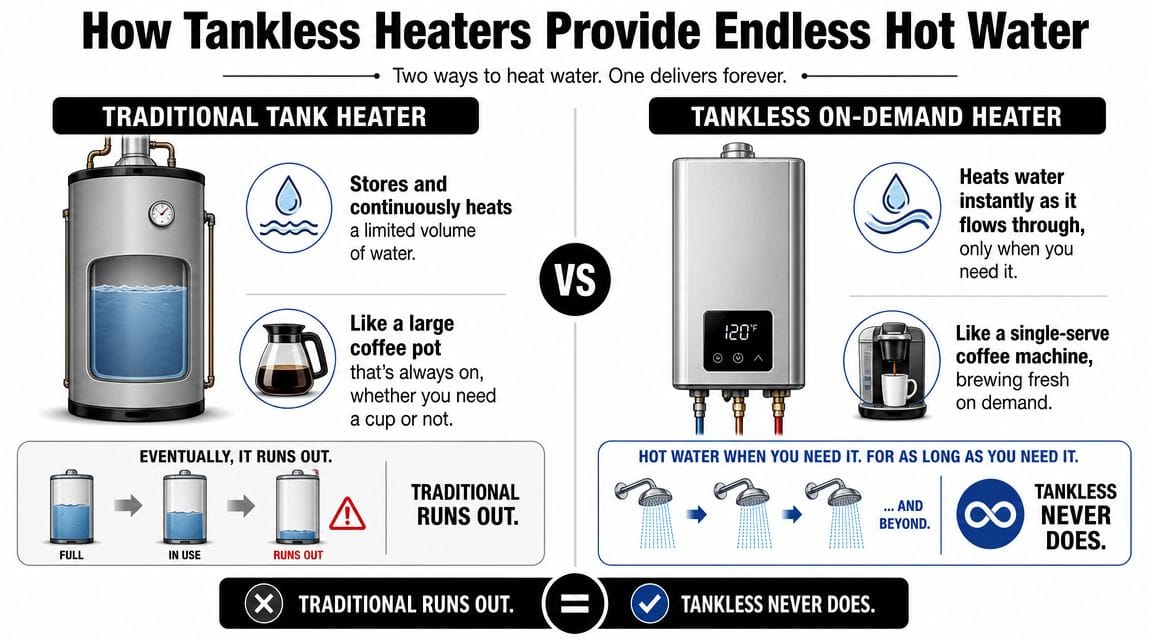
A tank heater is like a coffee urn sitting on a counter all day. It keeps a batch hot and ready, but once you empty it, you wait. An instantaneous water heater works more like a single-serve coffee machine. You ask for hot water, and the unit makes it at that moment.
That's the core difference. There's no large reservoir sitting there losing heat between uses.
What actually happens inside the unit
When you open a hot tap, water flows through the heater and passes a heat exchanger. The burner or heating elements respond to flow and raise the water temperature as it moves through. When the tap closes, the heater stops.
The big efficiency advantage comes from avoiding standby loss. The U.S. Department of Energy says that for homes using 41 gallons or less of hot water daily, demand-type water heaters can be 24% to 34% more energy efficient than conventional storage tanks because they eliminate standby energy losses, as explained in the DOE's guide to tankless or demand-type water heaters.
The appeal is simple. You're not paying to keep a full tank hot when no one's using it.
That doesn't mean unlimited output under all conditions. It means continuous hot water within the unit's flow capacity. If the heater is properly sized, a pair of morning showers one after another won't empty the system the way a tank can.
Tankless vs tank heater at a glance
| Feature | Instantaneous (Tankless) Heater | Traditional Tank Heater |
|---|---|---|
| Hot water supply | Continuous, as long as demand stays within unit capacity | Limited to stored volume, then recovery time |
| Energy use pattern | Heats water only when needed | Keeps stored water hot all day |
| Efficiency focus | Strong in homes with lower or intermittent use | Loses energy through stored heat over time |
| Footprint | Wall-mounted, compact | Larger floor-standing tank |
| Upfront project cost | Usually higher, especially in retrofits | Usually simpler replacement |
| Daily experience | Great for back-to-back use | Familiar, but can run empty |
A practical example is the classic Saturday morning rush. In a tank-heated home, one person showers, someone runs hot water at a sink, and the next person starts late because the stored supply is fading. With a properly sized tankless unit, the second and third shower can still be hot because the heater is producing water on demand instead of rationing a fixed reserve.
Choosing the Right Size Heater for Your Vancouver Home
Sizing is where many tankless projects succeed or fail. The wrong unit doesn't just underperform on paper. It shows up as a shower that cools off when someone opens the kitchen tap.
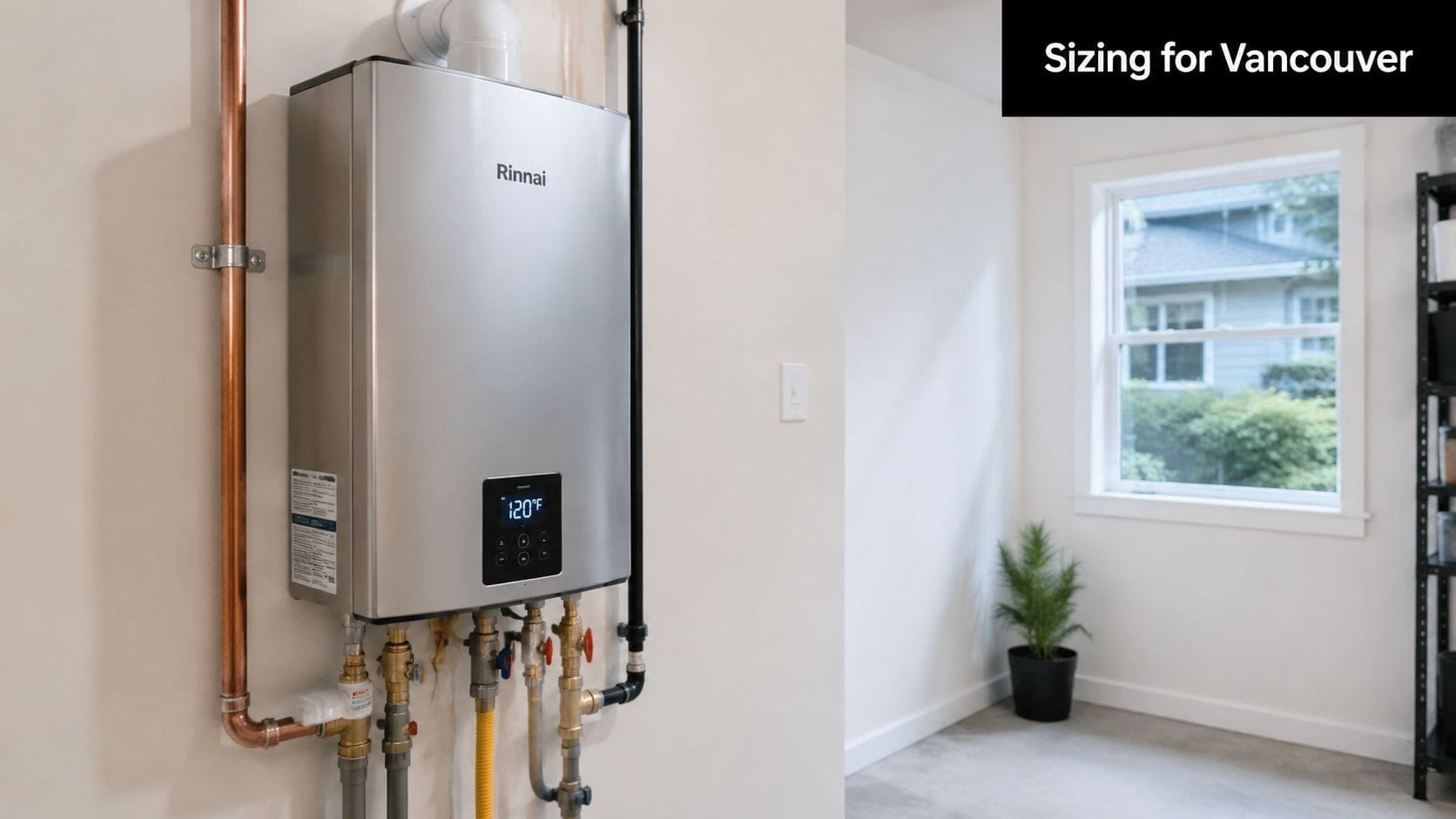
A homeowner usually hears “GPM” and “temperature rise” and tunes out. Keep it simple. GPM is how much hot water your fixtures want at the same time. Temperature rise is how hard the heater has to work to bring cold incoming water up to the temperature you expect at the tap.
Why Vancouver sizing goes wrong
Greater Vancouver isn't a warm-inlet market year-round. Colder incoming water puts more strain on a tankless system, especially in winter and especially in homes with multiple simultaneous demands.
Regional guidance from e-tankless sizing information notes that while a unit might support 8 GPM in a warm region, the same unit may only deliver about 3.5 GPM when dealing with colder northern inlet water temperatures. That's why advertised flow rates can mislead homeowners if no one explains the conditions behind them.
Sizing shortcut: Count what might run at the same time, then size the heater for that real peak load, not for a best-case brochure number.
A practical sizing example
Say your household commonly does this in the morning:
- One shower running
- Kitchen faucet in use
- Someone washing up at a bathroom sink
The exact fixture flow depends on the hardware in your home, but the important part is the method. Add the likely simultaneous demand, then check whether the heater can meet that demand at Vancouver-area inlet temperatures. If you skip that step, the unit may look fine on a sales sheet and disappoint in real life.
A common mistake is buying for average use instead of peak use. Average use sounds efficient. Peak use is what determines whether the system feels comfortable.
For a detached house in Richmond, that can mean choosing a larger gas unit than the owner expected. For a condo in Burnaby, it may mean accepting that a single electric instantaneous water heater is better suited to one bathroom and kitchen, not several fixtures firing at once.
Before you choose, watch this walkthrough on tankless operation and sizing basics:
Understanding the Costs and Real Energy Savings
The cost question usually lands in the same place. Homeowners don't mind paying more for a better system. They do mind paying more and then discovering the quote left out venting, gas work, electrical upgrades, drain changes, or wall repair.
What you're actually paying for
A tankless project typically includes more than the heater itself. The final price can involve:
- The unit: Gas and electric models differ in capacity and installation demands.
- Labour: Mounting, piping changes, commissioning, safety checks, and disposal of the old tank.
- Utility upgrades: Some homes need a larger gas line, new venting, or electrical work.
- Access conditions: Tight mechanical rooms, finished spaces, and condo rules can change the scope.
If you want a better sense of what drives project pricing, this breakdown of water heater replacement cost is useful because it frames the job as a system replacement, not just an appliance purchase.

What real savings look like
The savings side is where homeowners should be careful. Ignore blanket promises. Look for monitored field results and then compare them to your own usage pattern.
Measured results reported in an ACEEE paper showed annual savings of 50 to 85 therms for tankless water heaters, and a Minnesota field study found savings of about 102 therms, or 39%, after replacing typical storage water heaters with tankless units, as discussed in the ACEEE proceedings on measured tankless water heater savings.
That's useful because it reflects real operation, not just laboratory ratings. It also reinforces a point plumbers see all the time. The best savings show up when the system is properly sized, installed cleanly, and matched to the home's usage.
A practical example. If a Vancouver homeowner has a modest daily pattern and an older tank that sits hot most of the day, a tankless conversion can make good long-term sense. If a large household runs multiple fixtures constantly and the installation requires major upgrades, the economics need a harder look. The right answer isn't the same house to house.
Navigating Installation and Local Permit Requirements
Installation is where internet advice usually falls apart. A tankless water heater is not a plug-and-play swap in most Greater Vancouver homes. Gas piping, combustion air, venting, condensate handling on some models, clearances, shutoffs, and code compliance all matter.
Layout matters more than most homeowners think
People focus on the heater and forget the piping layout. That's a mistake. Technical standards for residential instantaneous units recognise that long pipe runs increase wait time and waste energy through pipe heat loss, so the heater should be placed as close as practical to the main hot-water use points, as outlined in California energy guidance for residential instantaneous water heater distribution planning.
In practice, that means a beautiful high-efficiency unit in the wrong location may feel less efficient than expected. You still wait for hot water. You still dump cooled water down the drain. The equipment can be doing its job while the system design lets it down.
Permits and strata approval in Greater Vancouver
Local permit requirements vary by municipality, and that matters in Vancouver, Richmond, Burnaby, New Westminster, Surrey, and Delta. Gas work, venting changes, and appliance replacements often trigger permit and inspection requirements. Condo owners and townhouse owners also need to check strata bylaws before any work starts, especially when the installation affects walls, vent terminations, gas service, or common property.
A practical example. In a strata building, the technical answer might be “yes, a tankless unit can work,” while the practical answer is “not unless strata approves the venting route and building rules allow the alteration.” That's why installation planning needs to happen before equipment is ordered.
If you're comparing electric retrofit options, this overview of tankless water heater installation for electric systems can help you understand what changes may be required behind the wall.
Essential Maintenance and Troubleshooting Tips
Tankless systems reward regular maintenance. Skip it, and the heater often lets you know in small ways first. Water temperature drifts. Flow feels weaker. The unit starts acting fussy under demand.
What a homeowner can do
The most useful routine task is flushing and descaling the unit on a regular schedule that matches your water conditions and manufacturer guidance. The goal is simple. Keep mineral buildup from coating the heat exchanger and reducing performance.
Homeowners can also stay on top of a few basic checks:
- Watch for error displays: Don't ignore codes, even if the unit still runs.
- Check the vent area: Make sure nothing is blocking intake or exhaust terminations where applicable.
- Notice pattern changes: If hot water gets inconsistent only during high demand, sizing or scaling may be part of the issue.
- Keep service records: This helps with warranty questions and future diagnosis.
A tankless heater usually gives warning signs before it stops outright. Owners who notice those signs early spend less time without hot water.
What usually needs a technician
Some symptoms sound minor but aren't good DIY projects. A “cold water sandwich,” for example, is that brief burst of cool water between periods of hot flow. Sometimes it's just the normal behaviour of the system. Sometimes it points to setup issues, crossover problems, recirculation quirks, or fixture-specific behaviour.
Inconsistent outlet temperature can also come from several places. Scale buildup, dirty inlet screens, sensor problems, venting faults, gas supply issues, and undersizing can all feel similar to the homeowner. The symptom is simple. The cause usually isn't.
A practical example. If your shower runs properly when nothing else is happening but turns unstable when someone uses the kitchen sink, don't jump straight to replacing the unit. The fix might be maintenance, a control adjustment, a plumbing issue elsewhere in the house, or a sizing problem that should have been caught at installation.
When to Call Encano for Your Water Heater Needs
A tankless unit can look fine right up to the moment it stops giving stable hot water. In Vancouver homes, I tell people not to wait too long once the problem moves beyond a simple reset or a dirty fixture screen. These systems involve gas or high electrical demand, combustion air, venting, controls, and safety devices. On a detached house, that usually means a service call. In a condo or townhouse, it can also mean checking strata rules before any repair or replacement work starts.
Professional help is the right call if you notice any of the following:
- Gas smell or signs of combustion trouble: Leave the area and treat it as a safety issue.
- Recurring error codes: One code after a power blip is one thing. Repeated codes usually need proper testing.
- No hot water, or the unit keeps shutting down: That often points to an ignition, flow, venting, or supply problem.
- Water around the unit or nearby connections: A small drip can damage cabinets, walls, or ceilings fast.
- Hot water temperature keeps swinging: The cause may be scale, a sensor fault, gas supply issues, or a problem elsewhere in the plumbing system.
- You are planning a new installation or replacement: Sizing, vent routing, gas capacity, electrical requirements, permits, and access all need to be sorted out before equipment is ordered.
The last point matters more in Greater Vancouver than many homeowners expect. Older houses often need venting changes or gas-line upgrades. Condos and townhomes may have placement limits, noise concerns, or strata approval requirements. Colder incoming water in winter also affects performance, so a unit that looked fine on paper can disappoint if the setup was rushed.
Encano Plumbing & Drainage Ltd. handles diagnosis, repair, replacement, and installation planning for tank and tankless water heaters in Vancouver and surrounding communities. If the problem involves safety, permits, or repeated loss of hot water, get a licensed technician involved early.
Frequently Asked Questions About Instantaneous Heaters
Is gas or electric better for a Vancouver home?
It depends on the house. Gas units are often the better fit for whole-home demand because they're commonly used where several fixtures may run at once. Electric instantaneous units can work well in smaller applications or point-of-use situations, but electrical capacity can become the limiting factor. The right choice comes down to the home's utility setup, layout, and peak hot-water demand.
What happens during a power outage?
Many modern instantaneous heaters rely on controls, fans, ignition systems, or electronic components. If the power is out, the heater may not operate even if it uses gas for heating. Homeowners often assume gas means fully independent operation, but that isn't always how modern equipment works. Check the model specifications before you buy if outage performance matters to you.
Can one unit handle a large house with multiple bathrooms?
Sometimes yes, sometimes no. The deciding factor is simultaneous demand, not square footage. A large home where one shower runs at a time may be fine with one properly selected unit. A home where two bathrooms, a kitchen, and laundry all compete for hot water may need a larger-capacity setup or a different design approach.
A practical example is a newer Vancouver special with a main suite, basement occupants, and busy morning routines. One unit might serve the home well if usage is staggered. If everyone uses hot water at once, the better answer may be a larger system design rather than forcing one undersized heater to do everything.
If you're weighing an instantaneous water heater for your Vancouver home and want a realistic answer about sizing, installation constraints, or whether the switch makes sense at all, talk to Encano Plumbing & Drainage Ltd.. A proper site assessment can save you from buying the wrong unit, missing permit steps, or ending up with a system that looks efficient on paper but underdelivers in daily use.