Carbon Monoxide Detector Guide for Homes with a Gas Furnace or Boiler (BC)
· By Ed Ferreira
If your home has a gas furnace, a boiler, a gas hot water tank or a gas fireplace, a carbon monoxide detector is not optional equipment. Carbon monoxide (CO) has no colour and no smell, so an alarm is usually the only warning you get before people start feeling sick.
This guide, written for Metro Vancouver homes, covers where CO comes from, the symptoms to know, what to do the moment an alarm sounds, how to place and replace alarms, and the furnace and boiler problems that cause CO in the first place. None of it calls for touching gas parts yourself.
Where Does Carbon Monoxide Come From in a Home?
Carbon monoxide comes from fuel that burns without enough air or without a clear path outside for its exhaust. Technical Safety BC lists the usual sources as furnaces, boilers, hot water tanks, stoves, fireplaces, portable heaters, generators and vehicles running in attached garages.
Gas appliances are designed to burn cleanly and push exhaust outdoors through a vent or chimney. CO becomes a problem when a part fails, the vent gets blocked, or the appliance stops getting the air it needs.
What Are the Symptoms of Carbon Monoxide Poisoning?
HealthLinkBC describes the early symptoms of carbon monoxide poisoning as headache, dizziness and nausea. As CO builds up in the blood, symptoms can progress to confusion, drowsiness, fast breathing, a fast heartbeat or chest pain, vision problems and seizures.
Early CO symptoms are easy to mistake for the flu. Be suspicious when several people in the house feel unwell at once, or when symptoms ease after you leave home. Technical Safety BC notes that pets can show signs too, such as drowsiness or refusing to come inside.
What Should You Do When a Carbon Monoxide Detector Goes Off?
Get everyone out of the house, including pets, and call 911 from outside. Do not stay inside to look for the cause, and do not go back in until emergency responders say it is safe. If anyone has symptoms, tell the 911 operator.
If it is safe on your way out, open doors and windows. Afterward, the appliance that caused the problem should stay off until a qualified technician has checked it. In BC, gas work has to be done by a licensed gas fitter working for a contractor licensed by Technical Safety BC.
A smell of gas (a rotten egg odour) is a different emergency. Leave the house, do not switch lights or appliances on or off, and call the FortisBC 24-hour emergency line at 1-800-663-9911 from outside.
Where Should a Carbon Monoxide Detector Go?
Technical Safety BC recommends Canadian-certified CO alarms on every floor of the home and near bedrooms. Near bedrooms matters most, because sleeping people cannot notice symptoms.
When you buy one, look for a label referencing CSA 6.19, the Canadian standard for residential carbon monoxide alarms. Plug-in models with battery backup and battery-only models are both easy options for an existing home. A hardwired alarm is an electrical job, so it needs a licensed electrical contractor or a homeowner electrical permit.
Follow the manufacturer's instructions for mounting height and distance from appliances, since they differ between models. Avoid putting an alarm right beside a furnace or water heater, in a bathroom, or next to a window or fan where readings can be thrown off.
On the rules: Technical Safety BC notes that the BC Building Code requires CO alarms in new residential buildings that contain a fuel-burning appliance, a fireplace or an attached garage. The City of Vancouver goes further and requires them in existing buildings with those features too, under its Fire By-law. In an older home elsewhere, the rule may not apply, but the safety case is the same.
How Often Should You Replace a Carbon Monoxide Detector?
Most carbon monoxide detectors need replacing every 7 to 10 years, according to Technical Safety BC. The sensor wears out over time even if the test button still works. Check the manufacture date printed on the back. If there is no date at all, the unit is likely past its useful life and should be replaced.
Press the test button once a month, change batteries as the manual recommends, and write the replacement year on the alarm with a marker so nobody has to guess later.
What Furnace and Boiler Problems Cause Carbon Monoxide?
A handful of problems account for most CO incidents involving gas heating. A technician checks for each of these during a service visit. None of them are homeowner repairs.
Cracked heat exchanger: in a furnace, the heat exchanger keeps combustion gases separate from the air blown through your ducts. A crack can let exhaust mix with the air you breathe. It often leads to the decision covered in our guide on whether to repair or replace a furnace.
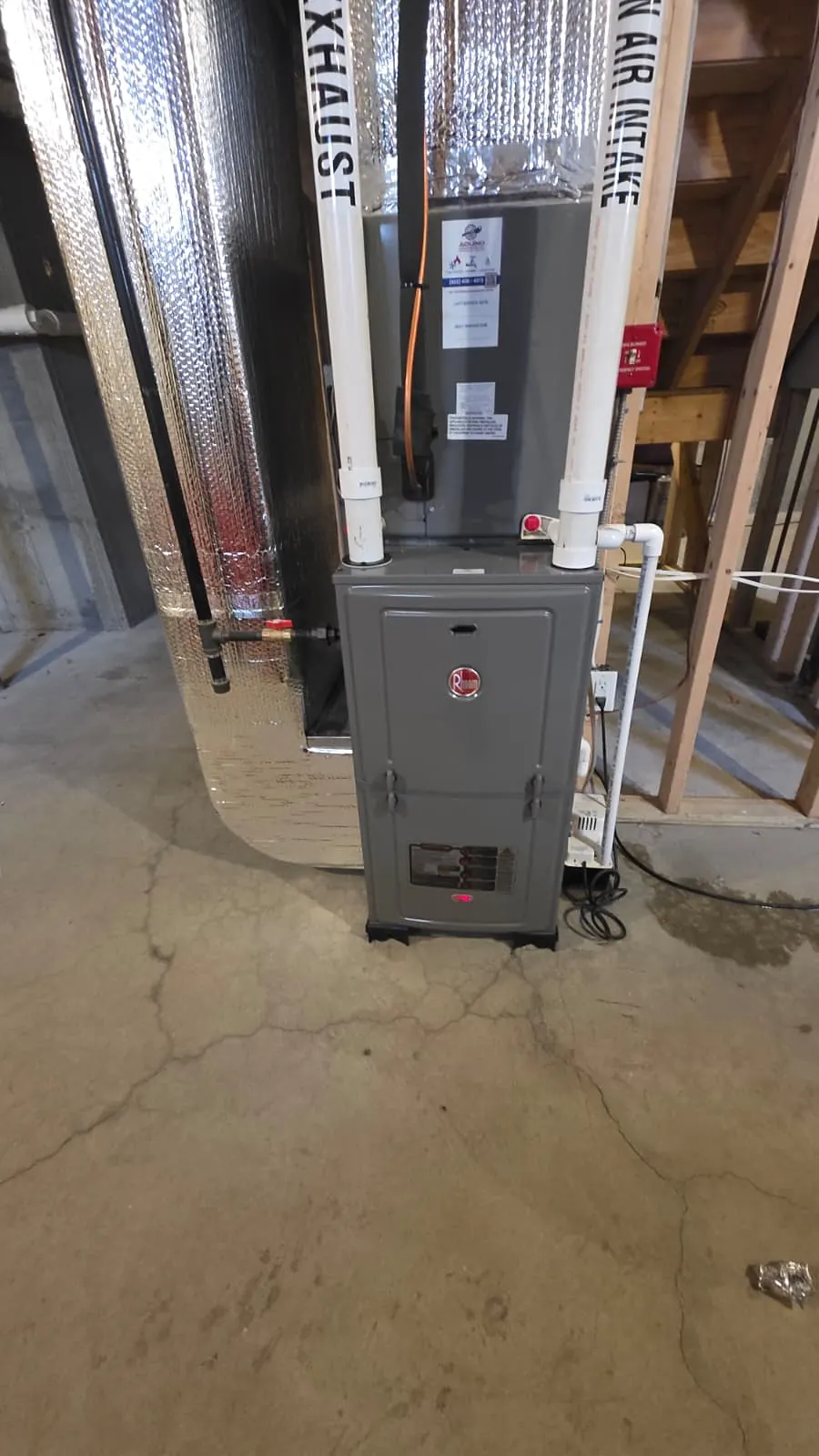
Blocked vents and intakes: high-efficiency furnaces and boilers often vent through plastic pipes on a side wall of the house, like the exhaust and intake pipes in the photo above. Snow, leaves, a bird nest, a stacked woodpile or a shrub grown over the outlet can block them. Check after a snowfall that the outside ends are clear. Keeping them visible is safe. Taking pipes apart is not.
Backdrafting: older appliances that vent up a chimney rely on natural draft. A blocked chimney or strong exhaust fans in a tight house can push exhaust back into the room. Soot or scorch marks near the draft hood are a warning sign.
Poor combustion: dirty burners, wrong gas pressure or too little combustion air can make an appliance burn badly and produce more CO. A lazy yellow flame instead of a steady blue one is a reason to call for a check. If your heat is out or acting strangely, see our furnace repair and boiler repair pages.
How Does Annual Service Help Prevent Carbon Monoxide?
Technical Safety BC recommends annual inspections of gas appliances by a licensed gas contractor to keep them safe and properly vented. A proper inspection looks at the venting, the burners and flame, the heat exchanger or boiler, and how the appliance draws its combustion air. Our article on how often to service a furnace or boiler explains what a typical visit covers and how to schedule it before winter.
What not to do: do not remove burner covers or sealed panels, adjust gas valves, tape over a cracked vent, or run a generator, barbecue or camp heater indoors or in the garage. Never block a combustion air opening in the furnace room. An alarm does not replace service, and service does not replace an alarm.
If your furnace or boiler is acting up, or you just want someone to look at your heating and venting before the cold sets in, Encano Plumbing serves homes in Richmond, Vancouver, New Westminster and the rest of Metro Vancouver. Call or text (604) 764-2031 any hour, or request an estimate, and you get one flat price in writing before any work starts. If an alarm is sounding right now, leave the house and call 911 first.
Frequently asked questions
- Can a furnace that is turned off still produce carbon monoxide?
- A gas appliance that is fully off is not burning fuel, so it is not producing CO. Other sources, like a water heater or a car in an attached garage, may still be running. If an alarm sounds, treat it as real, leave the house and call 911.
- Do I need a carbon monoxide detector if I only have a gas water heater?
- Yes. Any fuel-burning appliance can produce carbon monoxide if it fails or its vent is blocked, and gas water heaters are on Technical Safety BC's list of common sources. An attached garage is another reason to have one.
- Where is the best place to put a CO alarm?
- Technical Safety BC recommends a certified CO alarm on every floor and near bedrooms. Follow the manufacturer's instructions for height and distance from appliances, since these vary by model.
- How long do carbon monoxide detectors last?
- Most last 7 to 10 years before the sensor needs replacing. Check the manufacture date on the back of the unit, and replace any alarm with no date, since it is likely past its life.
- Why is my carbon monoxide detector beeping?
- A single short chirp at intervals usually means a low battery or an end-of-life signal, while a loud repeating pattern is a CO alarm. The manual for your model lists the exact patterns. If you are not sure which one you are hearing, get everyone outside and call 911.
- Can snow block my furnace vent and cause carbon monoxide?
- It can. Many high-efficiency furnaces and boilers vent through pipes on an outside wall close to the ground, and snow, leaves or plants can block them. Keep the area around the outside pipe ends clear, and call a qualified technician if the appliance shuts down or an alarm sounds.
Related services
Found this helpful? Make us a preferred source on Google.
Ready for an exact price?
Get a flat price in writing for your home, not a phone guess. The assessment is free in Richmond.