Radiant Floor Heating in Delta Homes: Care, Common Problems and Repairs (Ladner, Tsawwassen, North Delta)
· By Ed Ferreira
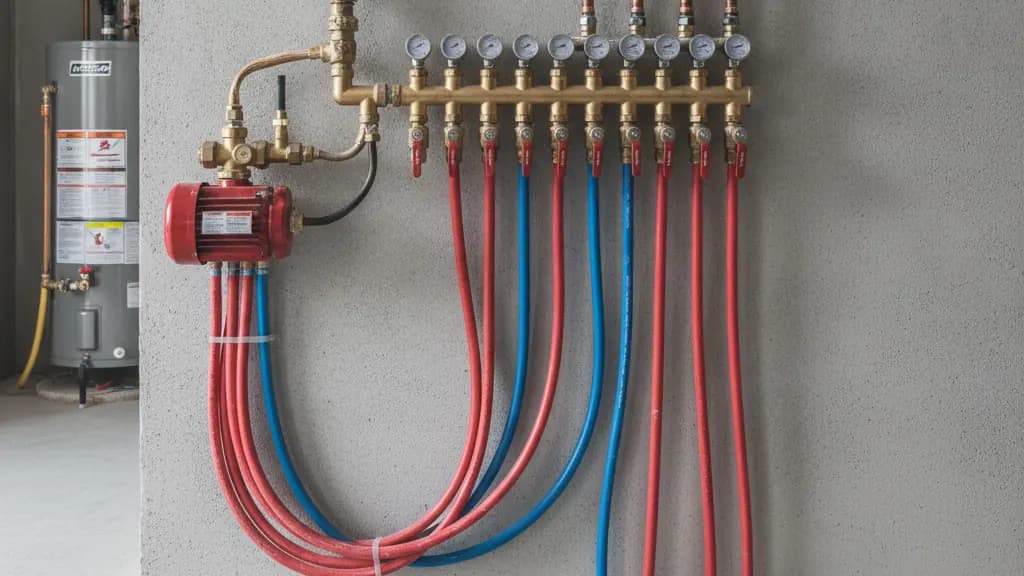
If your Delta home has radiant floor heating, you probably love it on a wet November morning and worry about it the first time one room stays cold. Hydronic systems are quiet and even, but most of their parts are hidden.
This guide is for people who already own a system in Ladner, Tsawwassen or North Delta. It explains how a hydronic floor works, the problems that come up most often, what you can check yourself without risk, and what a yearly service should cover. Planning a new system instead? Read about replacing the heat source separately.
Hydronic or Electric: Which Kind of Radiant Floor Do You Have?
There are two kinds of under floor radiant heat, and the fix depends on which one you have. Hydronic radiant floor heating circulates warm water through plastic tubing (usually PEX) set in concrete, in a thin pour over the subfloor, or in plates under the floor. Electric floors use heating cables or mats under tile.
The quick test: look for a manifold. A hydronic system has a rack of pipes with small valves or flow meters, usually in a utility room, closet or garage, plus a boiler or water heater feeding it. Electric floors have no water and no manifold. Electric floor problems are an electrician's job. The rest of this article is about hydronic systems.
What Are the Parts of a Hydronic Floor System?
A hydronic floor has six main parts. The heat source is a boiler, a combi boiler or, in some homes, a water heater. A mixing valve blends hot water down to a floor-safe temperature, since floors run much cooler than radiators. A circulator pump moves the water. The manifold splits the flow into separate loops, one or more per room or area. Each loop is a continuous run of tubing under the floor. Zone thermostats tell valves or pumps which areas need heat.
The system is a closed loop. The same water goes round and round, held at a set pressure, with an expansion tank to absorb the change in volume as it heats.
Why Is One Zone of My Radiant Floor Heating Cold?
A single cold zone usually points to that zone's controls or its loop, not the boiler. If the rest of the house is warm, the heat source is working. Common causes are a thermostat with dead batteries or a wrong schedule, a zone valve or actuator that has stopped opening, a closed or partly closed loop valve at the manifold, or air trapped in that loop.
Air is the classic culprit after repairs, a pressure drop or a summer shutdown, and an air pocket can stop a loop entirely. Watch for a flow meter that reads zero while the others move. Purging air from floor loops is done loop by loop with the right fittings and a fill source, so it is usually a service call.
If the whole floor is lukewarm, look upstream: the mixing valve may be stuck or set too low, the circulator may have failed, or the boiler may not be firing properly. Our guide to a boiler not heating or losing pressure covers the boiler side in more detail.
What Can a Delta Homeowner Safely Check?
You can safely check a handful of things before calling anyone. Confirm each thermostat is set to heat, has fresh batteries and is calling for a temperature above the room. Check the electrical panel for a tripped breaker on the boiler, pump or zone control. Look at the pressure gauge on the boiler or near the manifold and write down the reading, since a reading well below where it normally sits suggests a leak or a failing expansion tank.
Look at the manifold and around the boiler for drips, white or green crust on fittings, or damp spots on the floor. Note which flow meters move and which do not. Then stop there. Do not open the boiler cabinet, touch the burner or gas line, or start adding water through the fill valve without knowing the correct pressure for your system. Overfilling can open the relief valve.
Radiant floors are slow: a slab can take hours to respond, so a cold floor after a big overnight setback is often normal.
Why Does Pressure Keep Dropping, and Is a Leak Under the Floor Likely?
Pressure that keeps dropping means water is leaving the closed loop somewhere. In most cases the leak is at the boiler, the relief valve, the expansion tank or a manifold fitting, all places you can see. Buried tubing rarely fails unless a fastener or drill hit it.
In low-lying parts of Delta, a damp slab is not automatically a heating leak. Ladner and parts of Tsawwassen such as Beach Grove rely on dikes, and the City of Delta says it maintains over 63 kilometres of flood protection infrastructure and 31 drainage pump stations. Ground moisture, a perimeter drain issue or a floor drain backing up can all make a basement floor wet. Water near a floor drain is a drain backup question first. A steady pressure loss on the gauge together with a warm wet patch is what points to the heating loop.
How Often Should a Radiant Floor System Be Serviced?
Once a year, ideally before the heating season, is the usual advice for the boiler that drives a radiant floor. A good service checks the heat source and venting, system pressure, expansion tank, relief valve, circulator, mixing valve and manifold, and confirms every loop is flowing. For a gas boiler, the gas side has to be handled by a licensed gas fitter working for a contractor licensed by Technical Safety BC.
Water quality inside the loop also matters. The City of Delta notes its drinking water comes from the Metro Vancouver reservoirs and is soft, with a pH below 7. That is good news for scale, but frequent top-ups with fresh water bring in new oxygen, which is hard on iron parts like pumps and some boilers. A loop that needs regular refilling should be found and fixed, not just topped up. For timing across different systems, see how often to service a furnace or boiler, and for the repair side of the heat source, our boiler service page explains what we look at.
Do Permits or Flooring Choices Matter for Repairs?
Both matter. The City of Delta says a plumbing permit is required to install, alter or repair plumbing, and its permit fees specifically account for hot water heating systems. Inside plumbing work must be done by a plumber with a trades qualification and a current City of Delta business licence, with an exception for owner-occupiers of a single detached house who do the work themselves and sign a declaration. Check with the City of Delta before larger repairs or changes to the system.
Flooring affects how well the heat gets through. Tile and stone pass heat well; thick carpet or rugs can make a working zone feel weak. Before new floors go in, confirm the product is rated for radiant heat and that installers know where the tubing runs.
If your floors are acting up, Encano Plumbing serves homes across the Delta area. Call or text (604) 764-2031 any hour, and you get one flat price in writing before any work starts.
Frequently asked questions
- How long does it take a radiant floor to warm up?
- A hydronic floor set in concrete can take several hours to bring a room up to temperature. Steady thermostat settings usually work better than large overnight setbacks.
- Can I bleed air out of my radiant floor loops myself?
- Floor loops are purged one at a time with the correct fittings and a controlled fill, and doing it wrong can leave more air in the system or overpressure it. Most owners are better off having it done during a service visit.
- What pressure should my hydronic radiant floor system run at?
- Many residential hydronic systems run somewhere around 12 to 20 psi, but the correct number depends on the boiler and the height of the house. Watch for a reading that keeps falling.
- Is a wet spot on my Ladner basement floor a radiant heat leak?
- Not always. Low-lying areas can see moisture from groundwater, drainage or a floor drain, so a damp slab on its own is not proof of a heating leak. A steadily dropping boiler pressure combined with a warm wet patch is a stronger sign the heating loop is leaking.
- Does Delta's soft water affect a radiant floor system?
- The City of Delta describes its water as soft with a pH below 7, so mineral scale is not a big concern. The bigger issue is repeated refilling, because fresh water carries oxygen that can corrode iron parts. A system that needs frequent top-ups has a leak that should be found.
- Do I need a permit to repair my radiant floor heating in Delta?
- The City of Delta says a plumbing permit is required to install, alter or repair plumbing, and its fees include hot water heating systems. Any gas work must be done by a licensed gas fitter.
Related services
Serving
Found this helpful? Make us a preferred source on Google.
Ready for an exact price?
Get a flat price in writing for your home, not a phone guess. The assessment is free in Richmond.