Boiler Replacement Cost in Metro Vancouver: What Drives the Price (2026)
· By Ed Ferreira
If your boiler is old, leaking or needing a service call every winter, the boiler replacement cost is the number you want before deciding anything. The honest answer is a range, because two homes on the same street in Vancouver or Richmond can have very different boiler rooms, venting and radiator piping behind the walls.
This guide explains when repair still beats replacement, what pushes the price of a new boiler up or down, what proper commissioning looks like, and what a written quote should spell out, so you can compare offers on equal terms.
How Much Does Boiler Replacement Cost in Metro Vancouver?
As a rough guide, published price guides from Metro Vancouver contractors list boiler replacement starting from about $5,000. That figure is a floor for a straightforward swap, not a typical final bill. A like-for-like replacement with easy access sits near the bottom, while a move to a high-efficiency condensing boiler with new venting, a new indirect tank and extra zoning can land well above it.
Labour, piping, venting, controls, pumps, the hot water setup and removal of the old unit all add to the equipment price. Costs vary with the home, and the final price comes from an in-person estimate.
Is It Cheaper to Repair or Replace a Boiler?
Repair is usually cheaper in the short term. Published BC price guides put boiler repair anywhere from about $150 to $1,800, with most jobs around $400 and the typical range roughly $400 to $1,300. A failed pump, zone valve or expansion tank is a normal repair on an otherwise healthy boiler.
Replacement starts to make sense when the heat exchanger is leaking or cracked, when the same boiler needs several repairs in a season or two, when parts for the model are hard to find, or when one repair costs a large share of a new system on a unit that is already old. If you are still trying to figure out why the heat is not coming on, start with our guide to a boiler that is not heating or keeps losing pressure before you price a new one.
Ask for both options priced side by side. Costs vary with the home, and the final price comes from an in-person estimate.
What Changes the Price of a New Boiler?
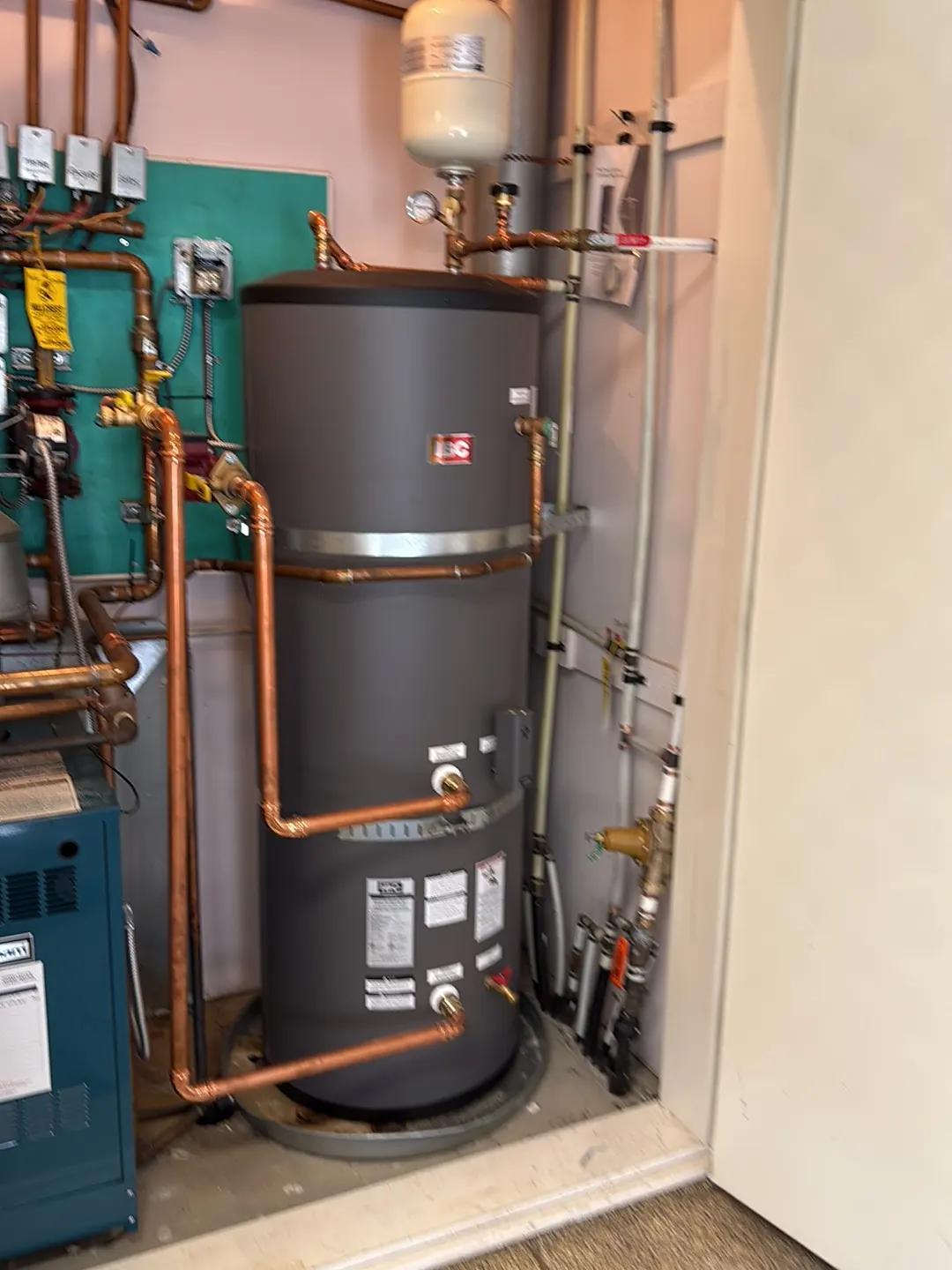
The biggest driver is the type of system you choose. A heat-only boiler that keeps an existing tank is the simplest swap. A combi boiler heats both the house and the domestic hot water in one unit. A boiler paired with an indirect tank, like the setup in the photo above, uses the boiler to heat a separate storage tank. We compare those in combi boiler vs hot water tank.
Efficiency is the next factor. Many older boilers are atmospheric units that vent hot exhaust up a chimney. A high-efficiency condensing boiler runs cooler exhaust through a dedicated sealed vent, usually plastic pipe out a side wall or roof, so the old chimney connection is retired and a new vent path has to be planned and installed. Condensing boilers also produce acidic condensate, which needs a drain route and normally a condensate neutraliser before it goes to the drain.
The chimney itself can add cost. If an old atmospheric gas water heater shared the chimney with the boiler, removing the boiler can leave the water heater venting alone into a flue that is now too large for it. That can call for a chimney liner or a change to the water heater, which should be checked during the estimate.
Pumps, zoning and controls also move the number. Adding zones, replacing tired circulator pumps, upgrading to an outdoor reset control or adding a new thermostat per zone each adds parts and labour. Access matters too: a tight closet or crawlspace takes longer than an open basement.
Why Older Radiator Systems Need a Flush First
Many homes in Vancouver and New Westminster still heat with cast-iron radiators and decades-old steel or black iron piping. Over the years that water picks up rust and sludge. A modern boiler, and especially a compact condensing heat exchanger with narrow passages, does not tolerate that debris well.
That is why a proper replacement on an old system usually includes cleaning or flushing the radiators and piping, and often a dirt separator or strainer on the return line to catch what remains. It adds to the boiler replacement cost, but skipping it can shorten the life of the new boiler and lead to noisy, uneven heat. See our guide to older Vancouver homes and radiators for more.
Who Handles the Gas Work and the Permit?
In BC, gas work has to be done by a licensed gas fitter working for a contractor licensed by Technical Safety BC. Disconnecting the old gas boiler, connecting the new one, setting up the venting and obtaining any required gas permit are the responsibility of that licensed gas contractor. Your quote should say clearly who is doing this part.
Never try to disconnect or move a gas appliance yourself. If you smell gas at any point, leave the house, avoid using switches, and call the FortisBC 24-hour emergency line at 1-800-663-9911 from outside.
What Should Commissioning Include After Installation?
Commissioning is the setup and testing done after the new boiler is in place, and it is where a good install separates itself from a fast one. At a minimum, ask for a combustion analysis so the burner is tuned to run cleanly and efficiently, a check of system pressure once the loop is filled and purged of air, and confirmation that the expansion tank is sized and pre-charged to match the system.
The installer should also test the relief valve and every zone, check the condensate drain, and show you the normal pressure on the gauge. Regular servicing after that keeps the new boiler efficient, and our article on how often to service a furnace or boiler explains the schedule.
What Should a Written Boiler Replacement Quote List?
A useful quote names the boiler model and type, its output and how it was sized for your home (a heat loss estimate, not just a match to the old unit), and the hot water setup it includes. It should spell out the venting plan, condensate drain and neutraliser if needed, any chimney liner work, pumps, zones and controls, system flushing, the expansion tank, removal of the old boiler, and who handles the gas connection and permit.
Rebates for heating upgrades change often, so check the current FortisBC and CleanBC Better Homes program pages before you sign.
Encano Plumbing and Drain is a family-owned plumbing and heating company in Richmond, and every job starts with one flat price in writing before work begins. For a boiler installation estimate in Richmond, Vancouver, New Westminster or nearby, call or text (604) 764-2031 any hour, or request an estimate online. The team speaks English, Portuguese and Spanish.
Frequently asked questions
- How much does a boiler cost to replace in BC?
- Published price guides from Metro Vancouver contractors list boiler replacement from about $5,000 for a straightforward job. Condensing boilers with new venting, indirect tanks, extra zones or old systems that need flushing cost more. Costs vary with the home, and the final price comes from an in-person estimate.
- Is it worth repairing an old boiler?
- It can be if the problem is a single part like a pump, zone valve or expansion tank and the boiler has otherwise been reliable. Published BC guides put most boiler repairs around $400, with a typical range of about $400 to $1,300. A leaking heat exchanger or repeated breakdowns on an old unit usually point toward replacement.
- Why does a high-efficiency boiler cost more to install?
- A condensing boiler needs its own sealed vent instead of the old chimney, plus a drain route for acidic condensate and usually a neutraliser. Its smaller heat exchanger also needs clean system water, so older radiator systems often need flushing and a dirt separator. Those extras add labour and parts on top of the boiler itself.
- Do I need a permit to replace a gas boiler in BC?
- Gas work in BC has to be done by a licensed gas fitter working for a contractor licensed by Technical Safety BC, and that contractor is responsible for any required gas permit. The written quote should say who handles it.
- Will replacing my boiler affect my chimney or water heater?
- It can. If an atmospheric gas water heater shared the chimney with the old boiler, the flue may be too large once the boiler is gone, which can require a chimney liner or a change to the water heater. It should be priced up front.
- What should happen after a new boiler is installed?
- The installer should commission it: run a combustion analysis, fill and purge the system, check the operating pressure and expansion tank, test the relief valve and every zone, and confirm the condensate drain works on a condensing unit.
Related services
Found this helpful? Make us a preferred source on Google.
Ready for an exact price?
Get a flat price in writing for your home, not a phone guess. The assessment is free in Richmond.